 By
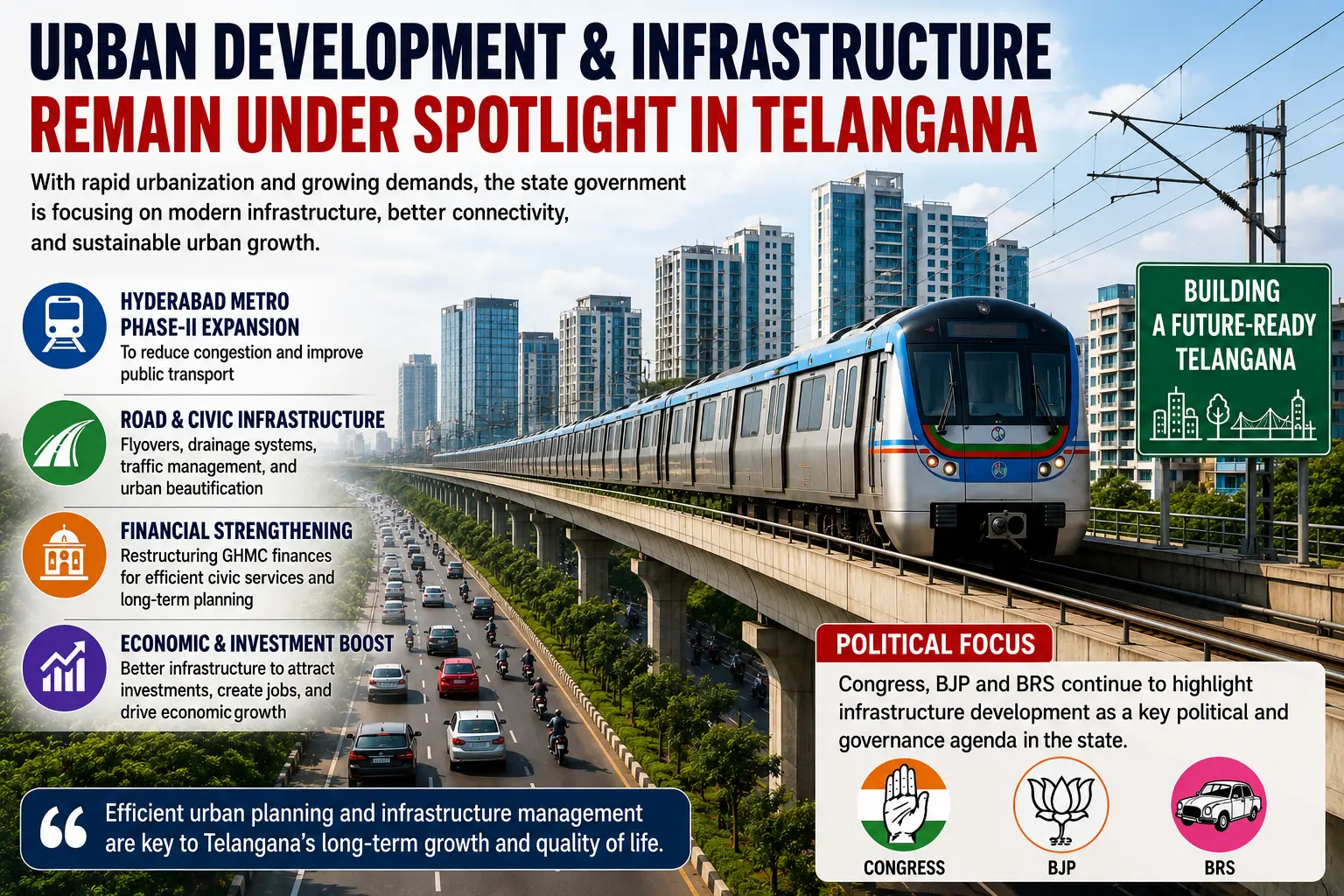
By Urban development and infrastructure continue to remain major priorities in the political and governance landscape of Telangana. With rapid urban expansion, increasing population pressure, and growing demands for modern civic facilities, the state government has intensified its focus on infrastructure modernization, transportation systems, and urban planning initiatives, particularly in Hyderabad.
The ruling Indian National Congress government has been actively promoting infrastructure development as one of its key governance themes. Chief Minister A. Revanth Reddy has repeatedly emphasized the importance of building a future-ready Telangana with improved roads, transportation systems, civic amenities, and investment-friendly urban infrastructure.
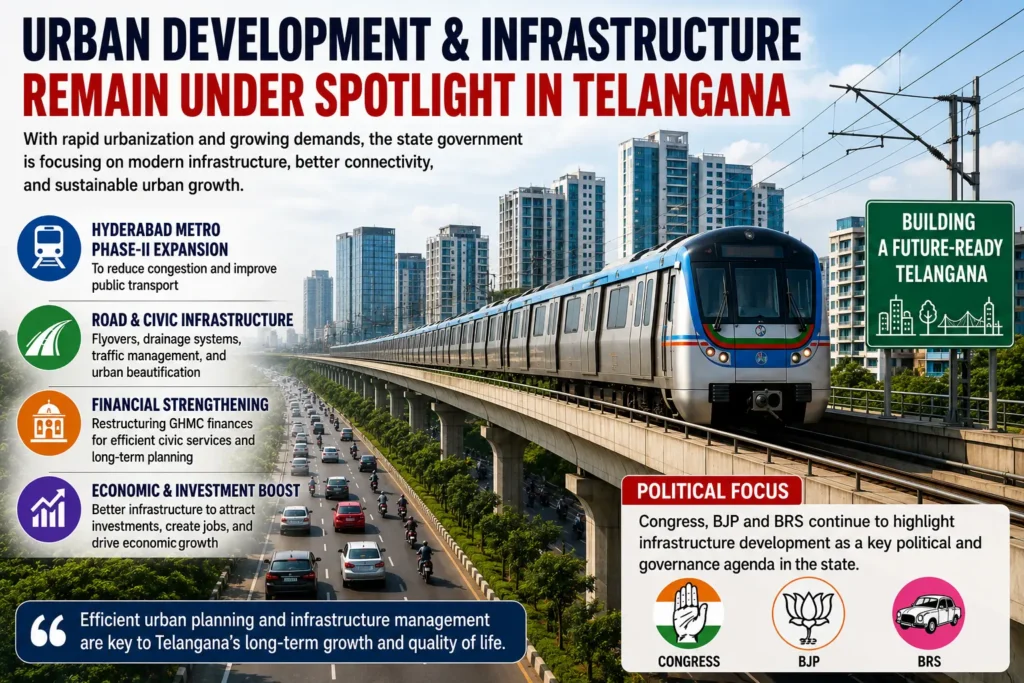
One of the most important projects currently under focus is the Phase-II expansion of the Hyderabad Metro Rail. The state government views metro expansion as essential for reducing traffic congestion, improving public transport, and supporting Hyderabad’s long-term urban growth. Officials believe that better connectivity between residential areas, IT corridors, and commercial zones will significantly improve commuter convenience and economic productivity.
Alongside metro expansion, the government has also been discussing road infrastructure improvements, flyovers, drainage systems, traffic management, and urban beautification projects. Rapid urbanization has created increasing pressure on Hyderabad’s civic infrastructure, making modernization efforts necessary to maintain the city’s growth momentum and quality of life.
The financial restructuring of the Greater Hyderabad Municipal Corporation (GHMC) has also remained a key discussion point. The Telangana government has been exploring measures to strengthen urban finances and improve the execution of civic development projects. Financial stability is considered important for maintaining essential public services and carrying out long-term infrastructure planning.
Urban development has also become politically significant because Hyderabad remains the economic and political center of Telangana. Major infrastructure projects influence investment flows, employment generation, real estate growth, and public perception regarding governance efficiency. Political parties are therefore increasingly using development projects as part of their broader political messaging.
The Bharatiya Janata Party (BJP) has criticized the Congress government over project implementation timelines and administrative performance, while simultaneously highlighting infrastructure support provided by the Central government. BJP leaders argue that Central investments and development initiatives have contributed significantly to Telangana’s urban growth.
Meanwhile, the Bharat Rashtra Samithi (BRS) continues defending its previous infrastructure achievements during its tenure in power. BRS leaders frequently point to projects initiated under the earlier government and accuse both Congress and BJP of engaging in political competition over development credit.
Experts believe Telangana’s long-term economic success will depend heavily on efficient urban planning and infrastructure management. Hyderabad’s position as a major technology, pharmaceutical, and investment hub requires world-class transportation systems, reliable civic infrastructure, and sustainable urban development policies. Modern infrastructure is also essential for attracting new investments and supporting employment growth.
However, urban development projects also face several challenges including funding requirements, land acquisition issues, environmental concerns, and coordination between multiple agencies. Managing rapid urban growth while ensuring sustainability and public welfare remains a major governance challenge for the state.
Urban planners have stressed the importance of integrated development approaches that combine transportation, housing, environmental sustainability, and civic services. Projects such as metro rail expansion, smart traffic systems, drainage modernization, and green urban planning are increasingly being viewed as interconnected parts of a larger urban transformation strategy.
In conclusion, urban development and infrastructure remain firmly under the spotlight in Telangana politics and governance. With Hyderabad continuing to expand as a major metropolitan and economic hub, infrastructure modernization has become both a governance necessity and a political priority. As Congress, BJP, and BRS continue competing over development narratives, urban infrastructure is expected to remain one of the most important themes shaping Telangana’s political discourse and future growth strategy.