 By
By Database Security in 2026: Essential Strategies to Protect Sensitive Data from Modern Cyber Threats
In today’s data-driven world, databases are the backbone of almost every business application. From customer records and financial transactions to healthcare information and enterprise analytics, organizations rely on databases to store and manage their most valuable assets. As businesses increasingly adopt cloud computing, AI-powered applications, and digital services, protecting databases from cyber threats has become more important than ever. In 2026, database security is no longer just an IT concern—it is a critical business priority.
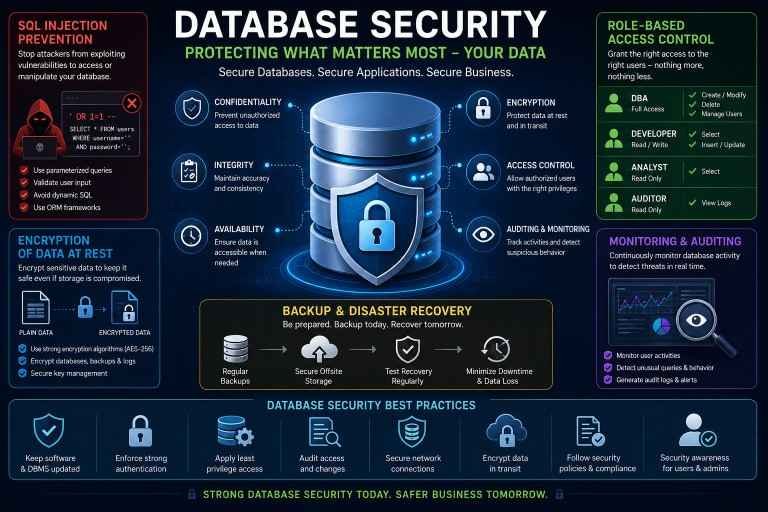
Database Security refers to the technologies, policies, and best practices used to protect databases from unauthorized access, theft, corruption, and cyberattacks. A comprehensive database security strategy safeguards both the data itself and the systems that manage it, ensuring confidentiality, integrity, and availability.
Why Database Security Matters
Modern organizations process massive amounts of sensitive information every day. Customer details, payment information, employee records, intellectual property, and business analytics all reside within databases. If attackers gain unauthorized access, the consequences can include financial losses, regulatory penalties, reputational damage, and operational disruption.
Cybercriminals frequently target databases using SQL injection, stolen credentials, ransomware, insider threats, and misconfigured database servers. As organizations continue expanding their cloud and hybrid infrastructures, securing databases requires continuous monitoring, strong authentication, and proactive risk management.
Preventing SQL Injection Attacks
SQL Injection remains one of the most common and dangerous attacks against database-driven applications. It occurs when attackers manipulate application input fields to execute unauthorized SQL commands against a database.
Organizations can significantly reduce SQL injection risks by following secure development practices:
- Use parameterized queries and prepared statements.
- Validate and sanitize all user inputs.
- Avoid dynamic SQL whenever possible.
- Restrict database account permissions.
- Hide database error messages from end users.
- Perform regular penetration testing and code reviews.
Developers should also follow secure coding standards such as the OWASP Top 10 recommendations to eliminate common vulnerabilities before applications are deployed.
Role-Based Access Control (RBAC)
Not every employee requires full access to organizational databases. Role-Based Access Control (RBAC) ensures users receive only the permissions necessary for their specific job responsibilities.
For example, customer support staff may only need read access, while database administrators require broader privileges for maintenance tasks.
Organizations should strengthen access management by:
- Applying the Principle of Least Privilege (PoLP).
- Enabling Multi-Factor Authentication (MFA).
- Regularly reviewing user permissions.
- Removing inactive or unnecessary accounts.
- Monitoring privileged user activities.
Effective access control reduces both insider threats and the impact of compromised user credentials.
Encrypting Data at Rest
Encryption is one of the strongest safeguards for protecting stored database information. Data at rest refers to information stored in databases, storage systems, and backup files.
Modern encryption algorithms such as AES-256 ensure that even if attackers obtain access to storage media, the information remains unreadable without the correct encryption keys.
Organizations should encrypt:
- Production databases
- Backup files
- Cloud storage volumes
- Database snapshots
- Archive storage
Proper encryption key management is equally important. Keys should be stored securely, rotated regularly, and accessible only to authorized personnel.
Continuous Database Monitoring
Traditional perimeter security is no longer sufficient. Modern database security relies on continuous monitoring to detect suspicious activities in real time.
Database Activity Monitoring (DAM) solutions help identify:
- Unauthorized login attempts
- Privilege escalation
- Large data exports
- Unusual query patterns
- Failed authentication attempts
- Insider misuse
AI-powered monitoring platforms can analyze millions of database events, identify anomalies, and automatically notify security teams before threats escalate into major incidents.
Backup and Recovery for Business Continuity
Despite preventive measures, organizations must prepare for ransomware attacks, accidental deletion, and hardware failures. Reliable backup and recovery strategies ensure critical data can be restored quickly.
Following the 3-2-1 backup rule—three copies of data, two different storage media, and one offline or offsite copy—helps protect against data loss. Immutable backups provide additional protection because they cannot be altered or encrypted by ransomware.
Routine recovery testing ensures backup systems function correctly when recovery becomes necessary.
Emerging Database Security Trends in 2026
Database security is rapidly evolving with advances in cloud computing and Artificial Intelligence. Zero Trust security models now require continuous verification before granting database access, regardless of user location.
Cloud-native database services increasingly provide built-in encryption, automated patch management, and AI-driven threat detection. Organizations are also adopting automated compliance monitoring to meet regulatory standards such as GDPR, HIPAA, PCI DSS, and ISO 27001.
Machine learning technologies continue improving anomaly detection by identifying suspicious database behavior that traditional security tools may overlook.