

 By
By Physical Security in 2026: Smart Strategies to Protect People, Property, and Business Assets
As organizations continue investing in digital transformation, physical security remains the foundation of a comprehensive security strategy. While cybersecurity protects digital assets, physical security safeguards the people, facilities, equipment, and infrastructure that keep businesses running. Offices, data centers, hospitals, schools, warehouses, and manufacturing facilities all depend on effective physical security measures to prevent unauthorized access, theft, vandalism, and emergencies. In 2026, advancements in Artificial Intelligence (AI), smart surveillance, and biometric technologies are reshaping how organizations secure their physical environments.
Physical Security refers to the systems, technologies, and procedures designed to protect buildings, employees, visitors, and valuable assets from physical threats. It combines traditional security measures such as locks, security guards, fences, and fire alarms with intelligent technologies like AI-powered CCTV cameras, biometric access control, and cloud-based monitoring platforms.
Why Physical Security Matters
Organizations today face a variety of physical threats, including unauthorized entry, theft, workplace violence, vandalism, sabotage, and natural disasters. Many businesses also house critical IT infrastructure such as servers and networking equipment that require secure physical protection.
A single physical security breach can disrupt operations, compromise sensitive information, damage valuable assets, and negatively affect an organization’s reputation. As businesses expand across multiple locations and adopt hybrid work models, implementing modern physical security solutions has become increasingly important.
Smart Locks and Access Control
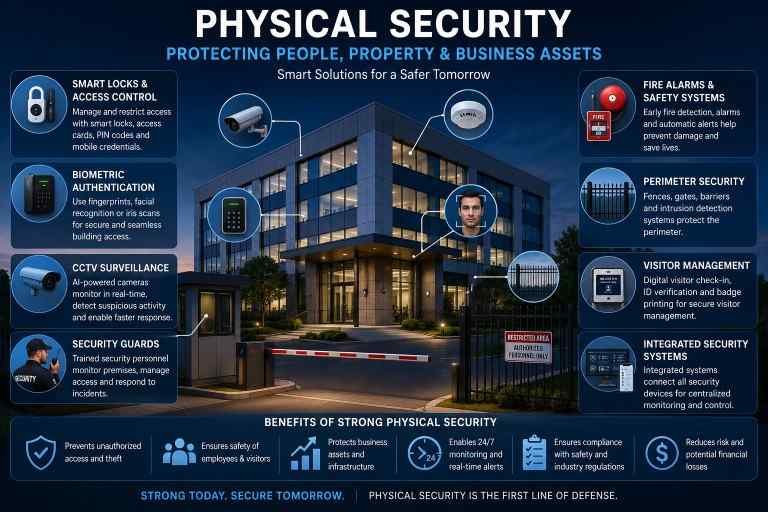
Traditional lock-and-key systems are gradually being replaced by intelligent access control solutions. Modern smart locks allow organizations to manage entry permissions using access cards, mobile credentials, PIN codes, and cloud-based management systems.
These systems provide centralized control over building access, allowing administrators to instantly grant or revoke permissions, schedule access times, and maintain detailed entry logs. Smart access control also minimizes the risks associated with lost keys or unauthorized duplication while improving operational efficiency.
Biometric Authentication for Building Access
Biometric authentication has become one of the most reliable methods for securing restricted areas. Instead of relying solely on access cards or passwords, biometric systems verify identities using fingerprints, facial recognition, iris scans, or palm vein recognition.
Industries such as healthcare, finance, government, and data centers increasingly use biometrics to protect high-security areas. Combined with Multi-Factor Authentication (MFA), biometric systems provide stronger protection against unauthorized access while offering a faster and more convenient user experience.
AI-Powered CCTV Surveillance
Closed-Circuit Television (CCTV) systems have evolved significantly with the integration of Artificial Intelligence. Modern surveillance cameras can automatically recognize suspicious behavior, detect unauthorized individuals, identify abandoned objects, and generate real-time security alerts.
AI-powered video analytics reduce false alarms by distinguishing between normal activity and genuine threats. Cloud-connected surveillance platforms also enable security teams to monitor multiple locations remotely, improving response times and operational awareness.
These intelligent surveillance systems have become an essential component of modern physical security strategies.
Fire Alarms and Emergency Preparedness
Physical security is not limited to preventing unauthorized access. It also includes protecting people from emergencies such as fires, smoke hazards, and natural disasters.
Modern fire protection systems integrate smoke detectors, heat sensors, automated sprinkler systems, emergency alarms, and centralized building management platforms. These systems can quickly detect hazards, notify occupants, and activate emergency response procedures.
Organizations should also conduct regular fire drills, inspect fire safety equipment, and ensure employees understand evacuation procedures to improve emergency preparedness.
Perimeter Security and Security Personnel
The first layer of physical protection begins at the perimeter. Fences, gates, barriers, vehicle access controls, and security lighting help prevent unauthorized access while protecting critical facilities.
Security guards continue to play an essential role in monitoring premises, verifying visitor identities, responding to emergencies, and coordinating incident management. Today, security personnel increasingly work alongside smart technologies such as AI-enabled surveillance systems, mobile patrol applications, and digital visitor management platforms, creating a more efficient and responsive security environment.
Integrating Physical Security with Cybersecurity
One of the most significant trends in 2026 is the convergence of physical security and cybersecurity. Access control systems, surveillance cameras, alarm systems, and building automation platforms are now connected to enterprise networks and cloud services.
Organizations must secure both the physical devices and the digital infrastructure that supports them. This includes encrypting communications, implementing secure authentication, applying software updates, and continuously monitoring connected security devices to prevent cyberattacks targeting physical security systems.