


 By
By Application Security in 2026: Protecting Software from Modern Cyber Threats and Vulnerabilities
Software applications are at the center of almost every modern business. Organizations use web applications, mobile apps, APIs, cloud platforms and enterprise software to manage everything from customer information to financial transactions. As applications become more connected and complex, they also become attractive targets for cybercriminals.
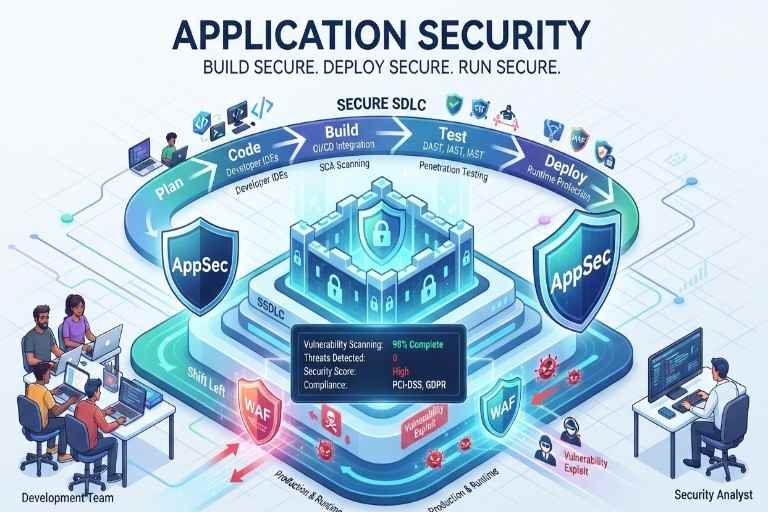
Application Security, commonly known as AppSec, focuses on protecting software applications from vulnerabilities, unauthorized access, data breaches and other cyberattacks. Rather than waiting for a security incident to occur, modern application security aims to identify and fix weaknesses throughout the entire software development lifecycle.
In 2026, application security is becoming even more important because organizations are rapidly adopting cloud computing, APIs, open-source software, containers and artificial intelligence. These technologies provide significant benefits but can also introduce new security risks.
Why Application Security Matters
A single application vulnerability can potentially allow attackers to access sensitive information, manipulate systems or disrupt business operations. Common application security risks include injection attacks, broken authentication, insecure APIs, misconfigured cloud services, vulnerable dependencies and improper access controls.
Security therefore needs to be considered from the beginning of application development rather than being treated as a final testing step.
1. Secure Coding Practices
Secure coding is one of the foundations of application security. Developers should write code with security in mind and follow established secure development practices.
This includes validating user input, implementing proper authentication and authorization, securely handling passwords, protecting sensitive information and avoiding unsafe coding patterns.
Developers should also avoid hardcoding passwords, API keys and database credentials inside source code. Instead, secrets should be stored using appropriate secret-management solutions and protected environment configurations.
Regular developer security training can further reduce mistakes that may introduce vulnerabilities into applications.
2. Code Scanning and Static Analysis
Finding security problems early can save organizations considerable time and money. Static Application Security Testing (SAST) tools analyze source code without necessarily executing the application and can identify potentially dangerous coding patterns.
Software Composition Analysis (SCA) tools can also examine third-party and open-source dependencies for known vulnerabilities.
This is particularly important because modern applications often depend on large numbers of external packages and libraries. An outdated dependency can introduce a security weakness even when the organization’s own code is well written.
Integrating automated security scanning into CI/CD pipelines allows vulnerabilities to be detected as developers commit and build new code.
3. Dynamic Application Security Testing
While static testing examines source code, Dynamic Application Security Testing (DAST) evaluates applications while they are running.
DAST can help identify vulnerabilities that may only become visible during application execution, including authentication problems, configuration weaknesses and certain web-application vulnerabilities.
Combining SAST, DAST and dependency scanning provides broader coverage than relying on a single security-testing method.
4. Penetration Testing
Automated tools are useful, but they cannot replace expert security testing. Penetration testing, or ethical hacking, involves authorized security professionals attempting to discover and exploit weaknesses in an application.
Penetration testers may examine login mechanisms, APIs, session management, access controls and business logic to determine whether vulnerabilities can actually be exploited.
The goal is not simply to identify problems but to understand their potential impact so organizations can prioritize remediation.
5. API Security
APIs have become a critical part of modern software architecture. Applications frequently use APIs to communicate with databases, cloud services, payment systems and other applications.
Poorly secured APIs can expose sensitive data or allow unauthorized users to perform privileged actions.
Organizations should implement strong authentication and authorization, input validation, rate limiting, secure communication and appropriate API monitoring. API endpoints should also expose only the information and functionality that users are authorized to access.
6. AI and Application Security
Artificial intelligence is changing application development rapidly. Developers are using AI coding assistants to generate, modify and troubleshoot software, which can improve productivity.
However, AI-generated code can also introduce security weaknesses if developers accept suggestions without proper review.
Organizations should therefore treat AI-generated code like any other code: it should undergo code review, automated security scanning, dependency checks and appropriate testing.
At the same time, attackers are using AI to discover vulnerabilities, automate attacks and create more convincing social-engineering campaigns. This makes continuous application security increasingly important.
7. Vulnerability Management and Remediation
Discovering a vulnerability is only the beginning. Organizations must prioritize and fix vulnerabilities based on their severity, exploitability and potential business impact.
Critical vulnerabilities should receive immediate attention, while lower-risk issues can be addressed through planned remediation.
After fixes are implemented, security teams should perform additional testing to confirm that vulnerabilities have been properly resolved and that the changes have not introduced new problems.
The Future of Application Security
Application security is moving toward a DevSecOps approach where security becomes an integrated part of development, operations and deployment.
Instead of testing security only before a production release, organizations can continuously scan code, dependencies, infrastructure and applications throughout the development lifecycle.
This approach helps development and security teams collaborate more effectively while allowing organizations to release software faster without ignoring security.