


 By
By Critical Infrastructure Security: Protecting the Systems That Keep Society Running
Modern society depends on critical infrastructure every day. Electricity powers homes and businesses, water systems provide essential resources, transportation networks connect communities, and healthcare systems protect lives. Behind these services are highly connected digital technologies that help organizations monitor, control and operate complex infrastructure.
As critical infrastructure becomes increasingly digital and connected, cybersecurity has become a major concern. Critical Infrastructure Security focuses on protecting essential systems and services from cyberattacks, physical threats, system failures and other disruptions that could affect public safety and economic stability.
A successful attack against a critical infrastructure organization can have consequences far beyond data loss. It can interrupt essential services, damage equipment, create financial losses and potentially put human lives at risk.
SCADA System Security
Supervisory Control and Data Acquisition (SCADA) systems are widely used to monitor and control industrial processes. They can be found in electricity networks, water treatment facilities, manufacturing environments and other essential operations.
SCADA environments were traditionally designed with reliability and availability as major priorities. However, connecting these systems to corporate networks, remote access systems and modern technologies has introduced additional cybersecurity risks.
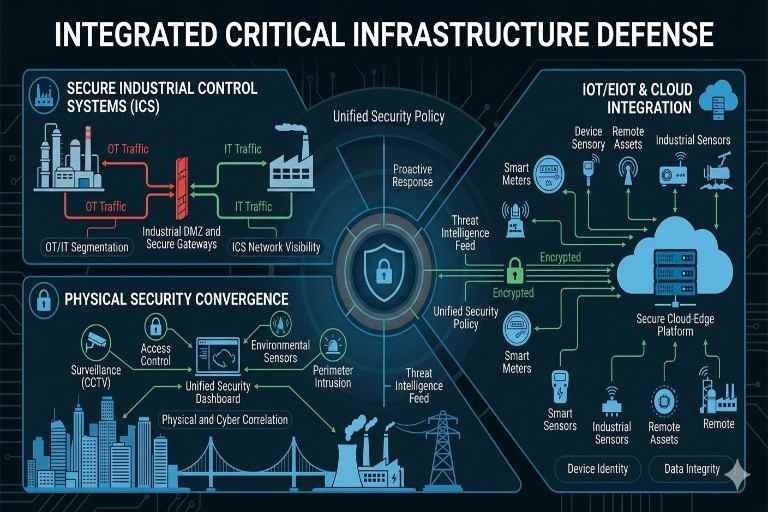
Organizations should protect SCADA environments by restricting unnecessary network access, separating operational technology from standard IT networks, monitoring system activity and applying security updates where operationally safe.
Because industrial systems often have strict availability requirements, security changes must be carefully planned and tested to avoid disrupting essential operations.
Industrial Control System Protection
Industrial Control Systems (ICS) control physical processes and equipment in environments such as power generation, manufacturing, transportation and water management.
Protecting ICS environments requires a different approach from securing ordinary business computers. Some industrial devices may operate for many years and may not support modern security technologies. Replacing them immediately may also be expensive or operationally difficult.
Organizations can reduce risks by implementing network segmentation, access controls, secure remote access, continuous monitoring and strict change-management procedures. Security teams should also maintain accurate inventories of operational technology devices so that vulnerabilities can be identified and addressed effectively.
Network Segmentation and Access Control
Network segmentation is an important defense for critical infrastructure. Instead of allowing every system to communicate freely, organizations can divide infrastructure into separate security zones.
For example, corporate IT systems can be separated from operational technology networks that control industrial equipment. Communication between these environments can then be restricted through carefully configured security controls.
Strong identity management and multi-factor authentication can further reduce the risk of unauthorized access. Remote maintenance connections should receive particular attention because compromised remote credentials can provide attackers with access to sensitive operational environments.
Backup and Disaster Recovery
Even with strong preventive security measures, organizations must prepare for the possibility of a successful attack or major system failure.
Backup and disaster recovery strategies help critical infrastructure organizations restore operations after ransomware attacks, equipment failures, natural disasters or other disruptive events.
Important systems should have reliable backups that are protected from unauthorized modification or deletion. Organizations should regularly test whether backups can actually be restored and establish clear recovery procedures.
Disaster recovery plans should also identify critical services, recovery priorities, responsible personnel and communication procedures. A backup that has never been tested may not provide the protection an organization expects during a real emergency.
Continuous Monitoring and Incident Response
Critical infrastructure requires continuous visibility into security events. Monitoring systems can help identify unusual network activity, unauthorized access attempts, unexpected configuration changes and other suspicious behavior.
Organizations should also maintain an incident response plan. Security teams need to know how to isolate affected systems, investigate incidents, communicate with relevant authorities and restore operations safely.
Regular exercises and simulations can help identify weaknesses before a real incident occurs.
Building Resilient Critical Infrastructure
Critical infrastructure security is not only about preventing cyberattacks. It is also about building resilience so that essential services can continue operating even when disruptions occur.
Organizations should combine cybersecurity controls with physical security, employee training, vendor risk management, backup systems and disaster recovery planning. Collaboration between IT, operational technology teams, management and external security organizations is also essential.