 By
By AI PCs Are Reshaping Computers in 2026: The Rise of Smarter and Faster PCs
September 14, 2026 — The personal computer industry is entering a new era, and artificial intelligence is quickly becoming one of the most important technologies driving that change. In 2026, AI is no longer limited to cloud-based chatbots and online applications. Computer manufacturers are increasingly building AI capabilities directly into laptops, desktops and compact PCs.
The result is a new generation of AI PCs designed to process artificial-intelligence workloads locally, improve efficiency and provide users with smarter computing experiences.
What Is an AI PC?
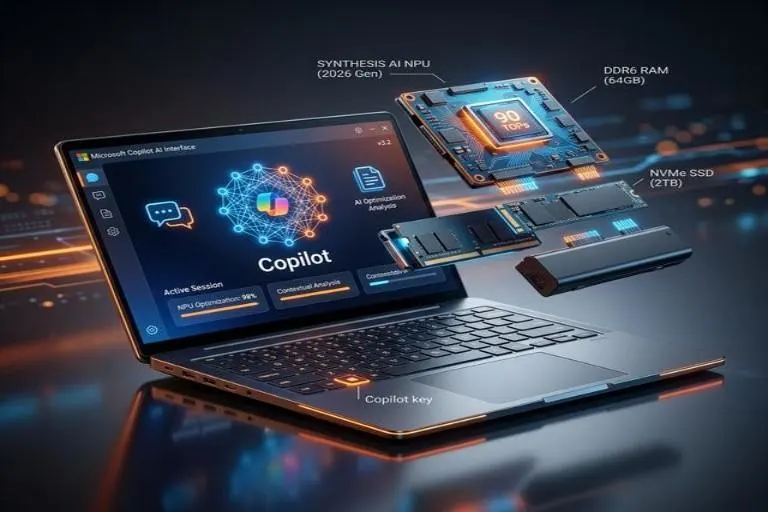
An AI PC is a computer designed with dedicated hardware for artificial-intelligence workloads. Along with the traditional CPU and GPU, many modern systems include a Neural Processing Unit (NPU).
The NPU is specifically designed to handle certain AI operations efficiently. Instead of sending every AI-related task to a remote cloud server or processing everything through the CPU, compatible applications can use the NPU for tasks such as speech recognition, image processing, video effects and intelligent assistants.
This can potentially improve responsiveness while reducing power consumption during supported workloads.
Local AI Is Becoming a Major Trend
One of the biggest developments in computing during 2026 is the growing focus on on-device AI.
Cloud AI remains extremely important, but local processing offers several advantages. When an AI task can be completed directly on the computer, the response can be faster because information does not always need to travel to a remote server.
Local AI can also provide privacy benefits. Sensitive documents, personal files or other information may be processed locally instead of being uploaded to an external service, depending on the application.
This is particularly valuable for professionals, businesses and developers working with confidential information.
Powerful Hardware for AI Workloads
The AI PC market is also changing computer hardware. Manufacturers are combining increasingly capable CPUs, NPUs and GPUs to create machines capable of handling demanding AI workloads.
NVIDIA, for example, is pushing compact RTX-based AI PCs designed to run AI models and agents locally. New systems are expected from PC manufacturers as the company expands its AI computing platform beyond traditional desktop graphics cards.
Meanwhile, companies such as Lenovo are introducing new computers that combine AI capabilities with high-performance processors and graphics hardware.
This means users no longer have to choose exclusively between a traditional productivity computer and a specialized AI workstation. Increasingly, one system can perform both roles.
AI Is Changing Everyday Computer Tasks
The most interesting aspect of AI PCs isn’t necessarily the hardware itself. It is what that hardware enables users to do.
AI-powered computers can assist with tasks such as summarizing documents, generating content, transcribing meetings, editing photographs, improving video and helping programmers write or understand code.
For students, AI can assist with research and learning. Office workers can use AI tools for productivity and communication. Designers and video creators can use local AI acceleration for creative applications, while developers can experiment with AI models directly on their computers.
As software developers continue optimizing applications for NPUs and GPUs, these capabilities are expected to become more common.
Gaming and AI Are Coming Together
Gaming PCs are also benefiting from the AI hardware revolution.
Modern graphics processors are increasingly designed not only for rendering games but also for accelerating AI workloads. Technologies such as AI-assisted upscaling and frame generation already demonstrate how artificial intelligence can improve gaming performance and image quality.
This creates an interesting overlap between gaming computers and AI workstations. A powerful gaming GPU can also provide significant computing power for AI applications.
As AI becomes more important in games, graphics, creative applications and development tools, this overlap is likely to grow.
Computer Prices Remain an Important Concern
Although AI PCs offer exciting capabilities, consumers are also facing higher hardware costs.
The global growth of AI data centers has increased demand for memory, storage and high-performance computing components. This pressure can affect the availability and pricing of components used in consumer PCs.
As a result, buyers in 2026 need to consider whether they actually require high-end AI hardware or whether a more affordable computer will meet their needs.
An everyday user who mainly browses the internet, watches videos and works with office applications may not need a powerful dedicated GPU. A developer, creator or AI enthusiast, however, may benefit significantly from additional RAM, a strong GPU and capable local AI hardware.
What Should You Look for When Buying an AI PC?
If you’re planning to purchase a computer in 2026, don’t focus only on the processor’s advertised speed.
Look at the complete system, including CPU performance, NPU capability, GPU performance, RAM, SSD storage, battery life, display quality and software compatibility.
It is also important to check which AI features are actually supported by the operating system and applications you use. An “AI PC” label alone does not guarantee that every AI application will perform better.
The Future of Personal Computing
The direction of the industry is becoming increasingly clear. Computers are moving from being machines that simply run applications toward becoming intelligent computing assistants.
Future PCs could understand natural-language instructions, search personal information, automate repetitive tasks and assist users across multiple applications. More AI processing could happen directly on the device, while cloud computing will continue handling tasks that require larger models and greater computing resources.
This combination of local and cloud AI could create a much more flexible computing experience.
Final Thoughts
AI PCs are quickly becoming one of the defining computer trends of 2026. Dedicated NPUs, powerful GPUs and smarter software are changing what laptops and desktops can do.
The transition will not happen overnight, and cloud-based AI will remain important. However, the growing ability to run AI directly on personal computers represents a major change in the way we think about computing.
The computer of the future will not simply be faster—it will be smarter, more personalized and increasingly capable of helping users get things done.