

 By
AI Mini PCs in 2026: How Compact Desktop Computers Are Transforming the Future of Computing
The computer industry is moving towards a new generation of smaller and more powerful desktop systems. In 2026, artificial intelligence is becoming one of the biggest influences on computer hardware, encouraging manufacturers to develop compact computers that can handle demanding workloads without requiring traditional large desktop cabinets.
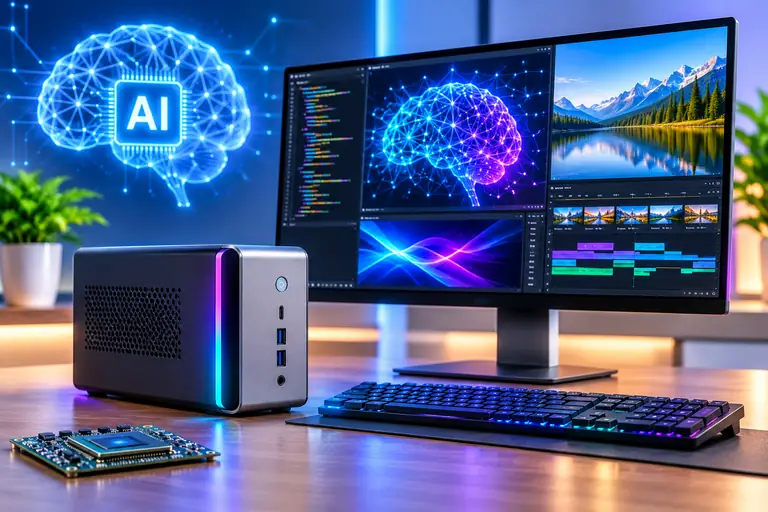
One of the latest developments is the growing popularity of AI-powered mini PCs. Companies such as NVIDIA, ASUS, Dell and MSI are introducing compact desktop systems designed for artificial intelligence, software development, video editing and professional applications.
These developments are changing how people think about desktop computers. A powerful computer no longer needs to occupy a large amount of desk space.
1. What Are AI Mini PCs?
AI mini PCs are compact desktop computers equipped with processors, graphics hardware and memory designed to support artificial intelligence applications.
Unlike traditional mini computers that mainly focus on browsing, office applications and entertainment, modern AI mini PCs are built to handle more demanding tasks.
For example, NVIDIA’s latest RTX Spark compact desktop systems combine a 20-core Grace CPU with a Blackwell-based RTX GPU and offer configurations with up to 128GB of unified memory.
According to NVIDIA, these systems can deliver up to one petaflop of AI computing performance.
This makes them interesting options for developers, researchers and creative professionals who need powerful computing capabilities in a smaller space.
2. Why Is Local AI Processing Becoming Important?
Many AI applications traditionally depend on cloud computing. Users send information to remote servers, where powerful computers process their requests and return the results.
Local AI processing offers another approach. It allows compatible applications and AI models to operate directly on a personal computer.
This can provide several advantages.
- Privacy: Certain files and information can remain on the local device.
- Reduced cloud dependence: Users can run supported models without constantly accessing online AI services.
- Convenience: Some AI tasks can continue even without an internet connection.
- Cost management: Local processing can reduce repeated cloud API charges for supported workloads.
However, large-scale AI tasks may still require cloud infrastructure.
3. Compact Computers Are Becoming More Powerful
One of the most interesting trends in computer technology is the improvement in performance per unit of space.
Traditional desktop workstations often require large cabinets, powerful cooling systems and multiple hardware components.
Modern compact systems combine advanced processors, graphics technology and high-capacity memory in much smaller designs.
NVIDIA’s latest compact desktops from ASUS, Dell and MSI demonstrate this direction.
Some systems are designed to run local AI agents continuously, process creative projects and support software development workflows.
This makes them particularly useful for offices, development studios and professional workspaces where space is limited.
4. How AI Mini PCs Can Help Developers
Software developers are among the users who may benefit significantly from AI-powered desktop systems.
These computers can support local language models, coding assistants, testing tools and intelligent automation applications.
Developers can experiment with AI models, generate code suggestions and build applications without depending entirely on external services.
They can also use supported development frameworks and graphics acceleration technologies to improve their workflows.
For programmers working with large datasets or advanced AI applications, additional memory and processing power can make a meaningful difference.
5. Benefits for Designers and Content Creators
AI mini PCs are also attracting attention from creative professionals.
Video editors, graphic designers and 3D artists increasingly use AI-powered software to improve productivity.
Modern applications can assist with image generation, video editing, background removal, rendering and other creative activities.
Powerful graphics hardware and sufficient memory are important for handling these demanding workloads.
A compact AI workstation can provide a dedicated environment for creative projects while taking up less space than a traditional professional desktop.
6. What Should Buyers Check Before Purchasing?
Although AI mini PCs offer impressive capabilities, they may not be suitable for every computer user.
Before buying one, consumers should consider several important factors:
- Processor: Check the CPU architecture and overall processing capabilities.
- Memory: Choose sufficient memory for the applications you plan to use.
- Graphics: Confirm that the GPU supports your preferred creative and AI applications.
- Storage: Look for fast SSD storage with enough capacity for software and project files.
- Cooling: Powerful compact systems need effective thermal management.
- Compatibility: Verify that your existing applications and accessories work properly.
Price is another important consideration. High-performance AI mini PCs can be significantly more expensive than ordinary desktop computers.
7. What Is the Future of Mini Computers?
The future of mini PCs will likely involve better AI performance, improved energy efficiency and more advanced connectivity.
As hardware technology develops, compact computers may become increasingly capable of running intelligent applications locally.
Businesses could use them for automation, content production and specialized computing tasks. Developers may also use dedicated mini workstations to build and test AI-powered applications.
At the same time, conventional desktops and cloud computing will continue to serve important purposes.
The biggest opportunity will be finding the right balance between performance, affordability and convenience.