

 By
By Computers have become an essential part of modern life. From education and business to healthcare and entertainment, computers play a vital role in improving efficiency and productivity. A computer is an electronic device that accepts data as input, processes it according to instructions, stores it, and produces output. In today’s digital era, understanding computers is important for students, professionals, and businesses.
What Is a Computer?
A computer is a programmable machine that performs calculations and logical operations automatically. It works based on instructions called programs. These programs are written using programming languages like Python, Java, and C++. Computers process information at high speed and provide accurate results, making them reliable tools for various tasks.
The basic working cycle of a computer is called the IPO cycle:
- Input – Entering data using keyboard, mouse, scanner, etc.
- Process – CPU processes the data.
- Output – Results displayed on monitor or printed.
- Storage – Saving data for future use.
Main Components of a Computer
A computer system consists of two main parts: Hardware and Software.
1. Hardware
Hardware refers to the physical parts of a computer that we can see and touch.
- Central Processing Unit (CPU) – Known as the brain of the computer.
- Monitor – Displays output.
- Keyboard and Mouse – Input devices.
- Hard Disk / SSD – Storage devices.
- Motherboard – Connects all components.
2. Software
Software refers to programs and applications that run on a computer.
- System Software – Like Windows, Linux, macOS.
- Application Software – MS Word, Excel, Browsers.
- Programming Software – Used to develop applications.
Types of Computers
Computers are classified based on size, performance, and purpose.
1. Supercompute

A supercomputer is the fastest and most powerful type of computer. It is used for complex scientific calculations such as weather forecasting, space research, and nuclear simulations. These machines can perform trillions of calculations per second.
2. Mainframe Computer
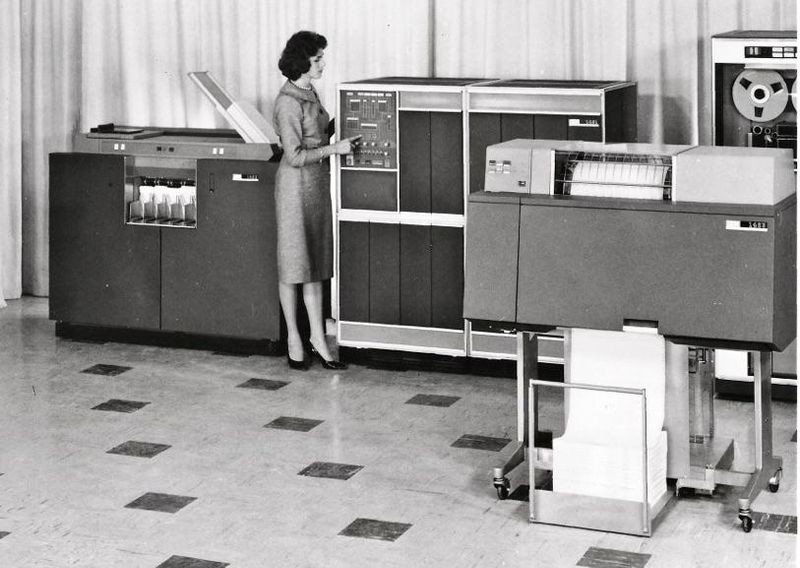
Mainframe computers are large systems used by big organizations like banks, airlines, and government offices. They can handle thousands of users simultaneously and process large volumes of data securely.
3. Minicomputer

Minicomputers are medium-sized computers used by small to medium businesses. They are less powerful than mainframes but more powerful than personal computers.
4. Microcomputer (Personal Computer)
A microcomputer, also called a personal computer (PC), is designed for individual use. Examples include desktops, laptops, tablets, and smartphones. These are commonly used in homes, schools, and offices.
Generations of Computers
Computers have evolved through five generations:
- First Generation (1940–1956) – Used vacuum tubes.
- Second Generation (1956–1963) – Used transistors.
- Third Generation (1964–1971) – Used integrated circuits.
- Fourth Generation (1971–Present) – Microprocessors introduced.
- Fifth Generation (Present & Future) – Artificial Intelligence and advanced technologies.
Each generation improved speed, size, storage, and reliability.
Uses of Computers
Computers are widely used in different sectors:
- Education – Online classes, research, exams.
- Business – Accounting, data management, communication.
- Healthcare – Patient records, medical imaging.
- Banking – Online transactions, ATM services.
- Entertainment – Games, movies, music.
- Communication – Emails, social media, video calls.
Computers save time, reduce human effort, and increase productivity.
Advantages of Computers
- High speed processing
- Large storage capacity
- Accuracy and reliability
- Multitasking ability
- Automation of tasks
Disadvantages of Computers
- Cybersecurity threats
- Health issues (eye strain, posture problems)
- Job displacement due to automation
- Dependence on electricity
Future of Computers
The future of computers includes Artificial Intelligence (AI), Quantum Computing, and Machine Learning. Smart devices and automation are becoming more common in everyday life. As technology advances, computers will become even faster, smaller, and more intelligent.
Conclusion
Computers are powerful electronic devices that have transformed the world. From supercomputers to personal computers, they are used in almost every industry. Understanding computer basics, types, components, and uses is essential in today’s digital age. With continuous technological advancements, computers will continue to shape the future of humanity.
Computers are not just machines; they are the foundation of modern innovation and development.
do you follow instaram