 By
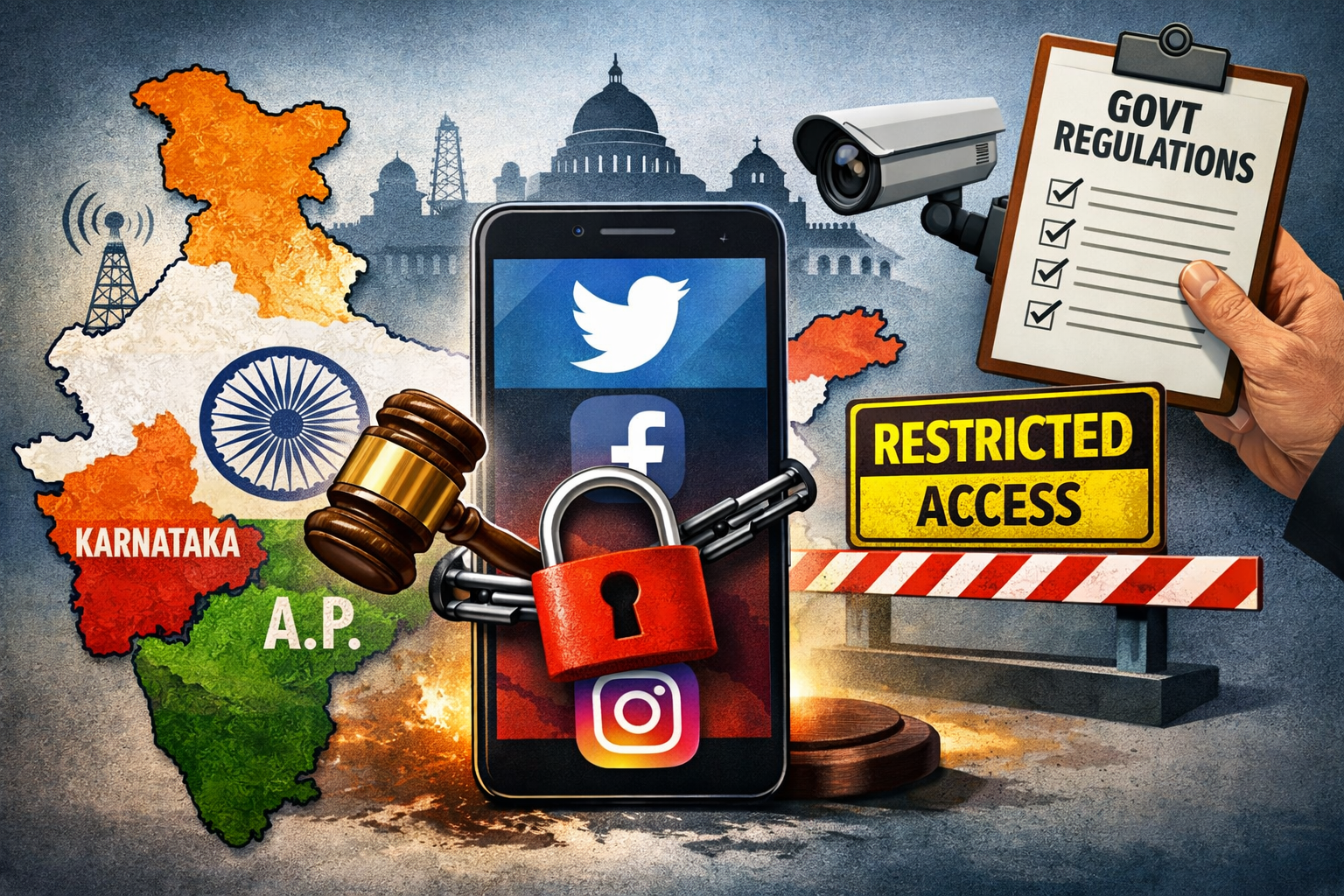
By India’s digital governance debate has taken a new turn after reports emerged about a social media ban imposed by A.P. and Karnataka, raising serious legal and constitutional questions. Experts say that regulating internet is Centre’s domain, and any attempt by individual states to control or ban social media platforms could face a major jurisdictional barrier.
The discussion has quickly turned into a national debate across political circles, legal experts, and social media users. While state governments claim such steps are necessary to control misinformation and maintain public order, constitutional experts argue that internet regulation falls under the authority of the Central Government.
Why the Social Media Ban Imposed by A.P. and Karnataka Is Being Questioned
The social media ban imposed by A.P. and Karnataka reportedly came after rising concerns about misinformation, online hate campaigns, and content that could potentially disturb law and order.
However, legal analysts say that regulating internet is Centre’s domain, primarily governed by laws like the Information Technology Act. Under India’s constitutional framework, telecommunications and internet infrastructure fall under the Union List, meaning the Central Government has the authority to regulate them.
This means that if a state government tries to block or restrict social media platforms independently, it could run into a jurisdictional barrier, potentially leading to legal challenges in higher courts.
Experts believe that such actions could trigger debates about the balance between state-level governance and central authority over digital platforms.
Legal Experts Explain Why Regulating Internet Is Centre’s Domain
Constitutional Framework
India’s Constitution divides powers between the Centre and the States through three lists:
- Union List – controlled by the Central Government
- State List – controlled by state governments
- Concurrent List – shared authority
Internet services and telecommunications fall under the Union List, making it clear why experts argue that regulating internet is Centre’s domain.
Legal experts say that only the Central Government can order large-scale blocking of websites or platforms under the IT Act. If a state government attempts to enforce a social media ban imposed by A.P. and Karnataka, courts may question the legal authority behind such decisions.
Possible Court Challenges
Several constitutional lawyers believe that if the policy moves forward, it could be challenged in High Courts or even the Supreme Court.
The courts may examine whether the states have the authority to implement such digital restrictions or whether they must rely on the Centre to act.
Political Reactions Across the Country
The social media ban imposed by A.P. and Karnataka has sparked political reactions from various parties.
Opposition leaders have questioned the move, arguing that restricting social media could affect freedom of expression and democratic debate. Some leaders have also warned that such actions could set a dangerous precedent for digital censorship.
Meanwhile, supporters of the decision argue that governments must take strong action to prevent fake news and maintain public peace.
The political divide shows how sensitive the issue of internet regulation has become in India’s rapidly expanding digital ecosystem.
Social Media Users React to the Debate
Unsurprisingly, the topic has gone viral online. Thousands of users have taken to platforms like Twitter, Instagram, and YouTube to express their opinions.
Some users believe stricter regulation is necessary to control misinformation and cyber abuse. Others argue that banning or restricting platforms could harm freedom of speech.
Many digital creators and influencers have also raised concerns, saying that sudden restrictions could disrupt their careers and affect millions of content creators who depend on social media for income.
As the debate intensifies, hashtags related to regulating internet is Centre’s domain and social media ban imposed by A.P. and Karnataka have started trending online.
Impact on Digital Industry and Content Creators
The controversy could also affect India’s booming digital economy.
Social media platforms play a major role in:
- Digital marketing
- Online entertainment
- Influencer economy
- Startup growth
If the social media ban imposed by A.P. and Karnataka leads to uncertainty about digital regulations, it could impact advertisers, creators, and tech companies operating in the country.
Industry experts say consistent national-level policies are important for maintaining stability in India’s digital ecosystem.
Companies operating in the digital space are closely watching how the government and courts respond to the issue.
What Could Happen Next?
The situation is still evolving, and several possibilities could unfold in the coming weeks.
The Central Government may clarify whether states have any authority to impose restrictions on social media platforms. At the same time, legal petitions could be filed challenging the move.
If courts intervene, they may issue guidelines defining the exact powers of state governments regarding internet restrictions.
For now, the debate around regulating internet is Centre’s domain continues to dominate legal and political discussions.
Conclusion
The debate over the social media ban imposed by A.P. and Karnataka highlights a larger issue about digital governance in India. While states may attempt to regulate online content to maintain law and order, constitutional experts emphasize that regulating internet is Centre’s domain.
As India becomes one of the world’s largest digital markets, clear rules and cooperation between the Centre and the states will be essential.
The coming weeks may determine whether the proposed restrictions survive legal scrutiny or reshape India’s approach to internet regulation.