


 By
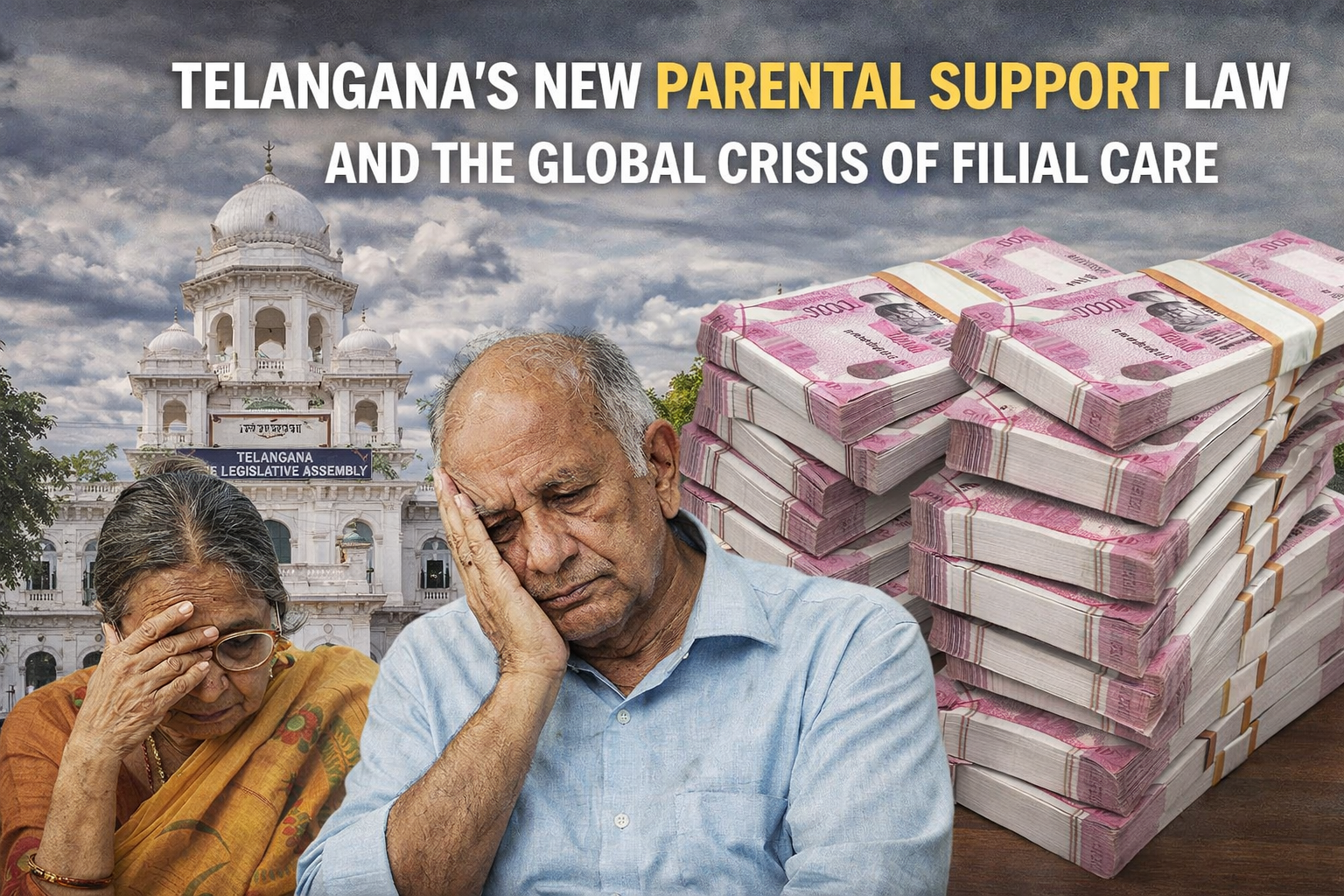
By HYDERABAD: The Telangana Legislative Assembly has passed the Telangana Employees Accountability and Monitoring of Parental Support Bill, 2026, marking a significant shift in how the state enforces filial responsibility. This landmark legislation, approved on March 29, 2026, is designed to ensure that elderly parents and step-parents receive financial support and dignity from their children who are gainfully employed.
This legislation moves beyond the 2007 Central Act by introducing a direct, workplace-linked mechanism to ensure that elderly parents are not left destitute. By targeting the salaries of government and private sector employees, as well as elected officials, the state has created a safety net that guarantees a dignified life for those who can no longer support themselves.
This development is not merely a local administrative change but a response to a global shift in how aging populations are treated, mirroring long-standing religious mandates while seeking to avoid the pitfalls of systemic neglect seen in more developed economies.
Under the provisions of the new law, the mandate for parental care extends to a wide range of individuals, including state government employees, staff in the private sector, and public representatives such as MLAs, MPs, and local body members. If an employee is found to be neglecting their dependent parents, the government is empowered to authorise a mandatory deduction of up to 15% of their monthly gross salary or Rs. 10,000, whichever is lower. This deducted amount is credited directly to the bank accounts of the parents, bypassing the employee entirely to ensure the funds reach the intended recipients without delay or interference.
The administrative process for seeking relief is designed to be time-bound and structured. Senior citizens who feel neglected can file a written application with the District Collector, who serves as the primary adjudicating authority. The Collector is required to hear both the parents and the employee and must dispose of the petition within 60 days.
To qualify for support, parents must demonstrate that they lack an adequate source of income to maintain a dignified livelihood and are in need of financial assistance from their child. The law also includes provisions for changing circumstances, such as allowing a surviving parent to claim the full apportioned amount upon the death of a spouse or allowing an employee to seek cancellation of the deduction after the demise of both parents.
To ensure oversight and handle disputes, the Bill establishes a new Senior Citizen Commission headed by a retired High Court judge. This commission possesses quasi-judicial powers and serves as an appellate body for those aggrieved by the District Collector’s orders or in cases of undue delay in the resolution process.
Chief Minister A. Revanth Reddy, while introducing the Bill, noted that while moral values and goodwill should ideally drive parental care, the rise of nuclear families and shifting social dynamics necessitated a legal safety net. He emphasised that the state must stand with neglected parents, reinforcing the traditional Indian family system through what he described as “enforceable morality.”
The core of this law resonates deeply with Islamic jurisprudence, which elevates parental care to a primary religious obligation. In Islam, the duty to honour parents is second only to the worship of God, as emphasised in the Quranic command to show Ihsan, or ultimate kindness. Islamic law does not view the maintenance of parents as a voluntary charitable act but as a non-negotiable legal right that the parent holds over a child’s wealth.
By instituting a mandatory salary deduction of up to 15% for neglected parents, the state is effectively enforcing the “right to maintenance” that has long been a part of Islamic jurisprudence. It bridges the gap between a moral ideal and a practical reality. For many parents, the fear of social stigma prevents them from taking their children to court under existing national laws. The Telangana Bill mitigates this by creating an administrative process that targets the source of income directly. It acknowledges that when the internal moral compass of a family fails, the state must act as the ultimate guarantor of dignity for its oldest citizens.
The Telangana law mirrors this spiritual mandate by ensuring that when a child has the means, the state will step in to ensure the parent receives their due share, reflecting the Prophetic teaching that a child’s wealth is, in essence, the parent’s wealth in times of need.
In a world where economic pressures often override traditional duties, the Telangana government has recognized that love and affection cannot always be legislated, but financial support can. By including public representatives and private sector employees in its scope, the law sends a clear message that no one is exempt from the responsibility of caring for those who gave them life. This is particularly relevant in the context of rising property disputes, where the elderly are often rendered homeless by their own heirs. The law ensures that even if a parent is evicted or pushed into an old-age home, they possess the financial autonomy to sustain themselves and access medical care.



