

 By
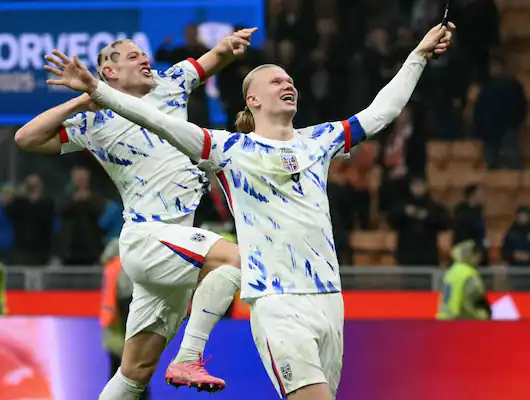
By Norwegian superstar Erling Haaland has once again demonstrated why he is one of the most dominant forwards in world football, scoring a decisive brace that propelled Norway to its first FIFA World Cup since 1998. The long-awaited qualification marks a historic moment for the Norwegian national team, which has spent more than two decades fighting to reclaim its place on football’s biggest stage. Haaland’s two clinical finishes in the decisive qualifier not only lifted the nation but also cemented his reputation as the driving force behind Norway’s revival. For fans who have endured years of near-misses and rebuilding phases, this moment represents a new era—one built around a generation of young talent and a striker who performs under pressure with exceptional consistency.
Norway’s qualification campaign has been shaped by a renewed sense of identity, discipline, and attacking fearlessness. With Haaland leading the line and captain Martin Ødegaard orchestrating from midfield, the team has achieved a balance that had long been missing in previous squads. Their tactical cohesion, combined with Haaland’s elite goal-scoring instincts, gave them the edge in a challenging qualification group. The brace that sealed their World Cup berth was emblematic of Norway’s entire journey—relentless pressing, quick transitions, and clinical finishing at crucial moments. For manager Ståle Solbakken, the achievement is a validation of his long-term vision of building a team capable not only of qualifying but also of competing against the world’s best.
While Norway celebrates a triumphant return to the global stage, the mood in Italy could not be more different. Once giants of international football and four-time World Cup champions, Italy now find themselves dangerously close to missing their second consecutive World Cup. Despite a talented squad packed with European stars, the Italian team has struggled to produce results when it matters most. Their qualification campaign has been marred by inconsistency, missed chances, and tactical uncertainty. Defensive lapses, a lack of clinical finishing, and mounting pressure have further complicated their path to the tournament.
Italian fans, still reeling from the disappointment of missing the 2018 and 2022 World Cups, are watching with growing anxiety as their national team once again flirts with failure. The fear of another historic setback looms large. Italy’s struggles highlight structural issues that have plagued the country’s footballing system—from youth development challenges and reliance on veteran players to the lack of a reliable goal scorer capable of delivering in high-stakes matches. The pressure on the coaching staff and players has reached a boiling point, with critics demanding urgent changes before it’s too late.
Comparisons between the two nations’ trajectories offer a compelling narrative. Norway, after years of rebuilding and investing in young talent, has finally assembled a squad capable of competing at the international level. Their qualification is not merely the result of Haaland’s brilliance but also the culmination of strategic development and a unified team vision. Italy, on the other hand, appears stuck in a cycle of transition without a clear direction. Despite possessing skill and experience, the team has not been able to translate potential into performance. Their fate now hangs in the balance as they face pressure to deliver in upcoming matches.
Haaland’s brace stands as a symbol of hope, ambition, and resurgence for Norway, while Italy’s precarious position reflects instability and the consequences of underperformance. As the football world reacts to these contrasting stories, one thing is clear: Norway is entering the next World Cup with momentum and belief, and Italy is battling to avoid another devastating absence from the world’s greatest football tournament. Their fate now hangs in the balance as they face pressure to deliver in upcoming matches.