 By
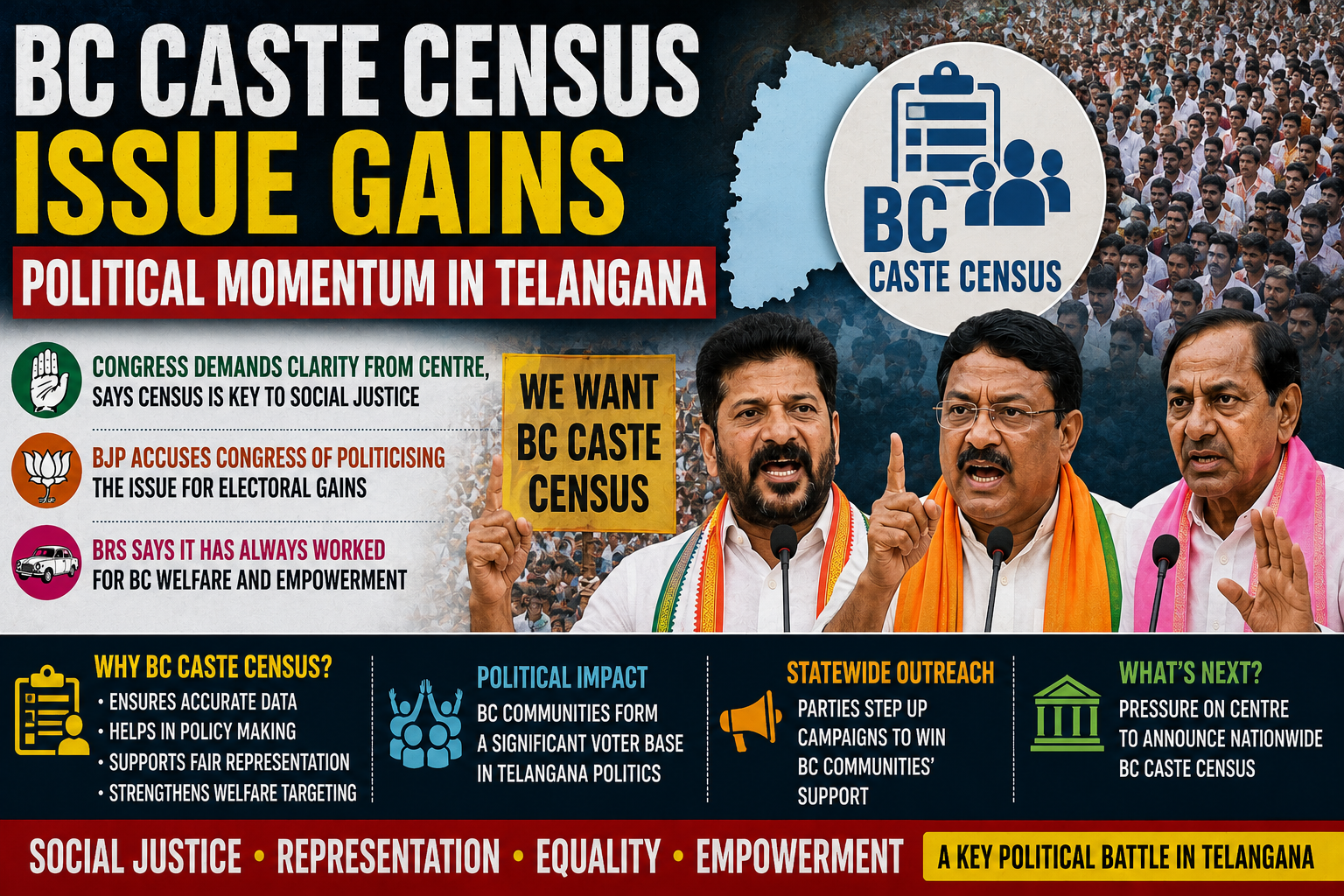
By The debate surrounding the Backward Classes (BC) caste census has gained significant political momentum in Telangana, emerging as one of the most discussed socio-political issues in the state. With major political parties taking clear positions on the matter, the issue is rapidly transforming from a policy debate into a major political and electoral narrative.
Leaders from the ruling Indian National Congress have intensified their demand for a nationwide caste census, particularly focusing on accurate data related to Backward Classes communities. Congress leaders argued that updated caste-based data is essential for ensuring fair representation, equitable distribution of welfare benefits, and informed policymaking. They claimed that without reliable demographic data, governments cannot effectively design policies addressing social and economic inequalities.
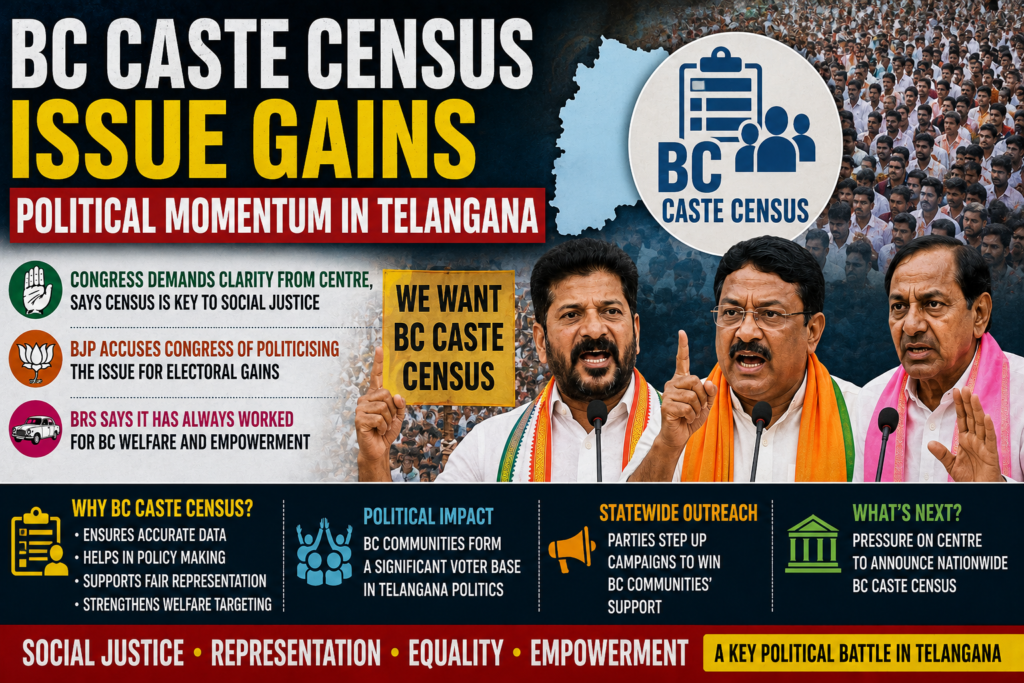
Senior Congress leaders in Telangana have also linked the issue to broader themes of social justice and political empowerment. They accused the Central government of delaying clarity on the caste census despite repeated demands from several states and political groups. Some leaders announced protests and public campaigns to increase pressure on the Centre and mobilize support among BC communities.
The Bharatiya Janata Party (BJP), however, criticized the Congress approach and accused it of politicizing caste-based issues for electoral advantage. BJP leaders argued that social welfare and development should benefit all sections of society without creating political divisions based on caste calculations. They also questioned whether Congress was using the issue primarily as a campaign strategy ahead of future elections.
Meanwhile, the Bharat Rashtra Samithi (BRS) has also been attempting to position itself on the issue by emphasizing its own welfare initiatives for backward communities during its tenure in government. BRS leaders accused both Congress and BJP of turning the caste census into a political battleground instead of focusing on practical welfare measures.
The growing attention on the BC caste census reflects the importance of backward communities in Telangana’s political landscape. BC communities form a significant portion of the population and play a major role in electoral outcomes across the state. As a result, political parties are increasingly trying to strengthen their connection with these groups through policy promises, public outreach programs, and social justice narratives.
Political analysts believe the caste census debate could significantly influence future political alignments in Telangana. Parties are not only competing for electoral support but also attempting to shape the larger narrative around representation and equality. The issue has therefore become closely tied to identity politics, welfare discussions, and political strategy.
Supporters of the caste census argue that updated demographic data is necessary for reviewing reservation policies, improving targeted welfare schemes, and understanding socio-economic disparities more accurately. They believe that such data could help governments make evidence-based decisions and improve inclusion in governance structures.
However, critics caution that caste-based political mobilization could deepen social divisions if not handled carefully. Some experts argue that while data collection is important for policymaking, political parties must avoid using the issue purely for electoral polarization. Balancing social justice concerns with social harmony remains a key challenge in the debate.
The issue has also sparked broader national discussions because several states and political parties across India have raised similar demands. Telangana’s active political engagement on the matter is therefore being closely watched as part of a larger national conversation about representation, reservations, and welfare policy.
In conclusion, the BC caste census issue is rapidly becoming one of the defining political topics in Telangana. As Congress, BJP, and BRS intensify their positions and outreach efforts, the debate is shaping both social and political discourse in the state. With strong emotional, electoral, and policy implications, the issue is expected to remain a major focus in Telangana politics in the coming months.