

 By
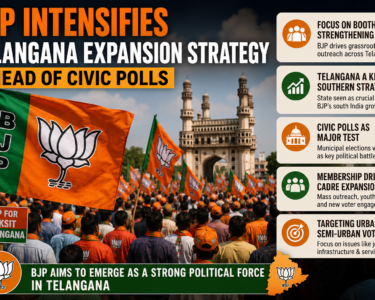
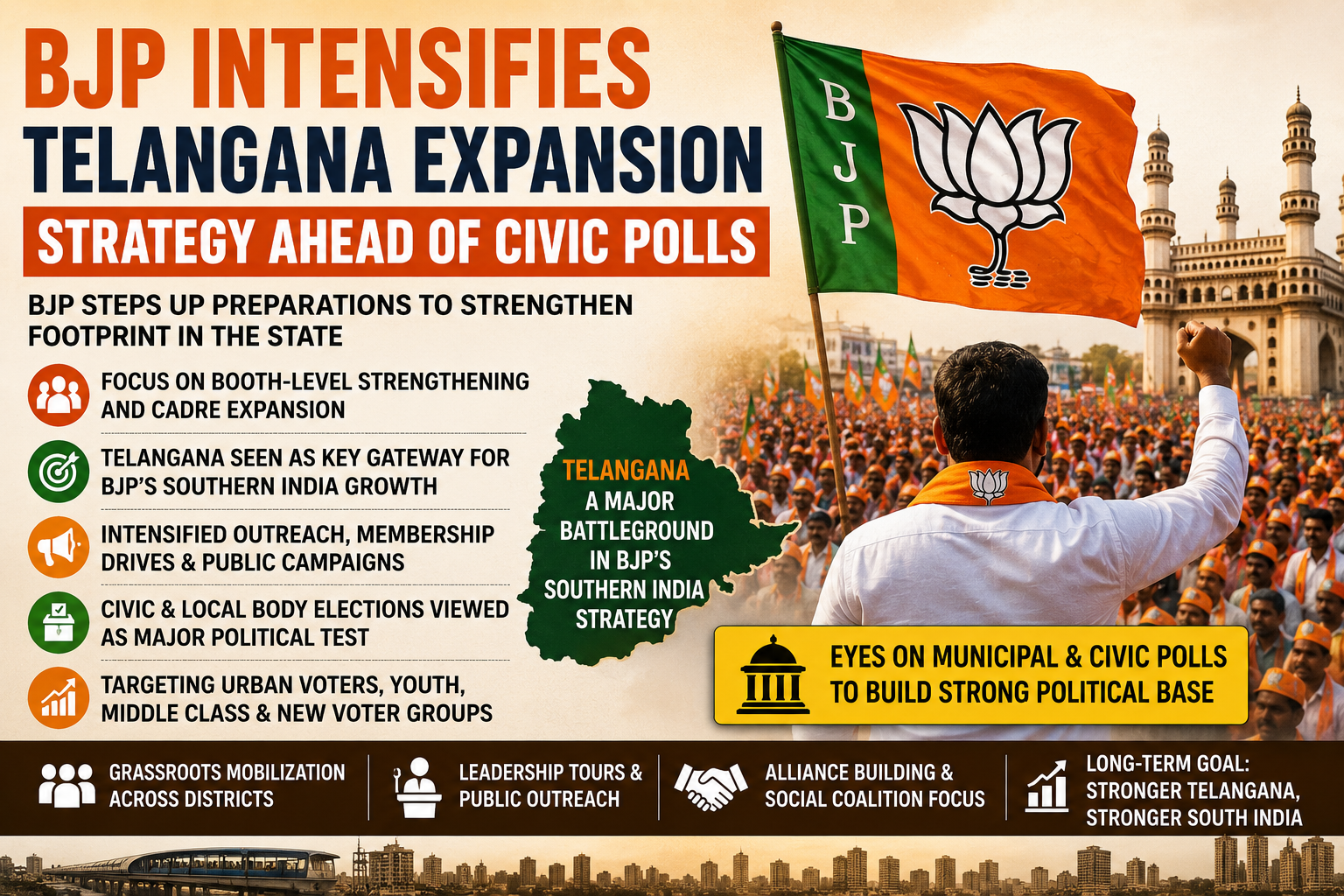
By The Bharatiya Janata Party has significantly intensified its political expansion strategy in Telangana ahead of upcoming civic and local body elections, viewing the state as one of its most important growth opportunities in southern India. Senior BJP leaders have increased organizational activities, public outreach campaigns, and booth-level mobilization efforts as part of a broader strategy to strengthen the party’s grassroots presence across Telangana.
Political observers believe Telangana has become a crucial battleground for BJP because of its growing urban voter base, expanding middle-class population, and increasing political competition between national and regional parties. The party leadership sees upcoming municipal and civic polls as a major opportunity to test organizational strength and expand influence beyond traditional strongholds.
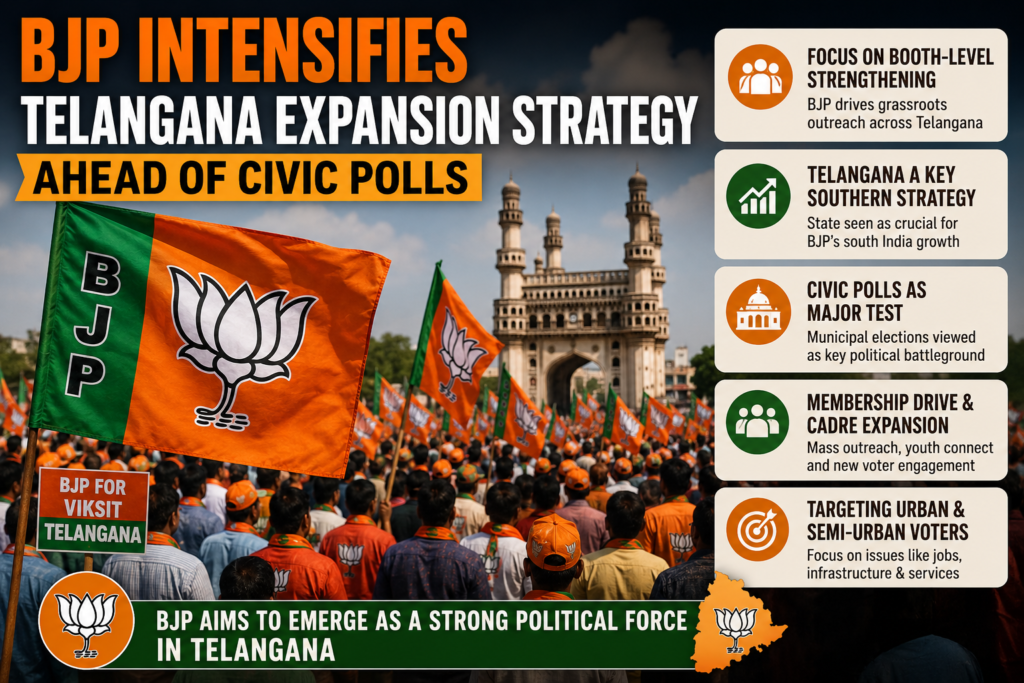
BJP leaders have been focusing heavily on booth-level restructuring and cadre strengthening programs across districts. Party workers have reportedly been instructed to intensify door-to-door campaigns, membership drives, and voter outreach activities in both urban and semi-urban regions. Special emphasis is being placed on youth voters, backward communities, first-time voters, and urban middle-class groups.
The BJP’s Telangana strategy is also linked to its larger ambition of expanding its footprint across southern India. After making gains in several southern states over recent years, the party now views Telangana as a strategic entry point for long-term political growth in the region. Senior national leaders have repeatedly highlighted Telangana’s political importance in party meetings and campaign planning discussions.
The ruling Indian National Congress government, led by Chief Minister A. Revanth Reddy, has accused BJP of prioritizing aggressive political campaigning over constructive governance cooperation. Congress leaders argue that the BJP is using civic elections as a political tool to expand its influence while simultaneously delaying approvals and support for key Telangana development projects.
At the same time, BJP leaders have strongly defended their expansion efforts and accused Congress of attempting to weaken opposition politics in the state. BJP leaders claim that the party’s growing support base reflects public dissatisfaction with governance issues related to infrastructure implementation, employment, civic administration, and agricultural concerns.
The Bharat Rashtra Samithi (BRS) is also closely monitoring BJP’s aggressive expansion strategy. BRS leaders have criticized both Congress and BJP while attempting to strengthen their own grassroots organization and reconnect with voters after recent political setbacks. The increasing three-way political competition is making Telangana one of the most politically active states in the country.
Upcoming civic and municipal elections are expected to become highly competitive because local body polls often influence broader political momentum and public perception. Control over municipal corporations, urban local bodies, and civic institutions also provides parties with stronger organizational networks and political visibility ahead of future Assembly and parliamentary elections.
The BJP has been particularly active in targeting urban constituencies such as Hyderabad, where issues like traffic congestion, civic infrastructure, urban development, and public services strongly influence voter sentiment. Party leaders have repeatedly highlighted governance issues related to roads, drainage systems, urban planning, and municipal administration as part of their political messaging.
Political analysts believe the BJP’s expansion strategy in Telangana is being driven by both electoral calculations and long-term organizational planning. By investing heavily in local body elections and grassroots expansion, the party aims to gradually strengthen its social and political base in the state over multiple election cycles.
At the same time, analysts note that civic elections in Telangana are likely to revolve around a combination of local governance issues and larger political narratives. Infrastructure development, welfare schemes, farmer issues, urban planning, and leadership politics are all expected to influence voter behavior during the upcoming political contests.
Experts also point out that Telangana’s rapidly urbanizing population presents both opportunities and challenges for political parties. Urban voters are increasingly focused on governance efficiency, infrastructure quality, employment opportunities, and public services. Parties that can effectively address these concerns while maintaining strong organizational networks may gain a significant advantage.
In conclusion, BJP’s intensified Telangana expansion strategy ahead of civic polls reflects the party’s broader ambitions in southern India and its determination to emerge as a stronger political force in the state. As Congress, BJP, and BRS continue intensifying their campaigns and organizational activities, Telangana is expected to witness increasingly competitive political battles in the months ahead.