


 By
By Cloud Security in 2026: Best Practices to Protect Data, Applications, and Cloud Infrastructure
Cloud computing has transformed the way organizations store data, develop applications, and deliver digital services. Businesses now rely on public, private, hybrid, and multi-cloud environments to improve scalability, flexibility, and operational efficiency. However, as cloud adoption continues to grow, so does the number of cyber threats targeting cloud-based infrastructure. In 2026, cloud security has become one of the most important pillars of modern cybersecurity, helping organizations safeguard sensitive information, maintain regulatory compliance, and ensure business continuity.
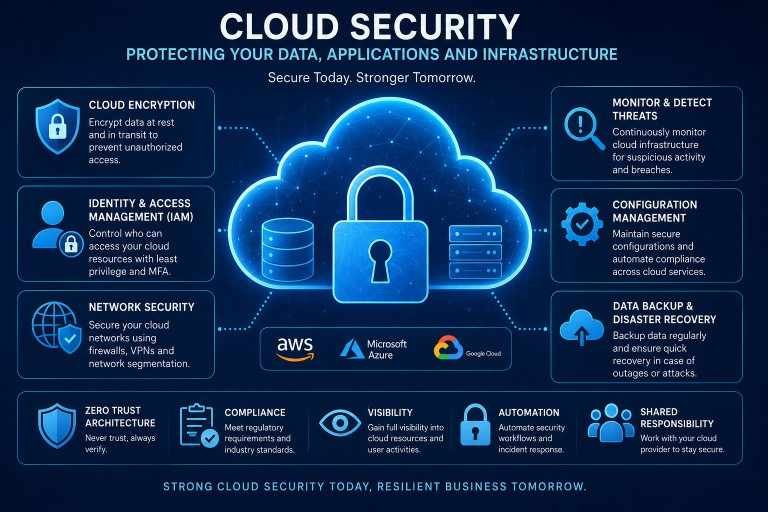
Cloud Security refers to the technologies, policies, and best practices used to protect cloud-hosted data, applications, workloads, and infrastructure from cyberattacks, unauthorized access, and data breaches. A strong cloud security strategy combines advanced encryption, identity management, continuous monitoring, and proactive threat detection to create a secure cloud environment.
Why Cloud Security Matters
Organizations increasingly store confidential customer information, financial records, intellectual property, and mission-critical applications in the cloud. While cloud providers invest heavily in infrastructure security, protecting cloud resources is a shared responsibility. Misconfigured storage, weak authentication, exposed APIs, and excessive user permissions remain some of the most common causes of cloud security incidents.
Cybercriminals often exploit these weaknesses to steal sensitive information, deploy ransomware, or gain unauthorized access to cloud environments. Implementing comprehensive cloud security controls helps organizations reduce these risks while maintaining trust with customers and business partners.
Cloud Encryption: Protecting Data at Every Stage
Encryption is one of the most effective methods for protecting sensitive cloud data. It converts readable information into encrypted data that can only be accessed using the correct cryptographic keys.
Organizations should encrypt data both at rest, when stored in cloud databases or storage services, and in transit, while data is moving between users, applications, and cloud platforms. Modern cloud providers support strong encryption standards such as AES-256 and TLS, helping organizations protect sensitive information against unauthorized access.
Secure encryption key management is equally important. Businesses should use dedicated key management services, rotate encryption keys regularly, and restrict access to cryptographic keys to authorized personnel only.
Identity and Access Management (IAM)
Identity and Access Management (IAM) plays a critical role in cloud security by ensuring that only authorized users and services can access cloud resources.
Effective IAM strategies include:
- Enforcing Multi-Factor Authentication (MFA) for all privileged accounts.
- Applying the Principle of Least Privilege (PoLP), granting users only the permissions required for their responsibilities.
- Using Role-Based Access Control (RBAC) to simplify permission management.
- Regularly reviewing user accounts and removing inactive identities.
- Implementing Single Sign-On (SSO) for secure and centralized authentication.
Proper IAM reduces the risk of credential theft and unauthorized access while improving overall security governance.
Continuous Monitoring of Cloud Infrastructure
Cloud environments are dynamic, with resources constantly being created, modified, and deleted. Continuous monitoring enables organizations to detect suspicious activities before they become major security incidents.
Modern cloud security platforms provide real-time visibility into cloud workloads and can identify:
- Unauthorized login attempts
- Misconfigured storage buckets
- Suspicious API activity
- Unusual user behavior
- Malware infections
- Compliance violations
Cloud Security Posture Management (CSPM), Security Information and Event Management (SIEM), and Extended Detection and Response (XDR) solutions help organizations continuously monitor cloud infrastructure and automate incident response.
Zero Trust for Cloud Environments
One of the biggest cloud security trends in 2026 is the adoption of the Zero Trust security model. Rather than automatically trusting users or devices inside the network, Zero Trust requires every access request to be continuously verified.
Zero Trust cloud security includes identity verification, device health checks, least-privilege access, micro-segmentation, and continuous monitoring of user activity. This approach significantly reduces the risk of insider threats and unauthorized lateral movement within cloud environments.
AI-Powered Cloud Threat Detection
Artificial Intelligence (AI) is revolutionizing cloud security by enabling faster threat detection and automated response. AI-powered security tools analyze millions of cloud events in real time to identify suspicious behavior, detect anomalies, and prioritize high-risk incidents.
Machine learning models continuously improve their ability to recognize new attack patterns, including zero-day threats and advanced persistent attacks. Automated security workflows can isolate compromised resources, revoke suspicious access, and alert security teams within seconds, minimizing the impact of cyber incidents.
Multi-Cloud Security and Compliance
Many organizations now use multiple cloud providers to increase flexibility and reduce dependence on a single platform. While multi-cloud environments offer business advantages, they also introduce additional security challenges.
Organizations should implement consistent security policies across all cloud platforms, automate compliance assessments, regularly audit cloud configurations, and maintain centralized visibility into cloud resources. Compliance with regulations such as GDPR, HIPAA, ISO 27001, and PCI DSS is also essential for protecting sensitive information and meeting legal requirements.