


 By
By Critical Infrastructure Security in 2026: Safeguarding Essential Services Against Modern Cyber Threats
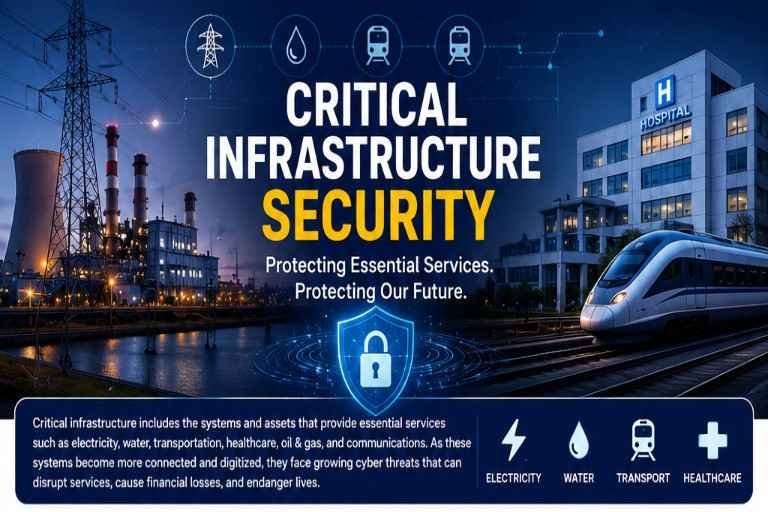
Critical infrastructure is the backbone of every nation’s economy and public safety. Services such as electricity, water supply, transportation, healthcare, oil and gas, and communication networks are essential for daily life. As these sectors increasingly adopt digital technologies, cloud platforms, and Industrial Internet of Things (IIoT) devices, they have become prime targets for cybercriminals and nation-state attackers. In 2026, securing critical infrastructure is no longer just an operational necessity—it is a national security priority.
Critical Infrastructure Security focuses on protecting Operational Technology (OT), Industrial Control Systems (ICS), and digital infrastructure from cyberattacks, physical threats, and system failures. A successful attack on these essential services can disrupt economies, impact public health, and endanger millions of lives. Organizations must therefore implement proactive security measures that ensure resilience, availability, and rapid recovery.
Why Critical Infrastructure Security Matters
Today’s critical infrastructure operates in highly connected environments where Information Technology (IT) and Operational Technology (OT) work together. While digital transformation has improved efficiency and automation, it has also introduced new vulnerabilities.
Cyberattacks targeting energy grids, healthcare facilities, transportation systems, and water treatment plants have increased significantly over the past few years. Ransomware, supply chain attacks, insider threats, and zero-day vulnerabilities can cause prolonged service disruptions, financial losses, and public safety risks.
Protecting critical infrastructure requires a multi-layered security strategy that combines technology, policies, employee awareness, and continuous monitoring.
Strengthening SCADA System Security
Supervisory Control and Data Acquisition (SCADA) systems play a vital role in monitoring and controlling industrial operations such as power generation, water distribution, manufacturing, and oil refineries. Because these systems directly manage physical processes, compromising them can have severe real-world consequences.
Organizations should secure SCADA environments by:
- Isolating SCADA networks from public internet access.
- Encrypting communications between control systems.
- Restricting remote access using Multi-Factor Authentication (MFA).
- Continuously monitoring operational activities.
- Applying security updates whenever operationally feasible.
Network segmentation further reduces the risk of attackers moving from corporate IT systems into critical operational environments.
Industrial Control System (ICS) Protection
Industrial Control Systems (ICS) include Programmable Logic Controllers (PLCs), Human Machine Interfaces (HMIs), and Distributed Control Systems (DCS) that manage industrial equipment and automated processes.
Unlike traditional IT systems, ICS environments prioritize operational availability and safety. Therefore, security controls must be carefully implemented without disrupting production.
Best practices for ICS protection include:
- Maintaining an accurate inventory of industrial assets.
- Conducting regular vulnerability assessments.
- Implementing strict access controls based on user roles.
- Monitoring OT networks for abnormal behavior.
- Using application whitelisting to prevent unauthorized software execution.
Combining IT and OT security teams also improves visibility across industrial environments and enables faster incident response.
Backup and Disaster Recovery Planning
Even the most secure infrastructure must be prepared for unexpected cyber incidents or natural disasters. A comprehensive backup and disaster recovery strategy helps organizations restore essential services quickly while minimizing downtime.
The recommended 3-2-1 backup strategy involves maintaining three copies of critical data, storing them on two different storage media, and keeping one copy offline or offsite. Immutable backups provide additional protection against ransomware attacks because they cannot be modified or deleted by attackers.
Organizations should also regularly test disaster recovery plans, define Recovery Time Objectives (RTOs) and Recovery Point Objectives (RPOs), and conduct simulation exercises to ensure operational readiness.
AI-Powered Monitoring and Threat Detection
Artificial Intelligence is playing an increasingly important role in protecting critical infrastructure. AI-driven security platforms continuously analyze operational data to identify unusual behavior, detect cyber threats, and automate incident response.
Security Information and Event Management (SIEM), Extended Detection and Response (XDR), and Industrial Intrusion Detection Systems (IDS) provide real-time visibility across both IT and OT environments. Machine learning algorithms can identify anomalies that traditional signature-based tools might overlook, allowing organizations to respond to threats before they disrupt essential services.
Building Cyber Resilience
Security is no longer just about preventing attacks—it is about maintaining resilience. Organizations should adopt Zero Trust principles, enforce least-privilege access, conduct regular employee cybersecurity training, and collaborate with government agencies and industry partners to strengthen defenses.
Compliance with standards such as IEC 62443, NIST Cybersecurity Framework, and ISO/IEC 27001 further helps organizations establish consistent security practices across critical infrastructure environments.