


 By
By Critical Infrastructure Security in 2026: Protecting Essential Services Against Evolving Cyber Threats
Critical infrastructure forms the backbone of every modern society. Essential services such as electricity, water supply, transportation, healthcare, telecommunications, and energy support daily life and economic growth. As these sectors increasingly adopt digital technologies, cloud computing, Industrial Internet of Things (IIoT), and automated control systems, they also become attractive targets for cybercriminals. In 2026, protecting critical infrastructure has become a global priority, as cyberattacks on these systems can cause widespread disruption, financial losses, and risks to public safety.
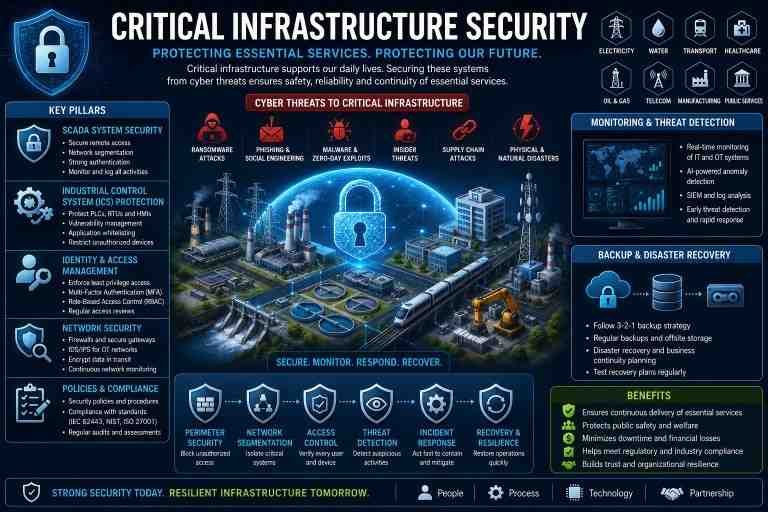
Critical Infrastructure Security refers to the technologies, policies, and best practices used to protect essential facilities, industrial control systems, and operational technology from cyber threats, physical attacks, and operational failures. A comprehensive security strategy ensures that critical services remain available, resilient, and secure even during sophisticated cyber incidents.
Why Critical Infrastructure Security Matters
Modern critical infrastructure relies on interconnected Information Technology (IT) and Operational Technology (OT) environments. While this integration improves efficiency and automation, it also expands the attack surface for malicious actors.
Recent cyberattacks targeting energy grids, hospitals, transportation systems, and water treatment facilities have demonstrated how vulnerable essential services can be. Threats such as ransomware, insider attacks, supply chain compromises, phishing campaigns, and zero-day vulnerabilities can interrupt operations and impact millions of people.
Organizations responsible for critical infrastructure must therefore implement layered security controls that prevent attacks, detect threats quickly, and ensure rapid recovery.
Strengthening SCADA System Security
Supervisory Control and Data Acquisition (SCADA) systems monitor and control industrial operations across sectors such as electricity generation, water distribution, manufacturing, and oil and gas.
Because SCADA systems directly control physical equipment, compromising them can have serious operational consequences. To strengthen SCADA security, organizations should:
- Isolate SCADA networks from public internet access.
- Encrypt communications between controllers and monitoring systems.
- Implement Multi-Factor Authentication (MFA) for remote access.
- Continuously monitor operational activities.
- Apply software updates and security patches during planned maintenance windows.
Network segmentation also helps prevent attackers from moving from business networks into critical operational environments.
Industrial Control System (ICS) Protection
Industrial Control Systems (ICS) include Programmable Logic Controllers (PLCs), Distributed Control Systems (DCS), and Human Machine Interfaces (HMIs) that automate industrial processes.
Unlike conventional IT systems, ICS environments require high availability and uninterrupted operations. Security measures should therefore balance protection with operational reliability.
Best practices include:
- Maintaining a complete inventory of industrial assets.
- Enforcing Role-Based Access Control (RBAC).
- Performing regular vulnerability assessments.
- Monitoring industrial networks continuously.
- Restricting USB devices and removable media.
- Using application whitelisting to prevent unauthorized software execution.
Collaboration between IT and OT security teams also improves visibility and accelerates incident response.
Backup and Disaster Recovery
No security system can guarantee complete protection against every cyber threat. Organizations must prepare for ransomware attacks, equipment failures, and natural disasters by implementing comprehensive backup and disaster recovery plans.
Following the 3-2-1 backup strategy—three copies of data, stored on two different media, with one copy kept offline or offsite—helps ensure critical information remains recoverable.
Disaster recovery plans should define:
- Recovery Time Objectives (RTO)
- Recovery Point Objectives (RPO)
- Incident response procedures
- System restoration priorities
- Regular recovery testing and simulation exercises
Well-tested recovery plans enable organizations to restore essential services quickly while minimizing downtime and operational impact.
AI-Powered Monitoring and Threat Detection
Artificial Intelligence is transforming critical infrastructure security by enabling real-time threat detection and predictive analytics.
AI-powered monitoring platforms continuously analyze operational data to detect unusual behavior, suspicious network traffic, and equipment anomalies before they become serious incidents. Security Information and Event Management (SIEM), Extended Detection and Response (XDR), and Industrial Intrusion Detection Systems (IDS) help organizations monitor both IT and OT environments from a centralized platform.
Machine learning also improves the ability to identify previously unknown threats while reducing false alarms, allowing security teams to respond more efficiently.
Building Resilient Critical Infrastructure
Cyber resilience has become just as important as cyber defense. Organizations should adopt Zero Trust architecture, implement least-privilege access, conduct employee cybersecurity awareness training, and regularly assess third-party supplier risks.
Compliance with globally recognized standards such as IEC 62443, the NIST Cybersecurity Framework, and ISO/IEC 27001 helps organizations establish consistent security controls and improve overall resilience against evolving threats.