


 By
By Cloud Security in 2026: Protecting Data, Applications, and Cloud Infrastructure from Emerging Threats
Cloud computing has revolutionized the way businesses operate by providing scalable infrastructure, flexible storage, and on-demand applications. Organizations of all sizes now rely on cloud platforms to host websites, manage customer data, run enterprise applications, and support remote workforces. While cloud technology offers numerous benefits, it also introduces new security challenges that require continuous attention. In 2026, cloud security has become a top priority for organizations seeking to protect sensitive information, ensure regulatory compliance, and defend against increasingly sophisticated cyber threats.
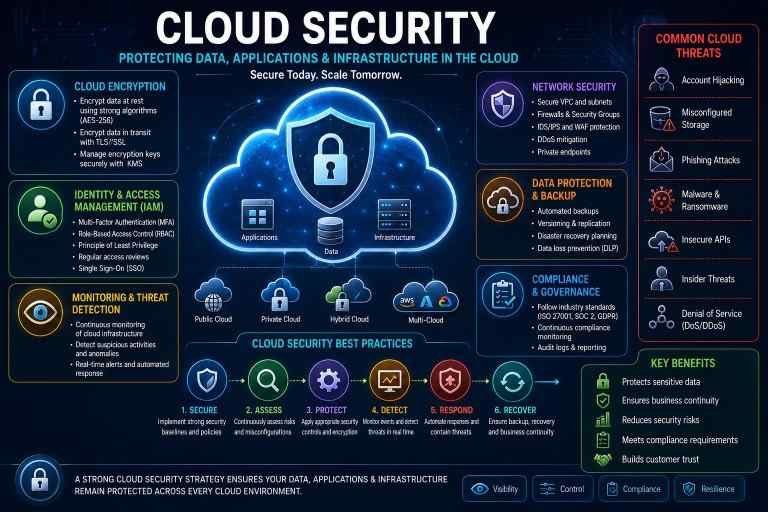
Cloud Security refers to the technologies, policies, and best practices used to protect cloud-hosted data, applications, services, and infrastructure from unauthorized access, data breaches, malware, and cyberattacks. A robust cloud security strategy combines encryption, identity management, continuous monitoring, and automated threat detection to safeguard digital assets across public, private, hybrid, and multi-cloud environments.
Why Cloud Security Matters
Businesses are rapidly migrating critical workloads to cloud platforms because they offer improved scalability, cost efficiency, and operational flexibility. However, cloud environments are shared and highly dynamic, making them attractive targets for cybercriminals.
Common cloud security risks include misconfigured storage buckets, stolen credentials, insecure APIs, insider threats, ransomware, and account hijacking. Since organizations often store customer information, financial records, intellectual property, and confidential business data in the cloud, even a single security incident can lead to financial losses, reputational damage, and regulatory penalties.
Implementing strong cloud security controls enables organizations to minimize these risks while maintaining customer trust and business continuity.
Cloud Encryption: Protecting Data Everywhere
Encryption is one of the most effective methods for securing cloud data. It transforms readable information into encrypted content that can only be accessed using authorized cryptographic keys.
Organizations should encrypt data in two key states:
- Data at Rest: Information stored in cloud databases, storage services, and backups should be protected using strong encryption standards such as AES-256.
- Data in Transit: Information moving between users, applications, and cloud services should be encrypted using secure communication protocols like TLS.
Equally important is encryption key management. Organizations should use dedicated Key Management Services (KMS), rotate encryption keys regularly, and restrict key access to authorized administrators.
Identity and Access Management (IAM)
Identity and Access Management (IAM) is the cornerstone of cloud security. IAM ensures that only authorized users, applications, and services can access cloud resources.
Key IAM best practices include:
- Enabling Multi-Factor Authentication (MFA) for all privileged accounts.
- Applying the Principle of Least Privilege (PoLP).
- Implementing Role-Based Access Control (RBAC).
- Regularly reviewing user permissions.
- Removing inactive accounts promptly.
- Using Single Sign-On (SSO) for centralized authentication.
Effective IAM significantly reduces the likelihood of unauthorized access caused by compromised credentials or excessive user permissions.
Monitoring Cloud Infrastructure for Breaches
Cloud environments constantly evolve as new virtual machines, containers, storage resources, and applications are deployed. Continuous monitoring helps organizations detect threats before they become major security incidents.
Modern cloud monitoring solutions can identify:
- Unauthorized login attempts
- Misconfigured cloud resources
- Suspicious API activity
- Privilege escalation
- Malware infections
- Unusual network traffic
- Compliance violations
Cloud Security Posture Management (CSPM), Security Information and Event Management (SIEM), and Extended Detection and Response (XDR) platforms provide real-time visibility into cloud infrastructure and automate incident detection and response.
Zero Trust Security for the Cloud
One of the leading cloud security trends in 2026 is the widespread adoption of the Zero Trust security model. Rather than automatically trusting users or devices based on their location, Zero Trust continuously verifies every access request.
Zero Trust principles include:
- Continuous identity verification
- Device health validation
- Least-privilege access
- Micro-segmentation
- Continuous activity monitoring
This approach minimizes insider threats and limits attackers’ ability to move laterally across cloud environments after compromising an account.
AI-Powered Threat Detection
Artificial Intelligence is transforming cloud security by enabling organizations to identify threats faster and respond automatically.
AI-powered security platforms analyze millions of cloud events every second to detect suspicious behavior, identify zero-day attacks, and prioritize high-risk incidents. Machine learning continuously improves detection accuracy by learning normal user behavior and identifying anomalies that traditional security tools might overlook.
Automated response capabilities can isolate compromised workloads, revoke unauthorized access, and alert security teams within seconds, significantly reducing the impact of cyberattacks.
Multi-Cloud Security and Compliance
Many organizations now operate across multiple cloud providers to improve flexibility and resilience. While multi-cloud environments offer business advantages, they also increase security complexity.
Organizations should implement consistent security policies across all cloud platforms, automate compliance monitoring, and regularly audit cloud configurations. Compliance with standards such as GDPR, ISO/IEC 27001, HIPAA, PCI DSS, and SOC 2 helps ensure sensitive data is protected while meeting legal and industry requirements.