 By
By IoT Security: Protecting the Connected World from Emerging Cyber Threats
The Internet of Things (IoT) has transformed the way people, businesses, and industries interact with technology. From smart home devices and fitness wearables to connected vehicles and industrial machines, billions of devices are now connected to the internet and continuously exchanging data. While this connectivity improves convenience, automation, and efficiency, it also creates new opportunities for cybercriminals. IoT security has therefore become an essential part of modern cybersecurity.
IoT security refers to the technologies, practices, and security controls used to protect internet-connected devices, networks, applications, and the data they generate. As organizations increasingly depend on connected devices, securing the entire IoT ecosystem is critical to preventing unauthorized access, data theft, service disruption, and other cyberattacks.
Why Is IoT Security Important?
Unlike traditional computers and servers, many IoT devices have limited processing power, minimal security controls, and long operational lifecycles. Some devices may also use outdated software or default passwords, making them attractive targets for attackers.
A compromised IoT device can become an entry point into a larger network. Attackers may use vulnerable devices to steal sensitive information, launch distributed denial-of-service (DDoS) attacks, monitor users, or disrupt critical operations.
For businesses, the risks can be even greater. Connected industrial machines, healthcare devices, surveillance systems, and smart infrastructure may handle sensitive information or control physical processes. A successful attack could therefore result in financial losses, operational downtime, privacy violations, or even safety risks.
Common IoT Security Threats
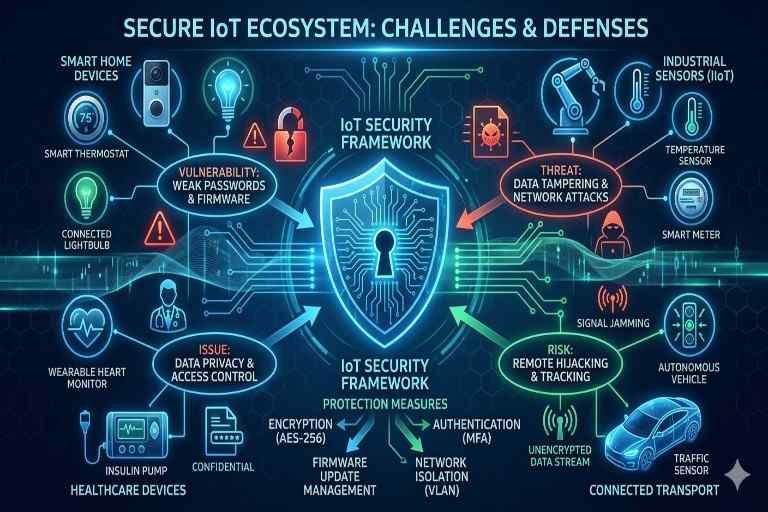
IoT environments face several cybersecurity challenges. Weak or default passwords remain one of the most common vulnerabilities, allowing attackers to gain unauthorized access easily.
Unpatched software and firmware are another major concern. If manufacturers or organizations fail to apply security updates, attackers can exploit known vulnerabilities.
Insecure communication can also expose sensitive information when data travels between devices and cloud platforms without adequate encryption.
Other threats include malware, botnets, device spoofing, man-in-the-middle attacks, unauthorized access, and data breaches. Attackers can compromise a single vulnerable device and potentially use it to move deeper into an organization’s network.
Examples of IoT Security in Action
IoT security is important across multiple environments. In smart homes, security controls protect devices such as smart cameras, locks, thermostats, speakers, and home assistants from unauthorized access.
In wearables, security helps protect personal information collected by smartwatches and fitness trackers, including activity and location-related data.
In industrial environments, connected machines and sensors require strong security because an attack could interrupt production or affect critical infrastructure. Industrial IoT security combines network segmentation, access controls, continuous monitoring, and secure device management to reduce these risks.
Best Practices for IoT Security
Organizations can strengthen IoT security by implementing several important practices.
First, every device should have strong, unique credentials, and default usernames and passwords should be changed immediately. Multi-factor authentication (MFA) should be enabled wherever supported.
Second, organizations should regularly update firmware, operating systems, and applications to address known security vulnerabilities.
Encryption should be used to protect data both during transmission and, where appropriate, while stored. Network segmentation can also prevent a compromised IoT device from accessing sensitive systems.
Organizations should maintain an accurate inventory of connected devices and continuously monitor them for unusual behavior. Devices that are no longer supported or required should be securely removed from the environment.
Finally, security should be considered during the entire IoT lifecycle—from device design and deployment to maintenance and retirement. Manufacturers should adopt secure-by-design principles rather than treating security as an afterthought.
The Future of IoT Security
As IoT adoption continues to grow, cybersecurity strategies will need to evolve alongside it. Artificial intelligence and machine learning can help organizations analyze large volumes of device activity and identify unusual behavior more quickly.
Zero Trust security models are also becoming increasingly relevant for IoT environments by requiring continuous verification instead of automatically trusting devices connected to a network.
With more smart devices entering homes, workplaces, cities, and industrial environments, IoT security will remain a critical cybersecurity priority. Organizations that combine strong authentication, encryption, regular updates, network segmentation, monitoring, and secure device management can significantly reduce their exposure to cyber threats.
The connected future offers enormous benefits, but those benefits depend on secure connectivity. Protecting IoT devices today is essential for building a safer, more reliable, and more resilient digital world.