


 By
By Database Security in 2026: Protecting Critical Data from Modern Cyber Threats
Data has become one of the most valuable assets for modern organizations. Customer information, financial transactions, employee records, business intelligence, healthcare data, application credentials, and operational information are stored and processed in databases every day. As organizations increasingly move databases to cloud and hybrid environments, protecting this information has become a critical cybersecurity priority.
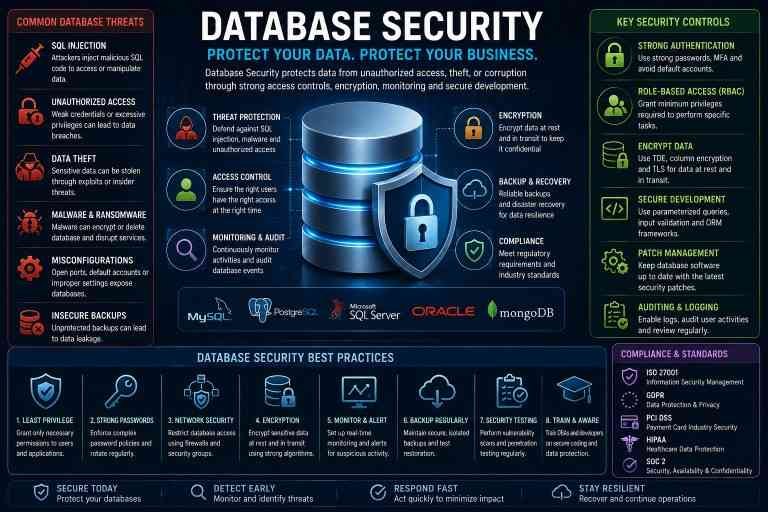
Database Security refers to the technologies, policies, and processes used to protect databases from unauthorized access, data theft, corruption, accidental deletion, malicious modification, and cyberattacks. In 2026, database security is evolving beyond traditional passwords and network firewalls as organizations face increasingly sophisticated attacks, cloud complexity, excessive privileges, insecure applications, and emerging AI-related risks.
Why Database Security Matters in 2026
A compromised database can have serious consequences. Attackers who gain unauthorized access may steal customer information, modify financial records, expose confidential business data, or use database credentials to move deeper into an organization’s infrastructure.
Modern databases are also increasingly connected to applications, APIs, cloud services, analytics platforms, and AI systems. This creates additional pathways through which attackers may reach sensitive information.
Recent IBM research continues to highlight the financial and operational impact of data breaches, while organizations are increasingly focusing on identity security, vulnerability management, and data protection as part of their broader cybersecurity strategies.
Preventing SQL Injection Attacks
SQL Injection remains one of the most important application-to-database security risks. It occurs when attackers manipulate application input in a way that causes unintended database queries to execute.
Developers can reduce SQL injection risks by using:
- Parameterized queries.
- Prepared statements.
- Secure Object-Relational Mapping (ORM) frameworks.
- Strict input validation.
- Proper database permissions.
- Web Application Firewalls (WAFs).
- Regular application security testing.
Applications should never construct database queries by directly concatenating untrusted user input.
Security testing should also include automated code scanning, dynamic testing, and penetration testing to identify injection vulnerabilities before attackers discover them.
Role-Based Access Control
Not every employee, application, or service should have unrestricted access to a database.
Role-Based Access Control (RBAC) allows organizations to assign permissions according to job responsibilities. For example, a reporting user may only need read access, while an application service may need access to a specific set of tables.
The Principle of Least Privilege should be applied wherever possible. Users and applications should receive only the permissions required to perform their tasks.
Organizations should regularly review:
- User accounts.
- Database roles.
- Administrative privileges.
- Service accounts.
- API credentials.
- Inactive accounts.
Removing unnecessary privileges reduces the potential impact if an account is compromised.
Encryption of Data at Rest and in Transit
Encryption is a fundamental component of database security.
Encryption at rest protects information stored on database servers, storage volumes, snapshots, and backups. If storage is stolen or improperly accessed, encrypted information is significantly harder to use without the appropriate keys.
Encryption in transit protects information as it travels between applications, databases, users, and other services. Secure protocols such as TLS should be used wherever sensitive database communications occur.
Encryption key management is equally important. Organizations should protect encryption keys separately, restrict access, rotate them according to appropriate policies, and monitor key usage.
Cloud Database Security
Cloud databases provide scalability and flexibility, but they also introduce security challenges. Misconfigured storage, overly permissive identities, exposed database endpoints, weak credentials, and insecure APIs can create opportunities for attackers.
Organizations should:
- Restrict database network access.
- Avoid publicly exposing database services unless absolutely necessary.
- Use strong IAM controls.
- Enable encryption.
- Monitor administrative activity.
- Apply security patches.
- Secure database backups.
- Regularly review cloud configurations.
Cloud database security should also follow the shared responsibility model, where the cloud provider secures certain parts of the infrastructure while the customer remains responsible for areas such as data, identities, configurations, and access permissions.
Database Monitoring and Threat Detection
Preventive controls are important, but organizations also need to detect suspicious activity.
Database Activity Monitoring can help identify unusual behavior such as:
- Unexpected administrative access.
- Large data exports.
- Repeated failed authentication attempts.
- Unusual queries.
- Unauthorized schema changes.
- Access outside normal working patterns.
- Unexpected access to sensitive tables.
Security teams can combine database logs with Security Information and Event Management (SIEM) platforms to correlate database activity with network, endpoint, identity, and application events.
AI and machine learning can also assist with identifying abnormal database behavior by establishing normal activity patterns and highlighting unusual queries or access behavior.
Protecting Databases from Ransomware
Ransomware does not only target files and endpoints. Attackers may also attempt to compromise databases, encrypt information, steal sensitive records, or disrupt access to critical applications.
A strong backup strategy is therefore essential.
Organizations should maintain multiple copies of critical databases, keep protected or isolated backups, restrict backup permissions, and regularly test restoration procedures.
A backup that has never been tested should not be considered a reliable recovery strategy.
Database Security and AI
AI is creating new opportunities as well as new security challenges for database environments.
Organizations are increasingly connecting AI applications to internal databases so that AI systems can retrieve and analyze business information. However, giving an AI application broad database access can introduce significant risks.
AI applications should use restricted service identities, read-only access where possible, carefully controlled queries, data filtering, logging, and strong authorization mechanisms.
Sensitive information should not automatically be exposed to an AI model simply because the model has access to a database.
Building a Strong Database Security Strategy
A modern database security program should combine multiple layers of protection:
- Secure application development.
- SQL injection prevention.
- RBAC and least privilege.
- Strong authentication and MFA.
- Encryption at rest and in transit.
- Network segmentation.
- Vulnerability scanning.
- Database activity monitoring.
- Secure backups.
- Regular penetration testing.
- Security patch management.
- Incident-response planning.
Security should be integrated throughout the database lifecycle—from design and development to deployment, operation, maintenance, and eventual retirement.