


 By
By Critical Infrastructure Security in 2026: Protecting Essential Services from Modern Cyber Threats
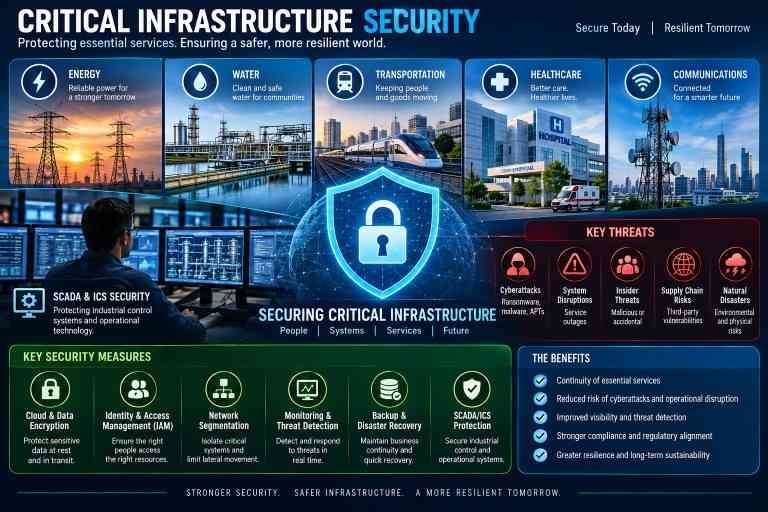
Critical infrastructure forms the foundation of modern society. Electricity grids, water systems, transportation networks, healthcare services, telecommunications, and other essential sectors depend on complex digital and physical systems to operate continuously. As these systems become increasingly connected, automated, and dependent on digital technologies, they also face a growing range of cybersecurity and operational risks.
Critical Infrastructure Security refers to the strategies, technologies, policies, and processes used to protect essential systems and services from cyberattacks, physical threats, operational failures, and natural disasters. In 2026, the focus is increasingly shifting from simply preventing attacks to building cyber resilience—the ability to detect incidents, limit their impact, maintain essential operations, and recover quickly.
Why Critical Infrastructure Security Matters
A cybersecurity incident affecting a traditional business may cause financial loss or temporary service disruption. However, an attack against critical infrastructure can have much wider consequences. A successful compromise could potentially interrupt electricity distribution, affect water treatment, disrupt transportation, delay healthcare services, or interfere with industrial operations.
Many critical environments rely on Operational Technology (OT), including Industrial Control Systems (ICS), Programmable Logic Controllers (PLCs), sensors, and SCADA systems. These technologies were often designed primarily for reliability and operational efficiency. As they become connected with IT networks and cloud-based services, organizations must carefully manage the additional security risks.
Securing SCADA and Industrial Control Systems
SCADA (Supervisory Control and Data Acquisition) systems are widely used to monitor and control industrial processes. They can support operations in energy, water, manufacturing, transportation, and other essential sectors.
Because these systems may directly influence physical equipment, security incidents can extend beyond data loss. Organizations should therefore implement layered protection, including:
- Network segmentation between IT and OT environments.
- Strict access controls and Multi-Factor Authentication (MFA).
- Secure remote access for administrators and vendors.
- Continuous monitoring of industrial networks.
- Regular asset inventories and vulnerability assessments.
- Controlled patch and change-management processes.
- Incident-response procedures designed specifically for OT environments.
Security updates must also be carefully tested before deployment because availability and safety are often critical in industrial environments.
Network Segmentation and Zero Trust
One of the most important security practices for critical infrastructure is separating systems according to their operational purpose and risk level. A compromised office computer should not provide a direct pathway to an industrial control system.
Network segmentation creates security boundaries between corporate IT, OT environments, administrative systems, industrial devices, and other sensitive assets. More granular controls can further restrict communication between workloads and devices.
A Zero Trust approach strengthens this model by requiring users, devices, and applications to be authenticated and authorized before accessing sensitive resources. Organizations should follow the principle of least privilege and regularly review accounts, permissions, and remote-access connections.
Continuous Monitoring and Threat Detection
Critical infrastructure environments require strong visibility. Security teams need to understand what devices are connected, how they communicate, and what activity is considered normal.
Continuous monitoring can help identify:
- Unauthorized remote connections.
- Unusual network traffic.
- Unexpected configuration changes.
- Suspicious login attempts.
- Abnormal communication between industrial systems.
- Potential malware activity.
- Unexpected changes to controllers or other critical assets.
Because OT environments can contain legacy systems that cannot always be patched immediately, monitoring and compensating controls become especially important.
Organizations should integrate IT and OT security information where appropriate while ensuring that monitoring systems do not interfere with critical operations.
Protecting Essential Sectors
Different sectors have different security priorities, but all require strong resilience.
Electricity and energy systems need protection against attacks that could disrupt generation, transmission, or distribution.
Water systems must secure treatment processes, monitoring equipment, and remote control capabilities to help maintain safe and reliable operations.
Transportation networks depend on increasingly connected systems for traffic management, logistics, rail operations, and other services.
Healthcare organizations must protect patient information while maintaining the availability of medical devices, hospital systems, and essential services.
Despite these differences, every sector benefits from accurate asset inventories, strong identity management, network segmentation, continuous monitoring, and tested recovery procedures.
Backup and Disaster Recovery
Prevention alone cannot guarantee security. Ransomware, hardware failures, software errors, natural disasters, and sophisticated cyberattacks can still disrupt operations. For this reason, backup and disaster recovery are essential components of critical infrastructure security.
Organizations should maintain secure and isolated backups of important data, configurations, and critical systems. Backups should be protected against unauthorized modification and tested regularly.
A strong disaster-recovery strategy should clearly define:
- Which systems must be restored first.
- Recovery Time Objectives (RTOs).
- Recovery Point Objectives (RPOs).
- Roles and responsibilities during an incident.
- Alternative communication methods.
- Procedures for restoring critical operations safely.
Regular exercises help identify gaps before a real emergency occurs.
Supply Chain and Third-Party Security
Critical infrastructure organizations often depend on hardware manufacturers, software vendors, cloud providers, maintenance companies, and remote support partners. Each third-party connection can introduce additional risk.
Organizations should assess supplier security practices, control vendor access, monitor third-party connections, and remove access when it is no longer required. Maintaining an inventory of software, hardware, and connected devices can also improve vulnerability management.
Supply chain security is especially important because a compromise in one trusted component or service provider can potentially affect multiple organizations.
Building Cyber Resilience
The goal of critical infrastructure security is not simply to create stronger defenses. It is to ensure that essential services can continue operating or recover safely when disruptions occur.
A resilient strategy should combine:
- Security risk assessments.
- IT and OT asset inventories.
- Network segmentation.
- Strong identity and access controls.
- Secure remote access.
- Continuous monitoring.
- Vulnerability management.
- Incident-response planning.
- Isolated and tested backups.
- Disaster-recovery exercises.
- Employee and operator security training.
- Third-party risk management.
Regular testing is essential. Organizations should conduct incident-response exercises and recovery drills to determine whether their plans work in real operational conditions.
The Role of AI and Automation
AI and automation are increasingly being used to improve infrastructure monitoring and threat detection. Security systems can analyze large volumes of network and operational data to identify unusual behavior and help security teams prioritize potential incidents.
However, AI also introduces new risks. Attackers can use automation to accelerate reconnaissance, phishing, and other malicious activities. Critical infrastructure organizations should therefore apply strong governance, human oversight, access controls, and monitoring when deploying AI-enabled systems.