


 By
By Cloud Security in 2026: Protecting Data, Applications, and AI Workloads in the Cloud
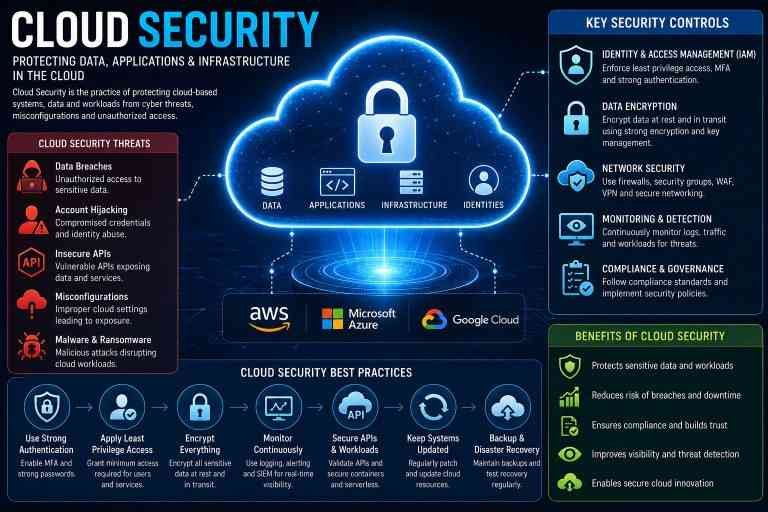
Cloud computing has transformed how organizations build, deploy, and manage applications. Businesses now rely on cloud platforms for databases, websites, APIs, storage, analytics, artificial intelligence, and critical business applications. However, this rapid adoption has also created a larger and more complex cybersecurity environment.
In 2026, Cloud Security is evolving beyond traditional infrastructure protection. Organizations must now secure identities, APIs, cloud workloads, data, third-party integrations, and increasingly, autonomous AI agents. The Cloud Security Alliance’s 2026 research identifies identity, artificial intelligence, third-party dependencies, and APIs among the leading cloud security concerns, with AI-enhanced attacks ranking particularly high.
Cloud Security refers to the technologies, policies, and practices used to protect cloud-hosted data, applications, services, infrastructure, and users from unauthorized access, cyberattacks, data loss, and service disruption.
Why Cloud Security Matters in 2026
The modern cloud environment is no longer limited to a single data center or cloud provider. Organizations commonly operate across public clouds, private infrastructure, SaaS applications, containers, Kubernetes clusters, APIs, and AI platforms.
This complexity creates more identities, permissions, configurations, and potential attack paths. Google Cloud’s 2026 Cloud Threat Horizons report found that identity compromise accounted for 83% of compromises involving major cloud and SaaS-hosted environments in its analyzed incidents.
This demonstrates why protecting cloud identities is just as important as protecting servers and networks.
Identity and Access Management
Identity and Access Management (IAM) is one of the most important components of cloud security. Users, administrators, applications, APIs, service accounts, and workloads all require some form of identity and access.
Organizations should follow the Principle of Least Privilege, ensuring that every identity receives only the permissions required to perform its function.
Important IAM practices include:
- Multi-Factor Authentication (MFA)
- Phishing-resistant authentication and passkeys
- Role-Based Access Control (RBAC)
- Privileged Access Management (PAM)
- Regular access reviews
- Short-lived credentials
- Strong service-account management
- Monitoring privileged activity
Organizations should also treat machine identities and AI agents as security-sensitive identities rather than assuming that only human users require access controls.
Cloud Encryption and Data Protection
Cloud environments contain valuable information such as customer records, financial data, credentials, source code, and intellectual property. Encryption helps protect this information if unauthorized access occurs.
Organizations should protect data at rest using encryption for databases, storage volumes, backups, and snapshots. They should also protect data in transit using secure protocols such as TLS.
Encryption alone is not enough. Organizations must also properly manage encryption keys, restrict key access, rotate keys where appropriate, and separate administrative responsibilities.
Data classification can further help organizations determine which information requires the strongest protection.
Zero Trust Cloud Security
Traditional security models often assumed that users or systems inside an organization’s network could be trusted. Cloud environments make this approach increasingly difficult.
Zero Trust follows a different principle: access should be continuously verified rather than automatically trusted.
A cloud-focused Zero Trust strategy should verify:
- Who is requesting access.
- What device or workload is making the request.
- What resource is being accessed.
- Whether the requested action is appropriate.
- Whether the behavior remains consistent with expected activity.
This approach is particularly valuable for hybrid and multi-cloud environments where users and workloads can operate from different locations.
AI and Cloud Security
Artificial Intelligence is becoming one of the defining cloud security trends of 2026. Organizations are rapidly deploying AI models, copilots, agents, and automated workflows within cloud environments.
However, AI introduces new risks. Cloud Security Alliance research found that 82% of enterprises reported unknown AI agents operating in their environments, while 65% reported AI-agent-related incidents during the previous year.
AI agents can potentially access cloud applications, databases, APIs, and files on behalf of users. If their permissions are excessive or their identities are poorly managed, they can become a significant source of data exposure.
Organizations should therefore establish clear AI-agent identities, permissions, monitoring, lifecycle management, and decommissioning processes.
Monitoring Cloud Infrastructure
Continuous monitoring is essential because cloud environments can change rapidly. New virtual machines, containers, APIs, identities, storage resources, and applications can be created within minutes.
Cloud security monitoring can help identify:
- Suspicious login attempts
- Unexpected privilege changes
- Unusual data transfers
- Publicly exposed storage
- Abnormal API activity
- Malware indicators
- Unauthorized configuration changes
- Suspicious workload behavior
Security teams can combine cloud logs, identity telemetry, endpoint information, and threat intelligence to create a more complete picture of potential attacks.
CNAPP and Cloud-Native Security
As cloud environments become more complex, organizations are increasingly adopting Cloud-Native Application Protection Platforms (CNAPPs) to bring multiple security capabilities together.
CNAPP approaches can help organizations identify vulnerabilities, misconfigurations, identity risks, workload threats, and compliance issues across cloud-native environments.
However, finding vulnerabilities is only useful if organizations can fix them. Recent 2026 cloud-remediation research highlights the continuing challenge of security teams facing large backlogs of unresolved cloud alerts.
Therefore, modern cloud security should focus not only on detection but also on prioritization, remediation, and continuous validation.
Protecting Against Cloud Data Breaches
Organizations should design cloud environments assuming that some security controls may eventually fail. A layered approach can reduce the impact of a breach.
Key measures include:
- Strong IAM and MFA.
- Encryption of sensitive information.
- Network segmentation.
- Secure API gateways.
- Continuous vulnerability management.
- Centralized security logging.
- Automated configuration monitoring.
- Immutable or isolated backups.
- Incident-response procedures.
- Regular security testing.
Backups are especially important against ransomware and destructive attacks. Organizations should regularly test whether critical systems and data can actually be restored.
The Future of Cloud Security
Cloud security is becoming increasingly identity-centric, automated, and AI-aware. Security teams must protect not only traditional workloads but also APIs, service accounts, containers, SaaS platforms, and autonomous AI systems.
Google Cloud’s 2026 security forecast emphasizes that the growing complexity of hybrid and multicloud architectures, combined with ungoverned AI agents, is increasing pressure on IAM and non-human identity management.
The future will therefore require security teams to combine Zero Trust principles, continuous monitoring, automated controls, AI-assisted detection, strong identity governance, and effective incident response.