


 By
By Network Security in 2026: Protecting Connected Networks from AI-Powered Cyber Threats
Modern businesses depend on networks for almost everything—from cloud applications and remote work to online transactions, communication, data sharing, and access to critical business systems. As organizations adopt hybrid cloud environments, IoT devices, remote connectivity, and AI-powered applications, their network infrastructure is becoming increasingly complex. At the same time, cybercriminals are using automation and Artificial Intelligence (AI) to make attacks faster and more scalable. In 2026, Network Security has therefore become a critical component of modern cybersecurity.
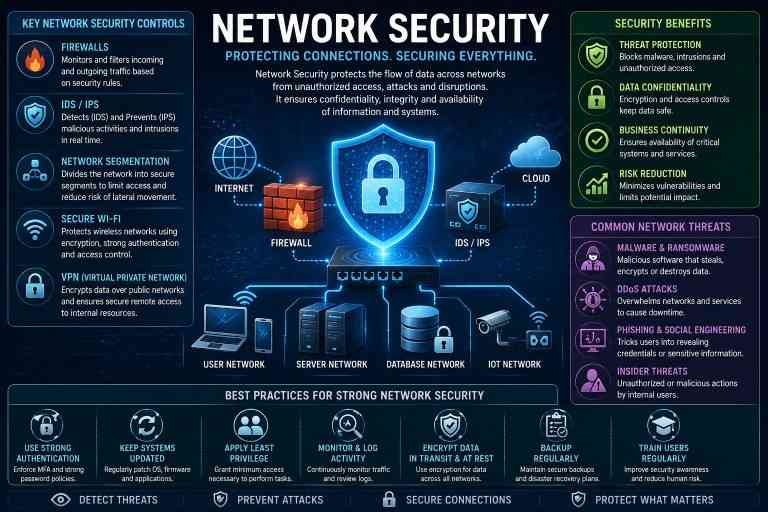
Network Security refers to the technologies, processes, and policies used to protect internal and external network communications from unauthorized access, malware, data theft, disruption, and other cyber threats. A strong network security strategy combines firewalls, intrusion detection and prevention, network segmentation, secure Wi-Fi, VPNs, identity controls, continuous monitoring, and Zero Trust principles.
Why Network Security Matters in 2026
Traditional security models often focused on protecting the organization’s network perimeter. However, today’s users, applications, devices, and workloads can exist anywhere—inside corporate offices, at home, in cloud platforms, or at the network edge.
The 2026 cybersecurity landscape is increasingly influenced by AI-driven attacks, ransomware, identity abuse, and complex hybrid environments. Check Point’s 2026 research highlights that attackers are combining AI, identity abuse, ransomware, edge infrastructure, and human interaction into increasingly coordinated campaigns.
This makes visibility and continuous protection essential.
Firewalls: The First Line of Network Defense
Firewalls remain one of the most important network security controls. They inspect network traffic and apply rules that determine which connections should be allowed or blocked.
Modern firewalls can provide more than basic port and IP filtering. Next-generation firewalls can inspect applications, identify suspicious traffic, integrate threat intelligence, and help detect malicious activity.
Organizations should regularly review firewall rules, remove unnecessary access, restrict exposed services, and ensure that administrative interfaces are not unnecessarily accessible from the internet.
IDS and IPS for Threat Detection
Intrusion Detection Systems (IDS) monitor network activity and generate alerts when suspicious behavior is identified. Intrusion Prevention Systems (IPS) go further by automatically blocking or preventing certain malicious traffic.
Together, IDS and IPS can help organizations detect activities such as port scanning, exploit attempts, malware communication, and unusual network behavior.
However, these systems are most effective when combined with centralized logging, threat intelligence, endpoint security, and skilled security monitoring rather than being treated as standalone solutions.
Network Segmentation and Microsegmentation
A flat network can allow attackers to move laterally after compromising one device or account. Network segmentation divides the infrastructure into separate security zones, limiting communication between systems.
For example, an organization could separate:
- Employee devices
- Guest Wi-Fi
- Production servers
- Database systems
- IoT devices
- Administrative systems
- Critical infrastructure
Microsegmentation takes this concept further by creating highly granular security boundaries around applications and workloads.
This approach is becoming increasingly important in modern hybrid environments because attackers frequently attempt to move laterally after gaining initial access. IBM’s 2026 guidance identifies microsegmentation as an important architectural response to lateral movement across hybrid data centers, cloud platforms, and Kubernetes environments.
Zero Trust Network Security
One of the biggest network security trends in 2026 is the continued adoption of Zero Trust.
Instead of automatically trusting users or devices because they are connected to an internal network, Zero Trust assumes that every access request should be verified.
A Zero Trust approach typically includes:
- Strong identity verification
- Multi-Factor Authentication (MFA)
- Least-privilege access
- Continuous verification
- Device security checks
- Network segmentation
- Detailed monitoring
The UK’s National Cyber Security Centre recommends ZTNA architectures that explicitly authorize access, reduce application exposure, restrict lateral movement, and continuously enforce access policies.
Secure Wi-Fi and VPN Protection
Wireless networks are essential for modern organizations, but poorly configured Wi-Fi can expose internal systems to unauthorized users.
Businesses should use strong encryption, secure authentication, separate guest networks, regularly updated access points, and strong administrative credentials.
VPNs remain useful for protecting remote connections, particularly when employees or administrators need access to private resources. However, organizations are increasingly evaluating Zero Trust Network Access (ZTNA) as an alternative or complement to traditional VPN-based remote access.
Recent 2026 threat reporting also shows why internet-facing VPNs and edge devices require particular attention: attackers continue to exploit vulnerabilities in these technologies to gain unauthorized access and deepen network compromise.
AI-Powered Network Monitoring
AI is transforming both sides of cybersecurity. Attackers can use AI to automate reconnaissance and accelerate attacks, while defenders can use AI to analyze enormous amounts of network telemetry.
AI-assisted network security can help identify:
- Unusual login behavior
- Suspicious data transfers
- Abnormal network connections
- Potential malware communication
- Lateral movement
- Unusual device behavior
- Emerging attack patterns
The World Economic Forum’s 2026 cybersecurity outlook identifies AI as a major driver of change, with 94% of surveyed respondents expecting AI to be the most significant factor shaping cybersecurity in the year ahead.
However, AI-based security systems still require human oversight, accurate data, and carefully designed response policies.
Building a Layered Network Security Strategy
No single security technology can protect an entire network. Organizations should implement defense in depth, combining multiple controls.
A modern network security strategy should include:
- Firewalls and secure gateway controls.
- IDS/IPS and continuous network monitoring.
- Strong authentication and MFA.
- Network segmentation and microsegmentation.
- Secure Wi-Fi configuration.
- VPN or ZTNA for remote access.
- Regular vulnerability scanning and patching.
- Endpoint and cloud security integration.
- Centralized logging and incident response.
- Employee cybersecurity awareness training.
Organizations should also regularly test their defenses through vulnerability assessments, penetration testing, configuration reviews, and incident-response exercises.