


 By
By Application Security in 2026: Protecting Software from Evolving Cyber Threats and AI Risks
Software applications have become essential to almost every modern business. From banking and healthcare platforms to e-commerce websites, mobile applications, cloud services, and enterprise systems, organizations depend on software to store information and deliver critical services. As applications become more sophisticated, cybercriminals are also developing new ways to exploit vulnerabilities. In 2026, Application Security (AppSec) is becoming increasingly important as organizations face traditional software vulnerabilities alongside new risks introduced by Artificial Intelligence (AI), third-party dependencies, APIs, and automated development tools.
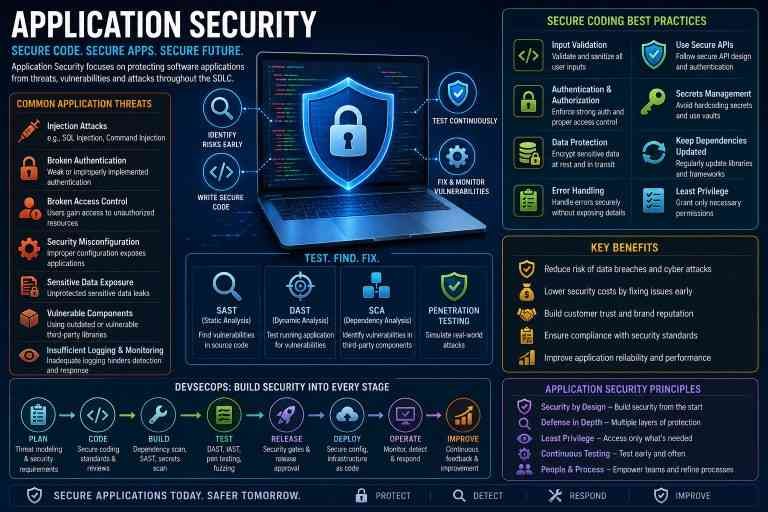
Application Security refers to the technologies, processes, and practices used to protect software applications from attacks, vulnerabilities, unauthorized access, and data breaches. Modern AppSec is no longer limited to testing an application before release. Security needs to be integrated throughout the entire Software Development Lifecycle (SDLC).
Why Application Security Matters
A vulnerable application can become an entry point into an organization’s infrastructure. Attackers may exploit weaknesses to steal sensitive information, manipulate transactions, compromise user accounts, or gain access to backend systems.
The latest OWASP Top 10:2025 continues to highlight major application risks such as Broken Access Control, Security Misconfiguration, Software Supply Chain Failures, Cryptographic Failures, Injection, Insecure Design, and Authentication Failures.
These risks demonstrate why organizations need security controls at every stage of software development rather than relying on a single security assessment.
Secure Coding Practices
Secure coding is the foundation of application security. Developers should consider security requirements while designing and implementing software instead of waiting until vulnerabilities are discovered in production.
Important practices include:
- Validating and sanitizing user input.
- Using parameterized queries to prevent SQL injection.
- Implementing strong authentication and authorization.
- Encrypting sensitive information.
- Avoiding hardcoded passwords and API keys.
- Applying the Principle of Least Privilege.
- Keeping frameworks and dependencies updated.
- Handling errors without exposing sensitive information.
Developers should also follow established security guidance such as the OWASP Top 10 and secure coding standards.
AI-Assisted Development and New Security Risks
One of the biggest application security trends in 2026 is the rapid adoption of AI coding assistants and autonomous development agents. AI can help developers generate code, identify vulnerabilities, write tests, and accelerate software delivery. However, AI-generated code should not automatically be considered secure.
Recent research has demonstrated that AI-generated software can still contain security weaknesses, including inappropriate access controls and insecure configurations.
Organizations should therefore treat AI-generated code like code written by any other source: it needs code review, automated security testing, dependency analysis, and human approval before production deployment.
Code Scanning and Automated Security Testing
Automated security testing allows organizations to detect vulnerabilities earlier and more consistently.
Common application security testing methods include:
Static Application Security Testing (SAST): Examines source code or compiled code to identify potential vulnerabilities without running the application.
Dynamic Application Security Testing (DAST): Tests running applications from an external perspective to identify exploitable weaknesses.
Software Composition Analysis (SCA): Identifies vulnerable or outdated open-source dependencies used by an application.
Interactive Application Security Testing (IAST): Combines application runtime information with security analysis to identify vulnerabilities during execution.
Integrating these tools into CI/CD pipelines helps developers identify problems before insecure code reaches production.
Penetration Testing
Automated scanning is valuable, but it cannot replace skilled security testing. Penetration testing simulates real-world attacks against applications, APIs, authentication systems, and business logic.
Security professionals may evaluate:
- Authentication and authorization
- Session management
- API endpoints
- Input validation
- Business logic
- File-upload functionality
- Access-control mechanisms
- Cloud configurations
Regular penetration testing helps organizations identify weaknesses that automated scanners may overlook.
DevSecOps: Making Security Continuous
The adoption of DevSecOps is another major trend in 2026. DevSecOps integrates security into development and operations rather than treating security as a separate stage.
Security checks can be incorporated into CI/CD pipelines so that code is automatically scanned whenever developers commit changes. Vulnerable dependencies can be identified, secrets can be detected, infrastructure configurations can be checked, and security policies can be enforced before deployment.
This “shift-left” approach allows teams to discover vulnerabilities earlier, when they are generally easier and less expensive to fix.
Application Supply Chain Security
Modern applications rarely consist entirely of code written by one development team. They depend on open-source libraries, packages, APIs, containers, cloud services, and third-party components.
A compromised dependency can introduce vulnerabilities into otherwise secure software. OWASP’s 2025 application-security framework specifically elevated Software Supply Chain Failures as a major category.
Organizations should maintain software inventories, scan dependencies, verify package integrity, monitor third-party components, and remove unnecessary libraries.
Securing AI-Powered Applications
Application security is also expanding to cover AI applications themselves. Modern applications increasingly integrate Large Language Models (LLMs), Retrieval-Augmented Generation (RAG), APIs, plugins, and autonomous agents.
OWASP’s Agentic AI security guidance identifies risks including agent goal hijacking, tool misuse, identity and privilege abuse, supply-chain vulnerabilities, and unexpected code execution.
Developers building AI-powered applications should therefore implement strong authorization, input validation, output handling, tool restrictions, logging, monitoring, and isolation.
Continuous Vulnerability Management
Finding a vulnerability is only the beginning. Organizations must prioritize, remediate, validate, and continuously monitor vulnerabilities.
A mature vulnerability-management process should include:
- Discovering vulnerabilities.
- Assessing their severity and business impact.
- Prioritizing critical risks.
- Applying security fixes.
- Testing the fixes.
- Monitoring for recurrence.
Organizations should avoid relying solely on vulnerability severity scores and consider factors such as exploitability, asset exposure, business importance, and available compensating controls.