 By
By Physical Security: Protecting People, Property, and Data in a Connected World
In today’s increasingly connected world, cybersecurity often gets the most attention. However, protecting digital systems is only one part of a complete security strategy. Physical security plays an equally important role by protecting buildings, employees, equipment, infrastructure, and sensitive information from unauthorized access, theft, damage, and physical threats.
From traditional locks and security guards to AI-powered CCTV cameras and biometric access systems, physical security is evolving rapidly. Organizations are combining traditional protection methods with smart technologies to create safer and more resilient environments.
What Is Physical Security?
Physical security refers to the measures, technologies, and procedures used to protect people, buildings, equipment, and physical resources. Its primary purpose is to prevent unauthorized individuals from entering restricted areas and to reduce risks such as theft, vandalism, fire, and unauthorized access.
Physical security is important in offices, data centers, warehouses, hospitals, schools, government buildings, financial institutions, and industrial facilities.
Key Components of Physical Security
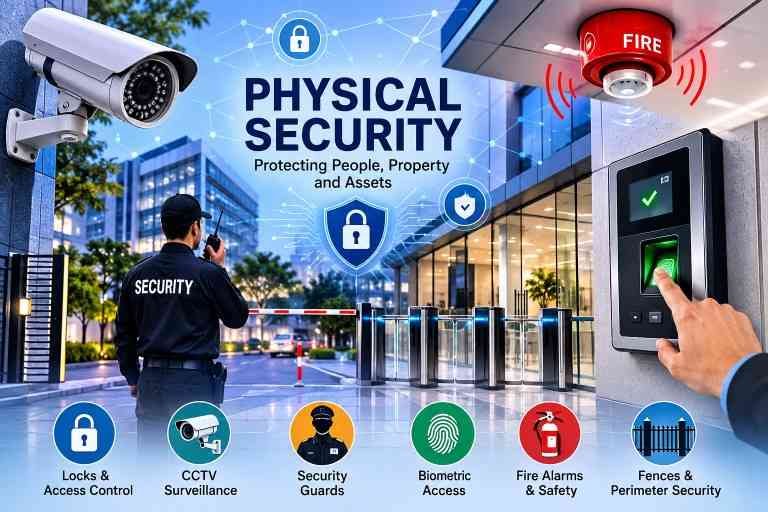
1. Locks and Access Control
Locks remain one of the most basic and effective physical security measures. Modern organizations are increasingly moving beyond traditional keys toward electronic locks, access cards, PIN-based systems, and smart locks.
Access control systems can ensure that employees only enter areas they are authorized to access, reducing the risk of unauthorized entry.
2. CCTV Surveillance
CCTV cameras have become a standard security solution for businesses and public facilities. Modern cameras can provide high-resolution video, night vision, motion detection, and remote monitoring.
Artificial intelligence is also making CCTV systems smarter. AI-powered surveillance can identify unusual activity, detect unauthorized movement, and generate alerts when predefined security conditions are triggered.
3. Security Guards
Technology cannot completely replace human security personnel. Security guards provide physical presence, monitor premises, respond to incidents, verify visitors, and handle situations that automated systems may not understand.
A combination of trained security personnel and modern surveillance technology can provide stronger protection than either approach alone.
4. Fire Alarms and Safety Systems
Physical security is not limited to preventing unauthorized access. Protecting people and property from environmental threats is equally important.
Fire alarms, smoke detectors, emergency lighting, fire suppression systems, and evacuation procedures help organizations respond quickly to fires and other emergencies. Regular testing and maintenance are essential to ensure these systems work when needed.
5. Fences and Perimeter Security
Fences, gates, barriers, and controlled entry points help protect the perimeter of a property. They create a physical boundary and make unauthorized access more difficult.
Organizations handling valuable equipment, sensitive information, or critical infrastructure may combine fencing with CCTV, motion sensors, security lighting, and controlled gates.
6. Biometric Security
Biometric authentication is becoming increasingly popular for building access. Fingerprints, facial recognition, iris scanning, and other biometric technologies can verify a person’s identity based on unique physical characteristics.
Biometrics can reduce the risks associated with lost access cards, stolen keys, or shared passwords. However, organizations must also consider privacy, data protection, accuracy, and secure storage when implementing biometric systems.
Why Physical Security Matters in the Digital Era
Physical security and cybersecurity are closely connected. A sophisticated cyberattack is not the only way sensitive information can be compromised. An unauthorized person who gains physical access to a server room, workstation, networking equipment, or storage device may create significant security risks.
For example, protecting a data center requires more than firewalls and encryption. Organizations may also need restricted entrances, surveillance cameras, biometric authentication, environmental monitoring, security personnel, and emergency response systems.
The Future of Physical Security
The future of physical security is becoming increasingly intelligent and automated. AI-powered video analytics, cloud-based access control, smart sensors, mobile credentials, and integrated security platforms are helping organizations monitor their environments more effectively.
Instead of operating independently, security systems can increasingly work together. For example, a biometric access system can communicate with CCTV cameras and access-control software to create a more complete security picture.