 By
By Critical Infrastructure Security in 2026: Protecting the Systems That Keep Society Running
Modern society depends on critical infrastructure every day. Electricity powers homes and businesses, water systems provide clean water, transportation networks move people and goods, and healthcare facilities deliver life-saving services.
Behind these essential services are increasingly complex digital and physical systems. As critical infrastructure becomes more connected, automated, and dependent on technology, it also becomes more vulnerable to cyberattacks, operational failures, and other disruptions.
In 2026, protecting critical infrastructure has become one of the most important cybersecurity priorities. Cybersecurity risks are increasingly influenced by artificial intelligence, geopolitical tensions, interconnected supply chains, and the growing convergence of Information Technology (IT) and Operational Technology (OT). The World Economic Forum has also highlighted the growing exposure of sectors such as energy, water, and transportation to cyber and cyber-physical threats.
What Is Critical Infrastructure Security?
Critical Infrastructure Security refers to the technologies, policies, processes, and security controls used to protect essential services from cyberattacks, physical threats, equipment failures, natural disasters, and operational disruptions.
Unlike a traditional IT system, a successful attack against critical infrastructure can have consequences beyond data loss. An attack against a power grid, water treatment system, hospital, or transportation network could disrupt essential services and potentially affect public safety.
For this reason, critical infrastructure security must focus on availability, safety, resilience, and rapid recovery, in addition to protecting sensitive information.
1. Securing SCADA Systems
SCADA, or Supervisory Control and Data Acquisition, systems are widely used to monitor and control industrial processes.
For example, SCADA systems may monitor electricity distribution, control water pumps, manage pipelines, or collect operational information from industrial equipment.
Because these systems interact with physical processes, SCADA security requires a specialized approach. Organizations should maintain visibility into connected assets, restrict unauthorized access, monitor unusual activity, and carefully control changes to operational systems.
Legacy equipment can also create security challenges because many industrial systems were designed for reliability and long operational lifecycles rather than modern cybersecurity requirements.
2. Protecting Industrial Control Systems
Industrial Control Systems (ICS) include the technologies used to control physical and industrial processes. These environments may contain programmable logic controllers, sensors, human-machine interfaces, engineering workstations, and other specialized devices.
One of the major security challenges in 2026 is the increasing connection between IT and OT environments. This convergence can improve operational efficiency and provide better access to data, but it can also create additional paths for cyber threats.
The World Economic Forum notes that increasing IT/OT convergence requires more advanced segmentation and improved governance to control risk exposure in industrial environments.
Organizations should therefore separate critical operational networks from standard corporate networks wherever possible. Strict access controls and monitored communication paths can help reduce the ability of attackers to move from an IT environment into critical operational systems.
3. Network Segmentation and Access Control
Network segmentation is one of the most important security measures for critical infrastructure.
Instead of allowing all systems to communicate freely, organizations can divide networks into separate zones based on operational requirements and risk levels.
For example, office computers, business applications, engineering workstations, SCADA systems, and safety-critical equipment should not necessarily share unrestricted access.
Strong identity and access management is also essential. Employees, contractors, vendors, and administrators should receive only the access required for their responsibilities. Multi-factor authentication and regular access reviews can further reduce the risk of compromised accounts.
4. Continuous Monitoring and Threat Detection
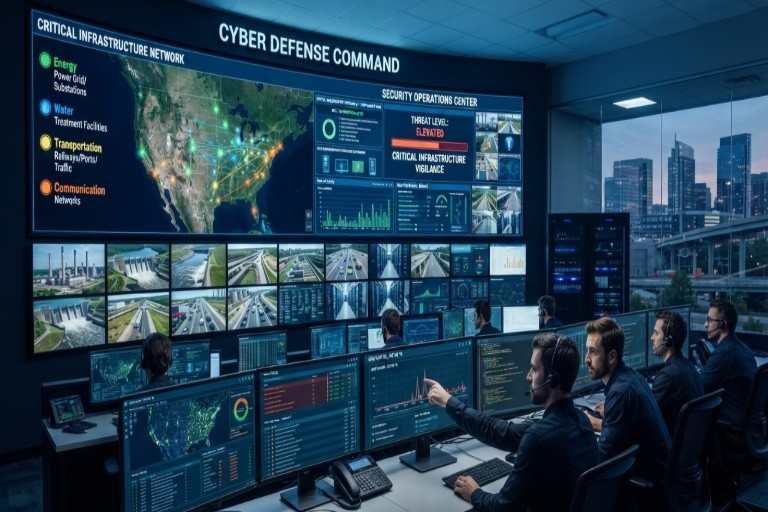
Critical infrastructure environments require continuous visibility.
Security teams need to monitor network activity, connected devices, configuration changes, remote access, and suspicious behavior. However, traditional IT security tools cannot always be deployed directly in OT environments because operational systems may be sensitive to changes or interruptions.
This makes specialized OT monitoring and passive security technologies increasingly important.
AI and automation can also help security teams analyze large volumes of security information and identify unusual activity more quickly. However, human expertise remains essential because automated responses in industrial environments must never create additional safety or operational risks.
5. Backup and Disaster Recovery
No security system can guarantee that an incident will never occur. This makes reliable backup and disaster recovery planning essential.
Organizations should maintain secure backups of critical operational configurations, system data, and other information required to restore services after a cyberattack, technical failure, or disaster.
NIST’s 2026 OT Backup Quick Start Guide emphasizes that OT backups should be integrated into change management, created regularly, tested, and reviewed during recovery exercises.
Testing is particularly important. A backup that has never been tested may not be sufficient during a real emergency. Organizations should practice recovery procedures and clearly define responsibilities before an incident occurs.
6. Building Cyber Resilience
Critical infrastructure security is increasingly focused on resilience rather than prevention alone.
Cyber resilience means preparing to withstand an incident, continue essential operations where possible, recover quickly, and learn from the event.
This requires coordination between cybersecurity teams, operational engineers, management, government agencies, technology vendors, and emergency-response teams.
Organizations should also evaluate third-party and supply-chain risks because a vulnerability in a connected vendor, software component, or service provider can potentially affect critical operations.
The Future of Critical Infrastructure Security
In 2026, critical infrastructure is becoming more intelligent, automated, and interconnected. At the same time, the boundaries between cyber threats and physical consequences are becoming increasingly blurred.
The future of infrastructure security will involve stronger IT/OT collaboration, improved asset visibility, advanced network segmentation, intelligent monitoring, Zero Trust principles, secure supply chains, and regularly tested recovery capabilities.
Artificial intelligence will support both attackers and defenders, making continuous improvement and skilled human oversight more important than ever.