


 By
By Application Security in 2026: The New Era of Software Protection
Software applications have become central to almost every business, from banking and healthcare to e-commerce and cloud services. As applications become more connected and intelligent, cyberattacks are also becoming more sophisticated. This makes Application Security (AppSec) a critical part of modern software development.
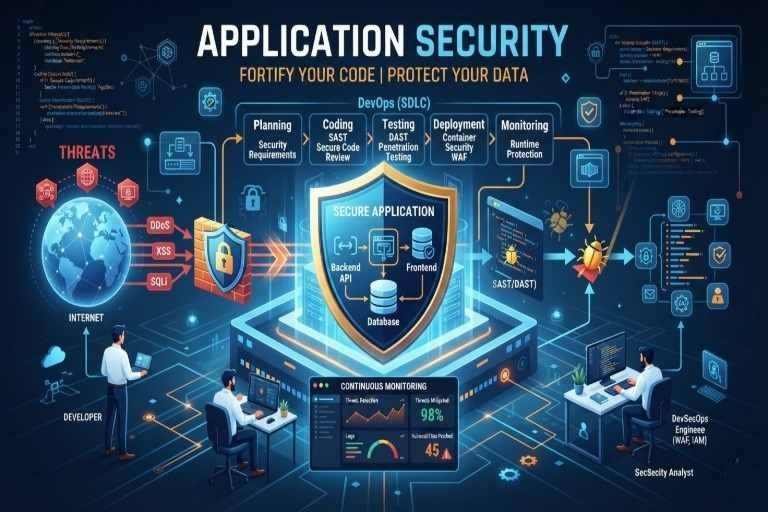
Application security focuses on protecting software from attacks, vulnerabilities, unauthorized access, and data breaches. In 2026, however, AppSec is no longer just about finding vulnerabilities after an application is built. Security is increasingly being integrated throughout the entire software development lifecycle.
Why Application Security Matters More Than Ever
Modern applications depend on APIs, cloud infrastructure, open-source libraries, third-party services, containers, and increasingly AI-generated code. Each component can introduce security risks if it is not properly designed, tested, and maintained.
Attackers are also using automation and artificial intelligence to discover vulnerabilities faster and create more convincing attacks. Organizations therefore need to move from reactive security to continuous application security, where vulnerabilities are identified and addressed before they become exploitable weaknesses.
1. Secure Coding Is the First Line of Defense
Security starts with the code itself. Developers can prevent many vulnerabilities by following secure coding practices from the beginning.
Common areas of focus include preventing SQL injection, cross-site scripting (XSS), broken authentication, insecure access controls, and improper input validation. Developers should validate user input, protect sensitive information, use strong authentication mechanisms, and follow the principle of least privilege.
AI coding assistants can improve developer productivity, but AI-generated code should not automatically be considered secure. Developers and security teams still need to review generated code for insecure dependencies, exposed secrets, improper authorization, and vulnerable coding patterns.
2. Code Scanning Becomes Continuous
Traditional security testing often happened near the end of the development process. Today, organizations are increasingly adopting automated security testing directly within development pipelines.
Static Application Security Testing (SAST) can analyze source code to identify potentially vulnerable patterns. Software Composition Analysis (SCA) can identify vulnerable open-source dependencies, while secret scanning can detect credentials or API keys accidentally committed to repositories.
When these tools are integrated into CI/CD pipelines, developers can receive security feedback while they are still writing or reviewing code. Finding a vulnerability early generally makes it easier and less expensive to fix.
3. Penetration Testing Still Has an Important Role
Automated scanning is powerful, but it cannot replace human security expertise. Penetration testing helps security professionals simulate real-world attacks against applications and APIs.
A penetration tester may attempt to bypass authentication, escalate privileges, manipulate business logic, or exploit weaknesses that automated tools might miss. Combining automated scanning with expert-led penetration testing provides a more comprehensive view of application risk.
4. Vulnerability Fixes Need to Be Prioritized
Finding vulnerabilities is only the beginning. Organizations need an effective process for deciding which issues should be fixed first.
A modern vulnerability management strategy considers factors such as severity, exploitability, exposure, business impact, and whether a vulnerability is actively being exploited. Critical vulnerabilities in internet-facing applications should generally receive urgent attention, while lower-risk findings can be addressed according to business priorities.
This approach helps security teams avoid simply creating large vulnerability reports that developers struggle to manage.
5. DevSecOps Makes Security Everyone’s Responsibility
One of the biggest trends in application security is the continued adoption of DevSecOps. Instead of treating security as a separate stage owned only by a security team, DevSecOps integrates security into development, testing, deployment, and operations.
Security checks can be automated across the software lifecycle, while developers, security professionals, and operations teams collaborate to reduce risk. This creates a security culture where vulnerabilities are addressed closer to the point where they are introduced.
The Future of Application Security
Application security is evolving rapidly. AI-assisted development, cloud-native applications, APIs, open-source dependencies, and software supply-chain risks are creating new challenges for security teams.
The organizations best prepared for these challenges will not rely on a single security tool. They will combine secure coding, automated code scanning, dependency management, penetration testing, continuous monitoring, and rapid vulnerability remediation.
Ultimately, application security is not simply about protecting software after it has been developed. It is about building security into the software from the very beginning. In 2026, organizations that make security a continuous part of development can build applications that are not only more innovative, but also more resilient against an increasingly sophisticated threat landscape.