 By
By Network Security in 2026: Protecting Connected Networks from Modern Cyber Threats
Networks are the backbone of modern digital businesses. Employees connect from offices, homes, and mobile devices, while applications, cloud platforms, IoT devices, and business systems continuously exchange information. As organizations become more connected, securing those communications has become more challenging—and more important than ever.
Network Security focuses on protecting internal and external network communications from unauthorized access, malicious activity, data theft, and service disruption. In 2026, the network security landscape is changing rapidly as attackers use automation and artificial intelligence to discover vulnerabilities and move through compromised environments faster.
Why Network Security Is More Important in 2026
The traditional idea of a secure corporate network surrounded by a strong perimeter is becoming less effective. Cloud services, remote employees, SaaS applications, mobile devices, and third-party connections have expanded the attack surface.
Modern security strategies therefore need to protect not just the network perimeter, but also users, devices, applications, identities, and data.
Recent security research highlights identity compromise, lateral movement, hybrid infrastructure, and AI-assisted attacks as important challenges for organizations.
Firewalls Remain a Critical Security Layer
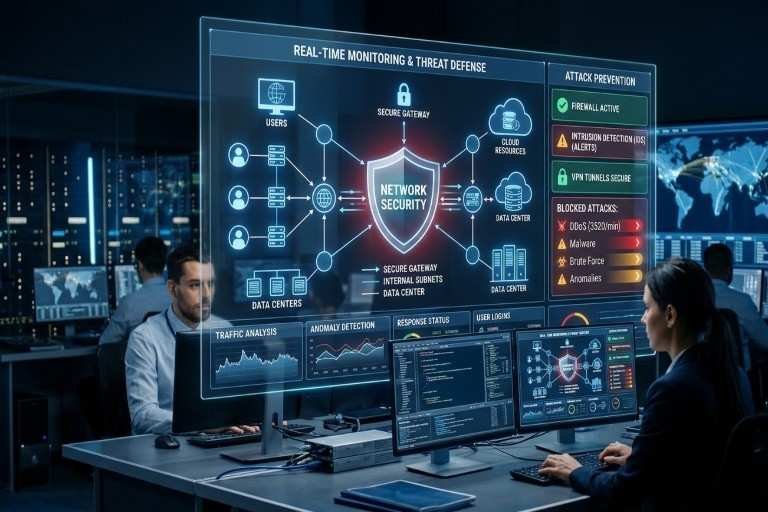
Firewalls continue to be one of the fundamental components of network security. They monitor network traffic and apply security rules to determine which connections should be allowed or blocked.
Modern Next-Generation Firewalls (NGFWs) go beyond traditional port and protocol filtering. They can provide application awareness, intrusion prevention, URL filtering, threat intelligence, and other security capabilities.
However, a firewall should not be treated as the entire security strategy. Attackers can exploit legitimate credentials or trusted connections that may pass through perimeter defenses.
IDS and IPS for Threat Detection and Prevention
Intrusion Detection Systems (IDS) and Intrusion Prevention Systems (IPS) provide another important layer of protection.
An IDS monitors network activity and alerts security teams when suspicious behavior is detected. An IPS can take the additional step of blocking or preventing malicious traffic.
As attacks become more automated, organizations increasingly need continuous monitoring and faster detection. Modern security platforms can combine network telemetry, behavioral analysis, threat intelligence, and automated response to help security teams identify suspicious activity more quickly.
Network Segmentation Limits Attackers
One of the most effective ways to reduce the impact of a breach is network segmentation.
Instead of placing every device and system on one large network, organizations can divide their environments into smaller security zones. Critical servers, employee devices, guest networks, IoT systems, and sensitive applications can have separate access controls.
Segmentation helps reduce lateral movement. If attackers compromise one device, they should not automatically be able to reach every other system.
This concept is becoming increasingly important as organizations move toward Zero Trust architectures. Security teams are focusing on limiting what users and devices can access rather than assuming that everything inside the corporate network is trustworthy.
Zero Trust Is Changing Network Security
Zero Trust has become one of the major security approaches shaping modern network architecture.
The basic principle is simple: never automatically trust a user, device, application, or connection just because it is inside the network.
Instead, access should be continuously evaluated based on factors such as identity, device security, application requirements, location, and risk.
Traditional VPNs remain useful for many environments, but organizations are increasingly evaluating Zero Trust Network Access (ZTNA) approaches that provide access to specific applications rather than broad access to an entire network.
Secure Wi-Fi and VPNs Still Matter
Wireless networks are another important part of an organization’s security strategy. Businesses should use strong encryption, modern authentication, regularly updated access points, separate guest networks, and appropriate network segmentation.
For remote workers, VPNs can provide encrypted communication between devices and organizational resources. However, VPN access should be combined with multi-factor authentication, device security controls, monitoring, and least-privilege access.
The goal is not simply to create a secure tunnel but to ensure that only authorized users and trusted devices can access the resources they actually need.
AI Is Raising the Stakes
Artificial intelligence is becoming a major factor on both sides of cybersecurity. Attackers can use AI and automation to accelerate reconnaissance, identify weaknesses, generate convincing social engineering content, and scale attacks.
At the same time, defenders can use AI to analyze network activity, identify anomalies, prioritize alerts, and automate parts of incident response.
This creates a race where speed matters. Security teams need visibility across their networks and the ability to respond quickly when unusual behavior appears.
Building a Strong Network Security Strategy
A modern network security strategy should use multiple layers rather than depend on one technology. Organizations should combine firewalls, IDS/IPS, network segmentation, secure Wi-Fi, VPN or ZTNA, identity controls, continuous monitoring, vulnerability management, and incident response.
Regular security assessments are equally important. Organizations should review firewall rules, monitor network traffic, remove unnecessary access, update network devices, test incident response procedures, and verify that critical systems are properly segmented.