

 By
By AI PCs Are Changing Computers in 2026: The Rise of Smarter, Faster and More Private Devices
The computer industry is entering a new phase in 2026 as artificial intelligence becomes a core part of modern PCs. Instead of depending entirely on cloud servers for AI-powered features, newer computers are increasingly designed to process AI workloads directly on the device. This shift is making AI PCs one of the biggest trends in computer electronics today.
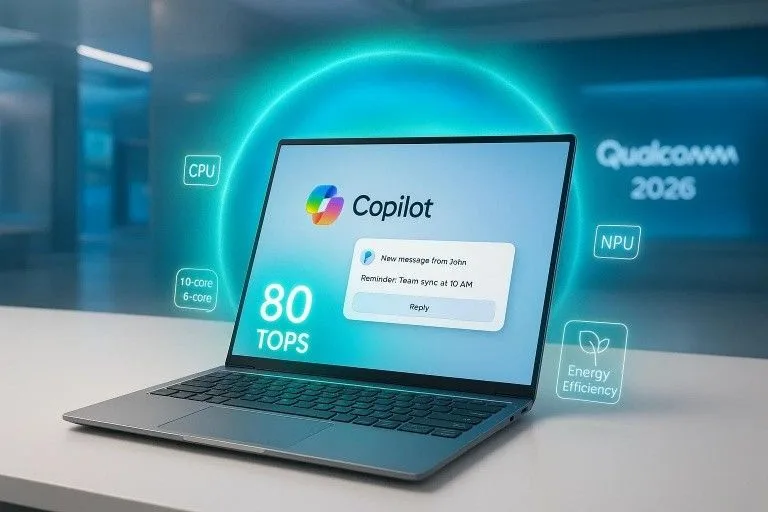
The latest generation of computers combines traditional CPU performance with GPUs and dedicated Neural Processing Units, or NPUs. These specialized components are designed to handle AI tasks more efficiently while reducing the need to send every workload to a remote server. Recent PC developments from Intel, AMD and Qualcomm demonstrate how quickly this technology is moving into mainstream laptops and desktops.
What Makes an AI PC Different?
A traditional computer primarily depends on its CPU and GPU for processing. An AI PC adds a dedicated NPU that is optimized for artificial-intelligence workloads.
This hardware can support tasks such as background-noise removal during video calls, automatic image enhancement, real-time transcription, language processing and other AI features. Because some of these tasks can happen locally, users can potentially experience faster responses while reducing dependence on an internet connection.
Microsoft’s Copilot+ PC ecosystem has also helped push dedicated AI hardware into the laptop market. Manufacturers are now building computers around processors specifically designed to handle AI workloads efficiently.
Intel, AMD and Qualcomm Increase the Competition
The AI PC market is becoming increasingly competitive. Intel’s latest Core Ultra processors, AMD’s Ryzen AI family and Qualcomm’s Snapdragon X platforms all emphasize dedicated AI processing.
Recent reports indicate that Intel’s newer Core Ultra X9 systems are appearing in retail hardware, while AMD’s Ryzen AI processors and Qualcomm’s Snapdragon X2 platforms are competing for the growing AI-PC market. Qualcomm has also been promoting local, agentic AI experiences on Snapdragon-powered PCs.
This competition is important because consumers are no longer choosing computers only by CPU speed, RAM or storage. AI processing capability is becoming another specification to consider.
AI Is Moving From the Cloud to the Computer
One of the most interesting developments is the growth of on-device AI.
In the past, many AI services required users to send information to cloud servers. Modern AI PCs can perform an increasing number of tasks directly on the computer. This can be particularly useful for users who work with sensitive documents, create content or frequently travel without reliable internet access.
Local processing can also reduce latency because information does not always need to travel between the computer and a remote data center before a result is produced.
However, cloud computing will continue to play an important role. Large AI models and computationally intensive workloads can still require powerful remote infrastructure. The emerging PC market is therefore becoming a combination of local and cloud-based AI rather than a complete replacement of one by the other.
Better Battery Life Is Another Major Goal
AI PC development is not only about adding artificial intelligence. Manufacturers are also trying to improve efficiency.
Dedicated NPUs can handle certain AI workloads without placing the same processing demand on the CPU or GPU. This can potentially help laptops perform AI-related functions while using less power.
Battery life has already become a major differentiator between modern laptop platforms. Recent testing of 2026 Windows laptops shows that some systems can deliver very long battery runtimes, demonstrating how processor architecture, display technology and software optimization are becoming increasingly important together.
What This Means for Computer Users
For students, professionals, developers and creators, AI PCs could change everyday computer workflows.
A laptop may increasingly be able to summarize meetings, organize information, improve photographs, translate conversations, assist with writing and perform other tasks without requiring separate applications for every function.
Gaming and creative computing are also evolving. Powerful GPUs remain important for demanding graphics workloads, while AI acceleration can support features such as image generation, video enhancement and intelligent editing.
The growing availability of local AI applications is another sign of this transition. For example, a recent Windows release of Perplexity’s local AI agent supports compatible Nvidia RTX systems with at least 24GB of VRAM, showing how demanding AI applications are beginning to take advantage of PC hardware directly.
The Future of Computers Is Becoming More Intelligent
The computer market in 2026 is moving beyond the traditional race for faster processors. AI capability, power efficiency, local processing and intelligent software are becoming equally important parts of the PC experience.
As Intel, AMD, Qualcomm, Nvidia and computer manufacturers continue developing AI-focused hardware, users can expect more applications to take advantage of dedicated AI processing.
The biggest change may be that AI eventually becomes less noticeable. Instead of opening a separate AI application, users may simply find that their computer automatically understands their workflow and helps complete everyday tasks.
For the electronics industry, that represents a major transformation: the computer is evolving from a device that simply runs software into a device that can increasingly understand, process and assist with the user’s work locally.