

 By
By AI PCs in 2026: How Smarter Computers Are Changing the Way We Work
The computer industry is entering a new phase in 2026 as artificial intelligence becomes a core part of personal computing. For decades, improvements in computers were largely measured by processor speed, graphics performance, memory and storage. Today, manufacturers are adding another important capability: dedicated hardware designed specifically to accelerate AI tasks.
This shift is creating a new category of devices commonly known as AI PCs. These computers combine traditional CPUs and GPUs with neural processing units, or NPUs, allowing certain AI workloads to run directly on the device.
What Makes an AI PC Different?
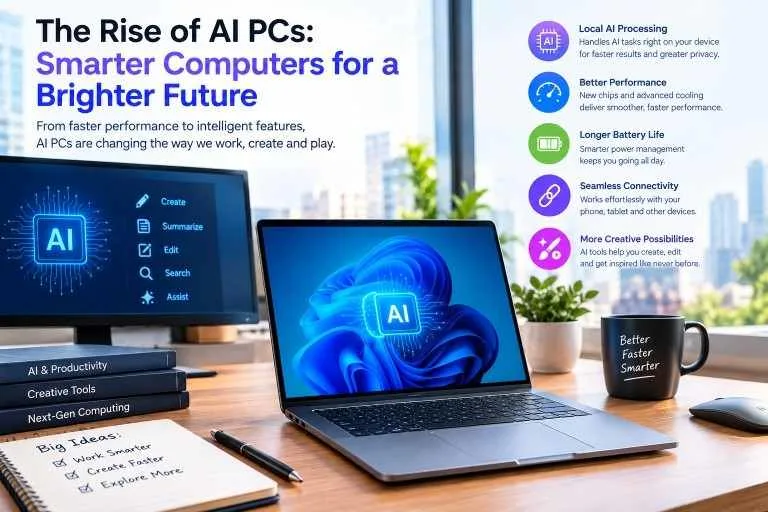
A traditional laptop can run AI applications through its CPU or GPU, but an AI PC includes dedicated hardware for specific machine-learning workloads. NPUs are designed to perform these tasks efficiently while potentially consuming less power than running the same workloads entirely on a CPU or GPU.
This means AI features can become part of everyday computer experiences. Users can encounter AI-powered tools for writing, summarizing documents, searching information, improving video calls, editing images and managing workflows.
Microsoft, Intel, AMD, Qualcomm and other technology companies have been developing hardware and software platforms around this trend. Windows PCs equipped with dedicated AI acceleration are increasingly designed to support AI features directly on the computer rather than depending exclusively on cloud processing.
Local AI Is Becoming More Important
One of the biggest trends in computing is local AI processing. Instead of sending every request to an online server, compatible AI workloads can be processed directly on a laptop or desktop.
Local processing can provide several potential advantages. Applications may respond more quickly because information does not always need to travel to a remote server. It can also be useful when internet connectivity is limited. For businesses and professionals handling sensitive information, keeping certain workloads on the device can provide additional control over where data is processed.
Apple is also emphasizing local AI capabilities in its latest Macs. The company has highlighted AI performance in its newest Mac mini and Mac Studio systems, showing how powerful desktop computers can be used for demanding AI development and workloads.
AI PCs Are Becoming More Useful for Creators
Content creators are another major audience for AI-powered computers. Video editors, photographers, designers and developers increasingly use AI tools as part of their everyday workflows.
A powerful AI PC can assist with tasks such as image generation, video enhancement, background removal, transcription, noise reduction and coding assistance. Dedicated AI hardware can help applications perform some of these operations more efficiently.
At the same time, powerful GPUs remain important. Generative AI applications, 3D rendering and advanced video editing can require substantial graphics processing power, meaning modern creator computers increasingly combine CPUs, GPUs and NPUs rather than relying on one component.
Battery Life Remains a Key Focus
Performance is only one part of the AI PC story. Laptop manufacturers are also trying to make computers more efficient.
Dedicated AI processors can handle certain workloads without placing as much demand on the CPU or GPU. Combined with more efficient processor architectures and improved power management, this can help manufacturers design laptops that balance performance with battery life.
This is especially important for students, professionals and people who frequently work away from a desk. A computer that can deliver useful AI features while maintaining good battery endurance has the potential to become a more practical everyday device.
AI Is Also Changing the User Experience
The most noticeable change may ultimately come from software rather than hardware.
Instead of opening a separate AI application whenever they need assistance, users are increasingly seeing AI integrated directly into operating systems and everyday programs. AI can help summarize information, organize content, search files, improve communications and automate repetitive tasks.
This could gradually change the way people interact with computers. Rather than simply clicking through menus and applications, users may increasingly describe what they want and allow software to complete multiple steps.
What Comes Next for Computers?
The AI PC trend is still developing, and not every computer user needs the same level of AI performance. Traditional processors, graphics capabilities, RAM and storage remain important when choosing a computer.
However, the direction of the industry is clear: AI is becoming part of the fundamental architecture of modern computers.
As chips become more efficient and software developers create more applications that take advantage of NPUs, AI features are likely to become increasingly common across laptops, desktops and mini PCs.
In 2026, the computer is evolving from a machine that simply runs applications into a device that can increasingly assist, analyze, create and automate. AI PCs are still at an early stage, but they are already influencing how the next generation of personal computing is being designed.