

 By
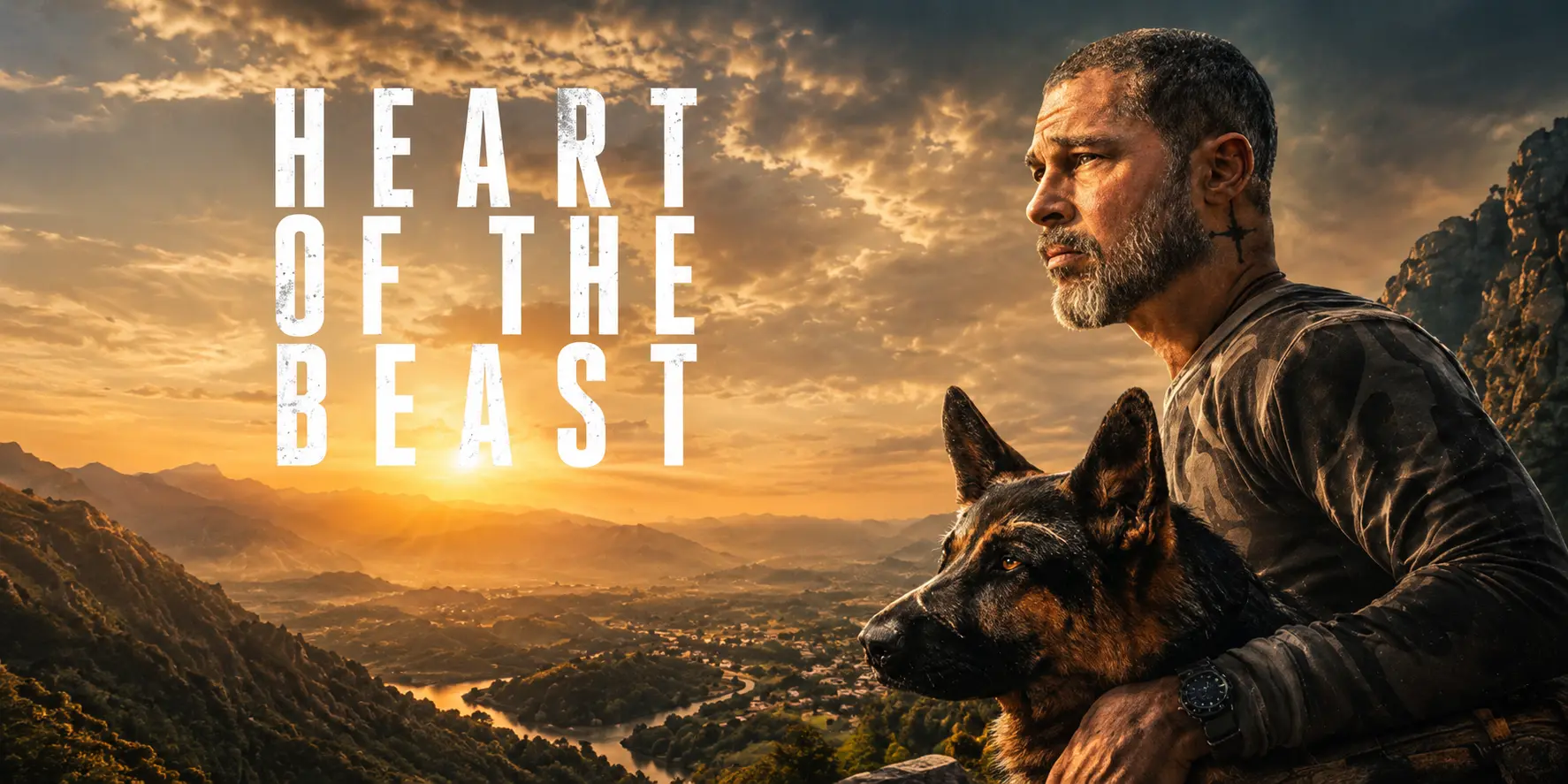
By Heart of the Beast is a 2026 survival adventure thriller directed by David Ayer, starring Brad Pitt, J.K. Simmons and Anna Lambe, with the German Shepherd Odin at the centre of the story. The film follows retired Special Forces veteran James Belmont and his combat dog after a plane crash leaves them stranded in the Alaskan wilderness. The film was released in India on September 25, 2026, and has a runtime of around 1 hour 41 minutes.
Rather than being just another wilderness survival movie, Heart of the Beast places its emotional focus on the relationship between a wounded veteran and the dog who has been with him through war. The result is a film that combines survival, action, trauma and an unusually strong man-and-dog bond.
Story & Concept
The story follows James Belmont, a retired Special Forces veteran, who travels into the remote Alaskan wilderness with Odin, his former combat dog.
Their peaceful trip quickly turns into a fight for survival when James suffers a medical emergency and the plane crashes. Stranded far from civilisation, the pair must travel through dangerous terrain while dealing with injuries, extreme weather and wild predators.
What makes the story different is that James isn’t simply trying to save himself. Odin is equally important to his survival, and their relationship becomes the heart of the movie.
The film gradually reveals that both James and Odin are carrying physical and emotional scars from their military past.
Performance
Brad Pitt gives a restrained performance as James.
Instead of relying on the typical larger-than-life action-hero style, Pitt plays the character as physically exhausted, emotionally damaged and quietly determined. Much of his performance depends on facial expressions and his interactions with Odin rather than long dialogue scenes.
But the biggest surprise of the film is Odin.
The dog becomes an important character rather than simply an animal accompanying the hero. Critics have particularly praised the believable chemistry between Pitt and the dog, with Odin providing many of the film’s most emotional moments.
J.K. Simmons also appears as Walter Boone, while Anna Lambe has a supporting role.
Screenplay & Direction
Director David Ayer, who previously worked with Brad Pitt on Fury, keeps the film relatively straightforward.
The screenplay doesn’t try to overload the story with unnecessary characters or complicated subplots. Instead, it concentrates primarily on James and Odin’s journey.
That simplicity works in the film’s favour, particularly during the quieter moments. However, the basic survival story is also familiar, and some developments can feel predictable.
The emotional relationship between the two leads is what gives the otherwise conventional survival formula its identity.
Survival & Action
The wilderness provides most of the film’s action.
James and Odin have to deal with injuries, harsh weather, difficult terrain, bears and wolves, while attempting to travel a long distance back toward civilisation.
The action sequences are not constant, but when danger arrives, the film becomes considerably more intense.
The survival situations also work because the film doesn’t make James completely invincible. His injuries and physical limitations make the journey feel more difficult.
James & Odin’s Bond
This is easily the strongest part of the movie.
James and Odin aren’t simply owner and pet. They are both veterans who have experienced war and carry scars from their past.
The film spends time showing their quiet companionship, which makes the later survival sequences more emotionally effective.
Small moments between them—rather than the bigger action scenes—are often where the movie works best. Critics have repeatedly highlighted this relationship as the film’s emotional centre.
Emotional Elements
Heart of the Beast deals with trauma, healing, loyalty and companionship.
James is dealing with the psychological consequences of his military past, while Odin has also been physically affected by his time as a combat dog.
The wilderness becomes more than just a dangerous setting. It gives James an opportunity to confront his past and rebuild his connection with Odin.
The film can become sentimental at times, but that emotional approach is central to what it is trying to achieve.
Cinematography & Visuals
The wilderness photography is another strong element.
Although the story is set in Alaska, much of the film was filmed in New Zealand, which provides sweeping landscapes, forests, rivers and mountains that give the movie a large cinematic scale.
The contrast between the beautiful landscape and the dangerous situations works particularly well.
Some of the digitally created wildlife has been criticized for looking less convincing than the rest of the film’s visuals.
Pacing & Runtime
At around 101 minutes, the film is relatively short for a modern survival adventure.
That helps the movie avoid becoming unnecessarily stretched.
The opening establishes James and Odin fairly quickly, while the survival journey keeps the narrative moving. There are quieter stretches, but they are generally used to develop the relationship between the two characters.
Some repetition does appear during the survival portions, but the compact runtime keeps the movie from becoming overly lengthy.
Second Half & Climax
The second half increases the survival stakes as James and Odin become more physically exhausted and encounter greater dangers.
The film increasingly focuses on whether the two will be able to make it out of the wilderness alive.
The climax is designed more around emotional payoff and survival than a massive action spectacle. This keeps the film consistent with its character-driven approach.
For viewers expecting a nonstop Brad Pitt action movie, the restrained approach may be unexpected. But for those invested in James and Odin’s relationship, the final stretch carries considerably more emotional weight.
What Works
- Brad Pitt’s restrained performance
- Excellent bond between James and Odin
- Strong canine performance
- Beautiful wilderness cinematography
- Emotional story
- Effective survival sequences
- Short and manageable runtime
- David Ayer’s grounded direction
- Themes of trauma, loyalty and healing
- Strong balance between action and emotion
What Doesn’t Work
- Familiar survival-movie storyline
- Some predictable developments
- Occasional repetition
- Certain CGI wildlife sequences look artificial
- Emotional moments can become overly sentimental
- Limited supporting-character development
- Some war flashbacks feel repetitive
Final Verdict
Heart of the Beast isn’t trying to reinvent the survival genre. Instead, it takes a familiar survival setup and builds it around one simple idea: the bond between a man and his dog can become a source of strength when everything else is taken away.
Brad Pitt gives the film a grounded lead performance, but Odin is arguably the real scene-stealer. Their relationship provides the movie with its strongest emotional moments and makes the survival journey more meaningful.
The film does have familiar storytelling and a few visual effects that don’t completely convince, but its compact runtime, beautiful landscapes, survival sequences and emotional core make it an engaging watch.
Overall Rating: 3.5/5
Story: ⭐⭐⭐½
Screenplay: ⭐⭐⭐
Performances: ⭐⭐⭐⭐
Action: ⭐⭐⭐½
Emotions: ⭐⭐⭐⭐
Survival Elements: ⭐⭐⭐½
Cinematography: ⭐⭐⭐⭐
Direction: ⭐⭐⭐½
Climax: ⭐⭐⭐½
Entertainment: ⭐⭐⭐½
Overall: ⭐⭐⭐½
Verdict: A heartfelt survival drama carried by Brad Pitt’s understated performance and an unforgettable bond between a veteran and his loyal combat dog. It may follow a familiar formula, but the emotional connection gives Heart of the Beast its bite.