 By
By Computers Are Entering a New AI-Powered Era
The computer industry is undergoing another major transformation in 2026. Instead of focusing only on faster processors, larger storage and better displays, manufacturers are increasingly designing computers around artificial intelligence that runs directly on the device.
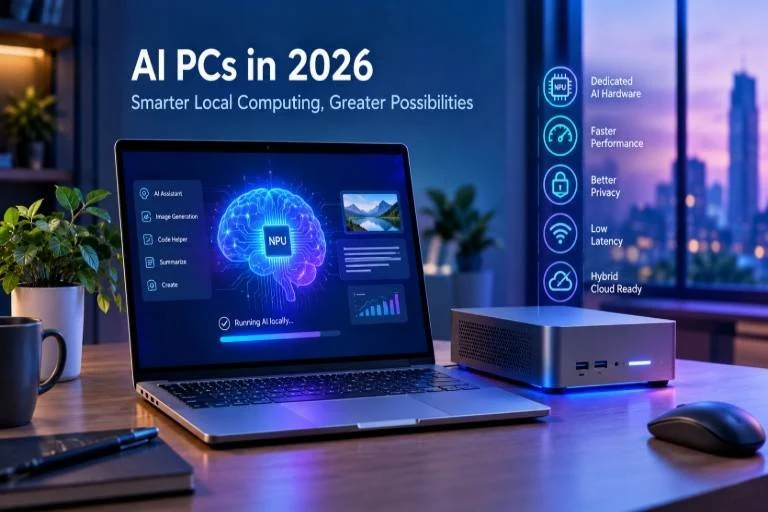
This shift toward local AI is becoming one of the most important trends in the PC market. Modern laptops and desktops increasingly include dedicated Neural Processing Units, or NPUs, designed to handle AI workloads without sending every task to a cloud server. Microsoft says its Copilot+ architecture uses dedicated AI hardware to run supported AI experiences locally on Windows devices.
Local AI Is Becoming the New Computer Feature
For years, AI services were primarily associated with cloud computing. Users sent requests to remote servers, where powerful data-center hardware processed them before returning a result.
That model is changing.
New generations of processors from companies such as Qualcomm, Intel, AMD and NVIDIA are designed to perform more AI processing on personal computers. This can potentially improve response times, reduce dependence on internet connectivity and provide greater control over certain types of data.
Microsoft’s latest Surface Pro and Surface Laptop models, announced in September, use Qualcomm’s Snapdragon X2 Plus processor. Microsoft says the new devices provide up to 95% faster on-device AI performance compared with the previous generation while maintaining a lightweight design.
The “AI PC” Label Is Changing
Interestingly, the computer industry is also changing how it talks about AI computers.
Microsoft and PC manufacturers have recently reduced their use of the Copilot+ PC branding. Reports published in late September say Microsoft’s newest Surface devices meet the underlying hardware requirements but are no longer prominently marketed using the Copilot+ PC label.
This does not mean AI capabilities are disappearing from computers. Instead, it may indicate that AI hardware and software are becoming a normal part of modern PCs rather than something that needs a separate marketing label.
The technology is increasingly becoming part of the computer itself.
Powerful Chips Are Driving the Change
Processor design is also evolving rapidly. New computer platforms are combining traditional CPU performance with GPUs and specialized AI accelerators.
NVIDIA, for example, has introduced its RTX Spark platform for Windows PCs designed around personal AI workloads. NVIDIA says the platform is built for personal AI agents and can provide up to one petaflop of AI performance with as much as 128GB of unified memory.
This demonstrates how the traditional definition of a personal computer is expanding. A modern PC is no longer simply a machine for browsing websites, running office applications or playing games. It can increasingly serve as a local platform for AI assistants, content creation, coding and other demanding workloads.
Why Local AI Matters for Users
Local processing can offer several practical advantages. AI tasks performed directly on a computer can potentially reduce latency because information does not always have to travel to a remote server.
Privacy is another important consideration. Microsoft describes its on-device AI components as supporting locally executed AI experiences, although the privacy benefits depend on the specific application and how it handles data.
For professionals, developers and creators, local AI could also reduce dependence on subscription-based cloud computing for certain workloads.
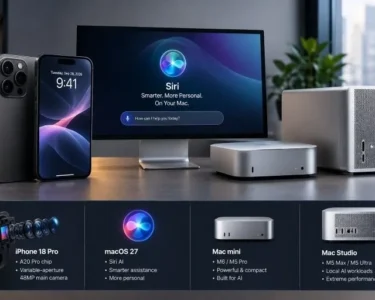
Apple is pursuing a similar direction with its latest high-performance Mac mini and Mac Studio computers. Reuters reported that Apple is positioning these machines for demanding AI workloads that can be processed locally rather than continually relying on cloud-based AI services.
What Comes Next for Computers?
The next stage of the PC market is likely to focus less on simply asking whether a computer is an “AI PC” and more on what its AI hardware can actually do.
Processor efficiency, NPU performance, memory capacity, battery life, security and software optimization will all become increasingly important when choosing a computer.
The biggest computer trend of 2026 is therefore not just the arrival of AI. It is the movement of AI from distant data centers toward the devices people use every day.
As processors become more capable and software becomes better optimized, laptops and desktops are evolving into intelligent computing platforms. The result could be a new generation of computers that are faster, more personalized and increasingly capable of handling AI tasks directly on the user’s desk.