

 By
By AI PCs Are Changing Computers in 2026: What’s Next for Laptops and Desktops?
The computer industry is entering another major transformation in 2026, and artificial intelligence is at the center of it. Instead of depending entirely on cloud servers for AI-powered features, modern laptops and desktops are increasingly being designed to process AI workloads directly on the device.
Recent industry analysis from IDC says AI has become a core design consideration across device categories, with companies including AMD, Qualcomm and Acer developing systems around local or on-device AI processing.
This shift is changing what consumers look for when buying a new computer. Processor speed, RAM and storage remain important, but AI performance, battery efficiency and dedicated neural-processing hardware are becoming increasingly significant.
What Makes an AI PC Different?
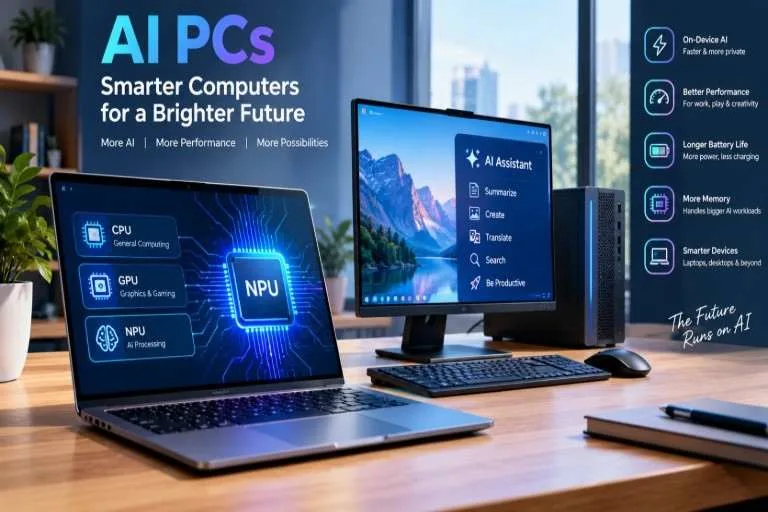
Traditional computers primarily depend on CPUs and GPUs for everyday computing. AI PCs add another important component: a dedicated Neural Processing Unit, commonly called an NPU.
An NPU is designed specifically for certain AI workloads. Instead of sending every AI task to a remote data center, compatible software can process some tasks locally. This can reduce dependence on an internet connection and potentially improve responsiveness and privacy for supported applications.
Qualcomm has been particularly active in this area. The company says its Snapdragon X Series PCs can support agentic AI applications that perform tasks locally, highlighting a move toward computers that can do more than simply respond to individual commands.
AI Is Moving Closer to the User
One of the most interesting developments is the growth of local AI. AI assistants, image-generation tools, transcription, translation and other workloads can increasingly be handled directly by the computer.
This does not mean cloud computing is disappearing. Large AI models still require enormous computing resources, and cloud services remain important for many advanced applications. Instead, the emerging model is a combination of cloud and local processing.
For everyday users, this could mean faster responses for supported features, reduced data transmission and greater functionality when internet connectivity is limited.
New Competition in PC Processors
The processor market is also becoming more competitive. Intel, AMD and Qualcomm are all developing platforms designed to improve performance while supporting increasingly demanding AI workloads.
Intel’s Core Ultra Series 3 processors, for example, are appearing in business-focused laptops with features designed around performance, battery life and enterprise management.
Meanwhile, recent testing reported by Windows Central showed Qualcomm’s Snapdragon X2 Elite competing strongly against Intel and AMD processors in several laptop workloads, including CPU performance, AI tasks and battery efficiency. The study was commissioned by Qualcomm, so its results should be considered in that context.
The competition gives consumers more choices, particularly between traditional x86-based Windows computers and newer Arm-based systems.
Memory Is Becoming a Major Issue
Performance is only one side of the story. The PC industry is also dealing with pressure in the memory market.
Recent industry reports point to AI infrastructure demand putting pressure on memory production, while shortages and rising prices are affecting consumer electronics.
This matters because AI applications can require substantial amounts of memory. As computers become more capable of running AI models locally, manufacturers may need to offer higher-memory configurations.
For consumers, that could make RAM capacity an increasingly important consideration when purchasing a laptop or desktop.
Smaller Computers Are Getting More Powerful
Another interesting trend is the development of compact computers capable of handling increasingly demanding workloads.
A recently unveiled industrial mini PC using Intel’s Panther Lake platform combines a compact design with high memory capacity and an unusual solid-state cooling system. The manufacturer claims the system can operate below 21 dBA while being thinner and lighter than comparable actively cooled systems.
This demonstrates how improvements in processors, cooling and AI acceleration are allowing powerful computing hardware to fit into smaller devices.
What Should Computer Buyers Expect?
For consumers shopping for a computer in 2026, specifications are becoming more complicated. A laptop with a fast CPU is no longer automatically the best option for every workload.
Buyers should consider the type of software they use, whether they need local AI capabilities, battery requirements, graphics performance, memory capacity and compatibility with their preferred applications.
Students and office users may prioritize battery life and portability, while creators and gamers may need powerful GPUs and larger memory configurations. Developers and AI enthusiasts may place greater emphasis on processor architecture, NPU performance and RAM.