

 By
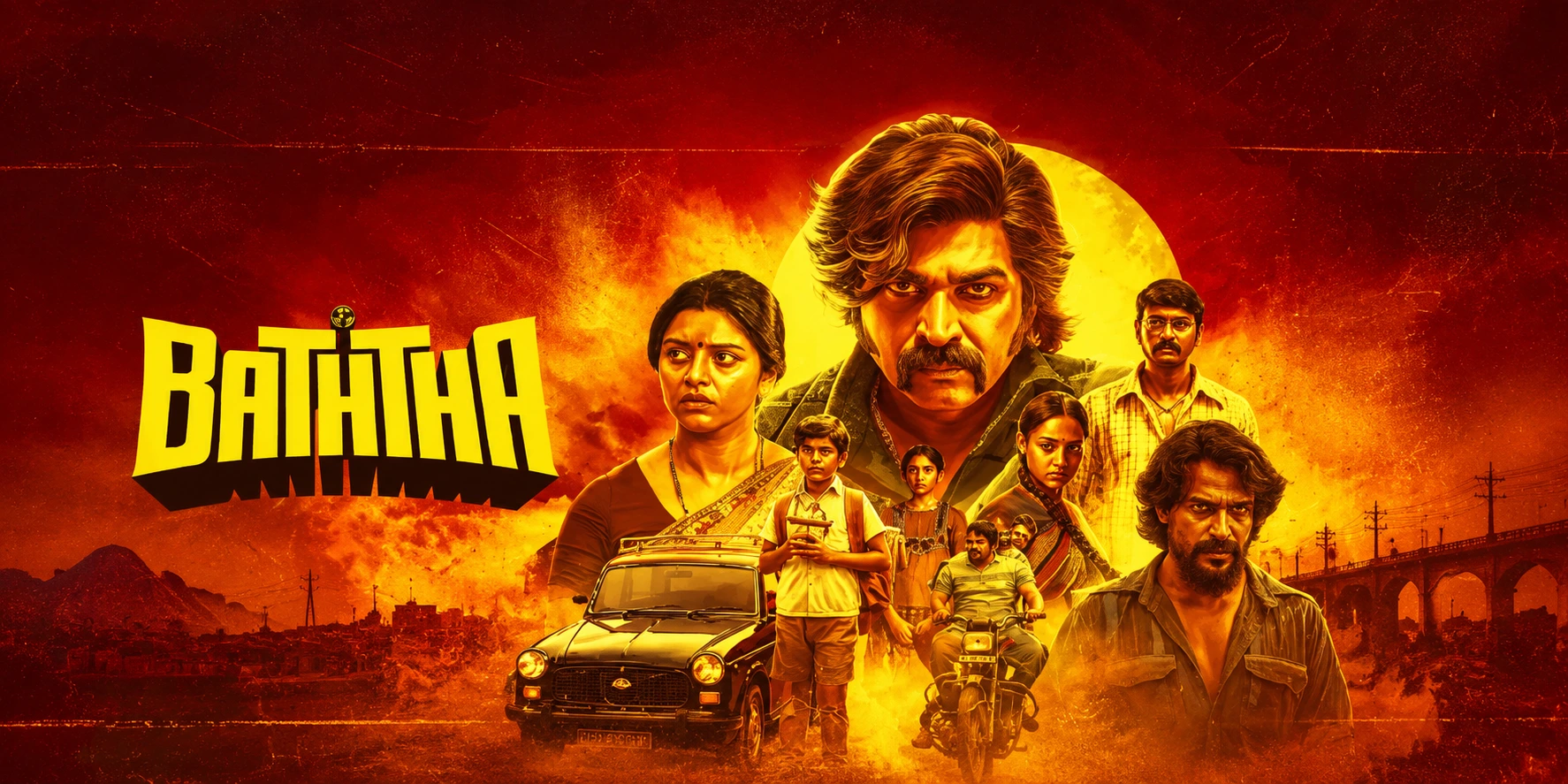
By Baththa is a 2026 Tamil comedy-drama directed by Balaji Tharaneetharan and starring Vijay Sethupathi, Sai Prithviraj, Lijomol Jose, Santhy Balachandran and others. Set in 1986 Madras, the film revolves around a feared local gangster whose life takes an unexpected turn after an eight-year-old boy accidentally locks him inside a school restroom. The film released in theatres on October 1, 2026, and runs for around 2 hours 39 minutes. Sai Abhyankkar composes the music, while Selvakumar handles the cinematography.
Unlike a conventional gangster film, Baththa uses its crime-world setting to tell a much more personal story about friendship, family, guilt and redemption. The film has received largely positive reviews for Vijay Sethupathi’s performance, the chemistry between him and the child actor, humour, emotional writing and period atmosphere. The main criticism is that the pacing slows in places, particularly toward the climax, while the tonal shifts between comedy and drama can occasionally feel uneven.
Story & Concept
Set in 1986 Madras, Baththa is introduced as a feared local gangster who has built his reputation through violence and intimidation. People are scared of him, and even his own family struggles with his aggressive personality.
Everything changes when eight-year-old Sabari accidentally locks Baththa inside a deserted school restroom. What initially looks like a simple comic situation gradually becomes the emotional heart of the movie.
The unusual relationship between a hardened gangster and an innocent child allows the film to explore how isolation and vulnerability can force a person to look at himself differently. The simple premise becomes a story about human connection rather than just crime and violence.
Performance
Vijay Sethupathi is the biggest strength of Baththa. He gets to play a character who is intimidating on the outside but increasingly vulnerable as the story progresses. The transformation is handled without turning Baththa into a completely different person overnight.
The young Sai Prithviraj is equally important. His natural performance and interactions with Vijay Sethupathi provide much of the film’s humour and emotional weight. Several reviews have specifically highlighted the boy’s performance as one of the film’s major positives.
Lijomol Jose also makes an impression as Baththa’s wife, particularly in scenes showing the consequences of his behaviour toward his family.
Screenplay & Direction
Balaji Tharaneetharan keeps the central premise surprisingly simple. Instead of turning the restroom situation into a gimmick, he uses it as a device to strip away Baththa’s gangster persona.
The screenplay also plants several small details early on and brings them back later, giving the narrative a sense of payoff. This approach has been praised for allowing the emotional transformation to develop naturally rather than relying entirely on melodramatic dialogue.
The major weakness is that the film occasionally stretches scenes after the emotional high point has already been achieved.
Comedy & Entertainment
The humour in Baththa largely comes from the contrast between the terrifying gangster image and his helpless situation.
The interactions between Baththa and Sabari generate several genuinely funny moments without completely destroying the emotional tone. The comedy is more character-driven than dependent on conventional one-liners.
However, the film’s tonal movement between humour, family drama and gangster elements can occasionally feel uneven.
Emotional Elements
This is where Baththa makes its biggest impact.
The bond between Baththa and Sabari gradually becomes more meaningful, while Baththa’s relationship with his wife and daughter reveals the damage caused by his violent lifestyle.
Rather than simply asking whether a gangster can become a good man, the film focuses on whether he can finally recognise the consequences of the person he has become. The emotional moments work because they are built through character interactions instead of forced sentimentality.
Music & Cinematography
Sai Abhyankkar’s music contributes significantly to the film’s period atmosphere and emotional sequences. Some reviews have praised the score, although there has also been criticism that the music does not always perfectly match the film’s tone.
Selvakumar’s cinematography effectively recreates the look and atmosphere of 1980s Madras. The period setting feels lived-in rather than merely decorative, helping the film maintain its nostalgic character.
Pacing & Runtime
At around 2 hours 39 minutes, Baththa is fairly long for a story built around such a simple central premise.
The film takes some time to establish Baththa and his world, but the narrative becomes more engaging once the central situation develops. The bigger pacing issue arrives toward the climax, where several scenes attempt to extend the emotional payoff.
Second Half & Climax
The second half brings together the emotional threads established earlier and gives greater importance to Baththa’s relationship with Sabari and his family.
The character transformation is satisfying, but the film slightly loses momentum after one of its major emotional reveals. Some subsequent scenes feel like they are trying to recreate an emotional peak that has already been achieved, making the climax feel somewhat stretched.
What Works
- Vijay Sethupathi delivers a layered and controlled performance
- Sai Prithviraj is excellent as Sabari
- Unique friendship between a gangster and a child
- Natural combination of humour and emotion
- Strong character transformation for Baththa
- Effective 1980s Madras atmosphere
- Good cinematography and production design
- Emotional scenes feel earned rather than overly melodramatic
- Balaji Tharaneetharan’s simple but distinctive storytelling
What Doesn’t Work
- Long runtime for a relatively simple premise
- Opening portions take time to settle
- Some tonal shifts between comedy and drama feel uneven
- Second half occasionally loses momentum
- Climax feels stretched after the major emotional reveal
- Music doesn’t always blend perfectly with the film’s changing tones
Final Verdict
Baththa is a warm and surprisingly emotional gangster drama that uses an unusual friendship to explore redemption, family and the possibility of change. Vijay Sethupathi is excellent as the intimidating yet vulnerable Baththa, while Sai Prithviraj gives the film its innocence and emotional centre.
The film isn’t completely flawless. Its lengthy runtime, occasional tonal imbalance and slightly stretched climax prevent it from being consistently tight. Still, Balaji Tharaneetharan succeeds in turning a simple premise into an engaging character-driven story with plenty of humour and heart.
Overall Rating: 3.5/5
Story: ⭐⭐⭐⭐
Screenplay: ⭐⭐⭐½
Performances: ⭐⭐⭐⭐½
Direction: ⭐⭐⭐⭐
Emotional Impact: ⭐⭐⭐⭐
Comedy: ⭐⭐⭐½
Music: ⭐⭐⭐½
Cinematography: ⭐⭐⭐⭐
Pacing: ⭐⭐⭐
Climax: ⭐⭐⭐
Overall: ⭐⭐⭐½
Verdict: Baththa is a heartfelt and entertaining gangster drama powered by Vijay Sethupathi and a wonderful child performance, with humour, emotion and nostalgia outweighing its pacing issues.