 By
By Volcano boarding has become one of Nicaragua’s most recognizable adventure-travel experiences, especially on the dark volcanic slopes of Cerro Negro near León. Instead of snow or ordinary sand, the activity involves descending loose volcanic material on a specially designed board. The dramatic black landscape and unusual setting have helped images and videos of the activity spread widely across travel media and social platforms. However, volcano boarding is an extreme activity with genuine injury risks, and Cerro Negro itself is an active volcano, so it should be understood as more than just a viral travel trend.
What Is Volcano Boarding?
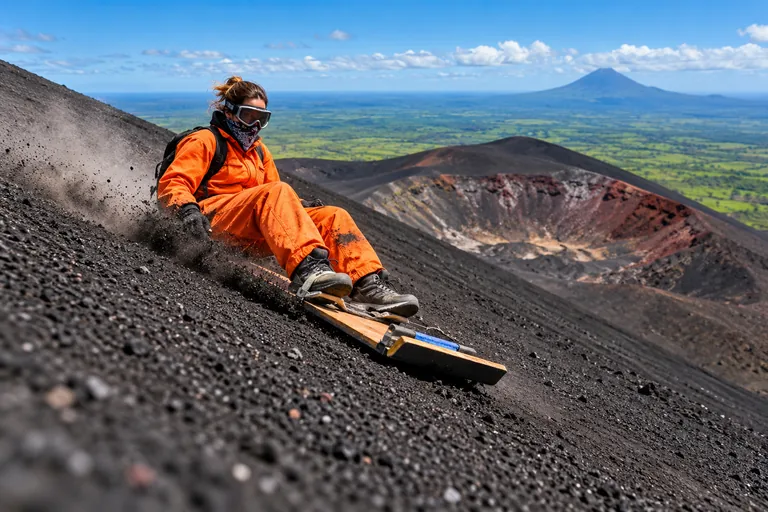
Volcano boarding is similar in concept to sandboarding, but it takes place on slopes formed from volcanic ash, cinders and other loose volcanic material. Cerro Negro has become particularly associated with the activity because its steep, largely vegetation-free slopes create the distinctive black landscape seen in many photographs.
León’s tourism information describes the activity as volcano boarding, sandboarding or surfing on volcanic sand. It also classifies it as an extreme-action sport and warns that it can be dangerous. VISIT LEÓN
Participants commonly use boards designed for the volcanic terrain along with protective clothing and eye protection. The activity is generally presented as an organized adventure experience rather than an ordinary recreational hike.
Why Cerro Negro Became Famous for Volcano Boarding
Cerro Negro stands out partly because of its geology. The Smithsonian Institution’s Global Volcanism Program describes it as Nicaragua’s youngest volcano, created during an eruption that began in April 1850. It is a basaltic pyroclastic, or cinder, cone within Nicaragua’s volcanic landscape. Smithsonian Global Volcanism
The volcano’s name means “Black Hill” in Spanish, an appropriate description of its dark surface. Unlike older mountains covered by forests and thick soil, much of Cerro Negro has the stark appearance associated with relatively young volcanic deposits.
Its landscape eventually attracted adventure travellers. León’s tourism site says the exact origin of modern volcano boarding there is uncertain, although the activity became increasingly popular during the 2000s. VISIT LEÓN
Today, volcano boarding and images of Cerro Negro are strongly connected with adventure tourism around León.
Cerro Negro Is Still Classified as an Active Volcano
Calling Cerro Negro an active volcano is not simply marketing language.
According to the Smithsonian Global Volcanism Program, Cerro Negro’s summit elevation is approximately 728 metres (2,388 feet). The database currently lists its last known eruption as 1999. Smithsonian Global Volcanism
Cerro Negro has experienced repeated eruptions since it first appeared in 1850. Its relatively short geological history is one reason scientists consider it particularly interesting.
Historical eruptions have included ash emissions, lava and explosive activity. Smithsonian records also show that the shape of its cone and crater has changed considerably through different eruptive periods. Smithsonian Global Volcanism
That history is important because visitors are not simply travelling through an artificial adventure park—they are entering a real volcanic environment.
Why Volcano Boarding Continues to Go Viral
Volcano boarding has several characteristics that make it highly shareable online.
The scenery immediately looks unusual: a person wearing protective clothing appears against an enormous black volcanic slope, often surrounded by very little vegetation. The visual contrast makes photographs and short videos instantly recognizable.
There is also a strong curiosity factor. Snowboarding and surfing are familiar activities, while the idea of boarding down a volcano sounds unexpected. That novelty naturally attracts attention on social media.
Cerro Negro’s connection with León adds another dimension. Travellers visiting the historic Nicaraguan city frequently encounter information about the nearby volcano, and the local tourism site lists volcano boarding among León’s notable attractions. VISIT LEÓN
Still, viral videos can make an extreme activity appear easier or more controlled than it really is.
The Science Behind Cerro Negro’s Black Landscape
Cerro Negro’s appearance comes from its volcanic origin.
The Smithsonian classifies the volcano’s major rock composition as basalt and picro-basalt. It formed through eruptions that built layers of volcanic fragments around its vents, eventually creating the cone visible today. Smithsonian Global Volcanism
These loose volcanic deposits produce the dark, rough slopes associated with volcano boarding.
Cerro Negro also belongs to the Central American volcanic environment created by tectonic processes along the region’s subduction zone. Its geology therefore provides visitors with a visible example of how volcanic landscapes can form and change over surprisingly short geological timescales.
For students and travellers interested in earth science, that geological story can be as fascinating as the adventure activity itself.
Volcano Boarding Has Serious Safety Risks
The dramatic setting should not hide the risks.
León’s tourism information specifically describes volcano boarding as an extreme-action sport and warns that it can be dangerous. It emphasizes protective equipment and guidance from experienced tourism professionals. VISIT LEÓN
Loose volcanic material can cause falls and abrasions, while dust and small particles can affect visibility and exposed skin. Conditions on a volcanic slope can also change.
Because Cerro Negro remains an active volcanic system, local restrictions, volcanic monitoring information and official safety decisions matter more than social-media videos or old travel posts.
Volcano boarding should therefore be viewed as a professionally managed extreme activity, not something to imitate independently.
Volcano Boarding and Nicaragua’s Adventure Tourism
Volcano boarding has helped give Nicaragua a distinctive place in international adventure-travel culture. Cerro Negro combines geological history, unusual scenery and an activity rarely associated with conventional tourism.
Its popularity also draws attention to León and the wider volcanic landscapes of western Nicaragua. That can encourage visitors to learn about geology, conservation and the communities surrounding volcanic areas rather than treating the destination only as a background for extreme-sport videos.
Responsible tourism is especially important in fragile natural environments. Following official access rules and respecting protected areas helps reduce unnecessary environmental damage.
Is Volcano Boarding Still Relevant in 2026?
Yes. Cerro Negro continues to be widely associated with volcano boarding, while current Smithsonian volcano records still identify it as Nicaragua’s young, historically active cinder cone with a last known eruption in 1999. Smithsonian Global Volcanism
The activity remains memorable because few travel experiences combine extreme sport imagery with such a young volcanic landscape.
But the most useful way to understand volcano boarding is not as a simple dare or social-media challenge. It is an extreme tourism activity taking place in a genuine geological environment with real hazards.
Cerro Negro’s deeper appeal comes from that combination of science, landscape and modern travel culture. Its black slopes tell a geological story that began less than two centuries ago—and that story is ultimately more remarkable than any viral clip.