 By
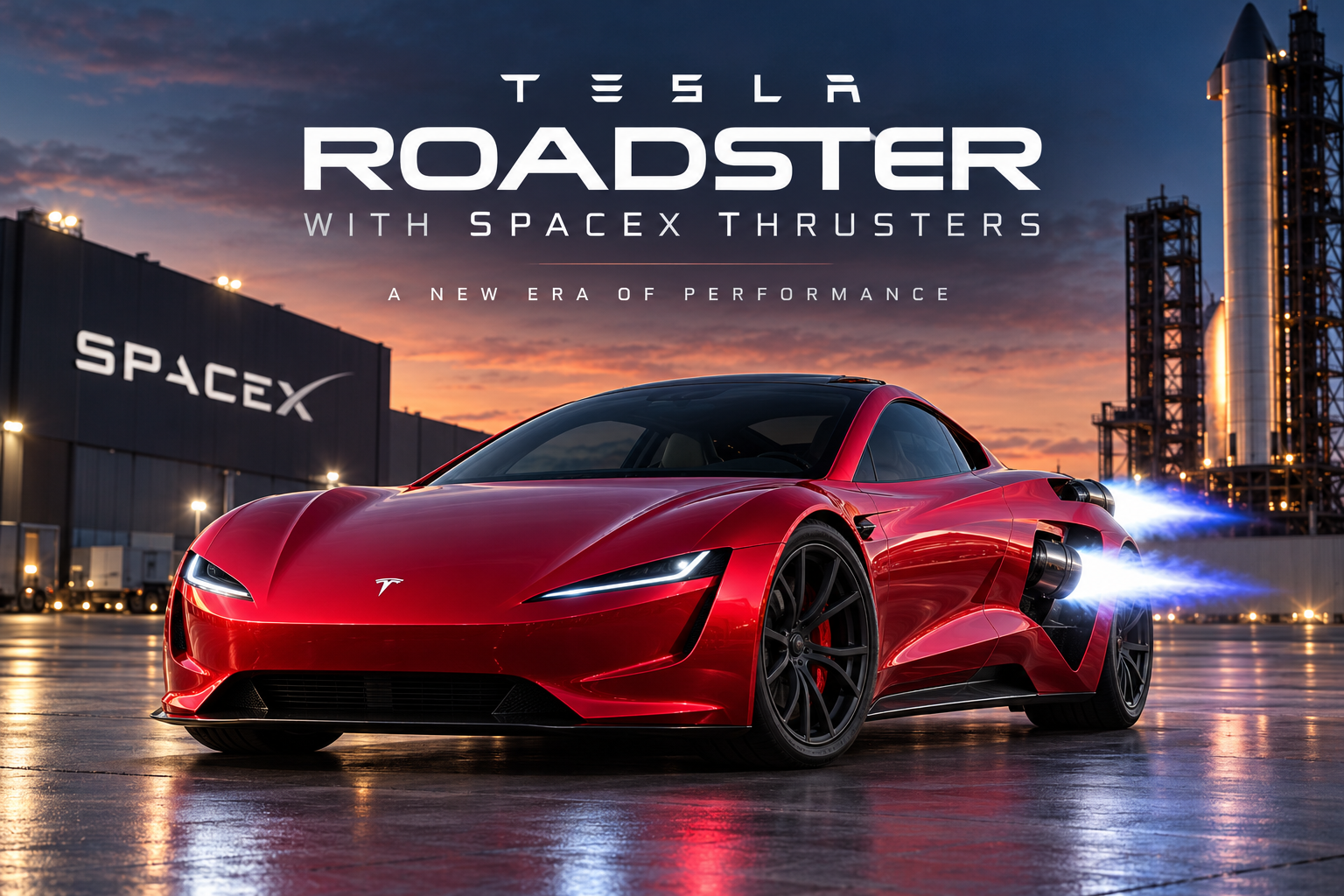
By Tesla Roadster SpaceX Thrusters have become one of the biggest talking points in the electric vehicle industry following Tesla’s spectacular unveiling on October 15, 2026. At a SpaceX testing facility in McGregor, Texas, Elon Musk introduced the redesigned second-generation Tesla Roadster, demonstrating extraordinary acceleration, airborne movements and futuristic engineering.
The new electric supercar combines Tesla’s electric vehicle technology with SpaceX-inspired propulsion systems. Although production is targeted for 2028, the demonstration has already raised important questions about the future of high-performance electric cars and flying vehicles.
Tesla Officially Unveils the New Roadster in 2026
Tesla first introduced its second-generation Roadster concept in November 2017, promising exceptional performance and advanced electric vehicle technology.
After several delays, the company finally showcased a redesigned prototype in October 2026.
The event featured a remarkable demonstration involving an inverted ramp, powerful fans and compressed-gas thrusters.
The Roadster travelled along an upside-down section of track, performed an airborne manoeuvre and returned to the ground. Another demonstration showed the vehicle briefly passing over several Tesla models.
These demonstrations highlighted experimental capabilities rather than features approved for everyday public-road driving.
What Are Tesla Roadster SpaceX Thrusters?
The most exciting feature of the new Roadster is its SpaceX-inspired cold-gas thruster system.
Unlike conventional combustion engines, these thrusters release highly pressurised gas to generate directional force.
Tesla’s advanced prototype uses compressed-gas propulsion to help control movement and provide additional acceleration.
The system includes:
- Multiple cold-gas thruster nozzles.
- High-pressure gas storage.
- Directional thrust control.
- Advanced electronic control systems.
- Integration with the vehicle’s electric powertrain.
Tesla engineers described a configuration involving 10 thrusters connected to approximately 600 litres of compressed-gas storage.
However, the most advanced thruster configuration is not intended for ordinary public-road use.
Can the New Tesla Roadster Really Fly?
The Roadster demonstration has attracted enormous attention because the vehicle briefly became airborne.
However, there is an important difference between a short controlled airborne movement and sustained flight.
Tesla demonstrated a prototype capable of using propulsion to perform dramatic jumps and aerial manoeuvres.
That does not establish that the Roadster can travel through the air like a traditional aircraft.
The prototype also uses an advanced suction system designed to produce unusually high grip.
This combination of aerodynamic engineering, electric motors and propulsion technology makes the Roadster an experimental high-performance vehicle.
Its capabilities remain subject to engineering limitations and regulatory requirements.
Tesla Roadster Performance and Speed
Tesla has announced ambitious performance targets for its next-generation electric sports car.
Some of the key figures presented during the unveiling include:
| Feature | Announced performance |
|---|---|
| Acceleration | Under 1 second, 0–60 mph, for a thruster-assisted variant |
| Top speed | Over 230 mph |
| Driving range | Approximately 300 miles |
| Powertrain | Fully electric |
| Production target | 2028 |
| Special technology | Cold-gas thrusters and suction system |
These figures represent Tesla’s announcements and demonstration claims. Independent testing of final customer vehicles remains necessary.
The Roadster is expected to compete in the high-performance electric supercar category.
Tesla Roadster Versions and Special Features
Tesla introduced three proposed versions of the redesigned Roadster.
1. Performance
The Performance variant focuses on electric acceleration, handling and aerodynamic efficiency.
It is intended to be the more conventional road-focused configuration.
2. Thrust
The Thrust variant introduces additional propulsion technology designed for extraordinary acceleration and specialised performance applications.
3. Rocket
The Rocket version represents Tesla’s most experimental configuration.
It features multiple cold-gas thrusters capable of supporting short airborne manoeuvres.
This limited version is invitation-only and is not currently approved for ordinary road use.
Final production specifications may change before vehicles reach customers.
Tesla Roadster Price and Reservation Details
The new Roadster is expected to occupy the premium electric supercar market.
Following the October unveiling, reports indicated reservation deposits of approximately:
- Performance version: $50,000.
- Thrust version: $250,000.
- Rocket version: invitation-only availability.
These amounts are reservation deposits, not confirmed final vehicle prices.
Actual pricing, regional availability, payment terms and delivery arrangements may change.
Customers should review Tesla’s official information before making financial commitments.
When Will the Tesla Roadster Launch?
Tesla currently aims to begin Roadster production in 2028.
However, production timing and customer delivery dates are not the same.
The Roadster was originally expected to arrive much earlier, but engineering and development challenges contributed to repeated delays.
Before widespread deliveries, Tesla must complete important manufacturing, testing and regulatory processes.
The specialised propulsion versions may face additional restrictions.
Consequently, 2028 should be understood as a production target rather than a guaranteed delivery year.
Why the New Roadster Matters for Electric Vehicles
The Tesla Roadster could influence the direction of future high-performance electric vehicle engineering.
Its development highlights several areas of innovation:
- More advanced electric propulsion.
- Improved aerodynamic control.
- Powerful acceleration systems.
- Integration of aerospace-inspired technologies.
- New approaches to vehicle performance.
However, the Roadster also raises questions about affordability, practicality, regulatory approval and manufacturing complexity.
A spectacular prototype demonstration does not automatically guarantee a commercially successful vehicle.
Conclusion
The Tesla Roadster SpaceX Thrusters unveiling marks an important moment in Tesla’s long-running electric supercar project.
The October 2026 demonstration showed an ambitious combination of electric acceleration, suction technology and short airborne movements.
With production currently targeted for 2028, the Roadster remains one of the most closely watched upcoming electric vehicles.
Whether its experimental features become practical customer technology will depend on successful testing, manufacturing and regulatory approval.
For now, Tesla has demonstrated an unusual vision of high-performance electric mobility, while the final production experience remains to be seen.