

 By
ASUS Showcases Next-Generation AI Computers in 2026: The Future of Smart PCs
Artificial intelligence is rapidly transforming the computer industry, and 2026 is becoming an exciting year for computer enthusiasts, technology professionals and content creators. From powerful laptops to compact desktop computers, manufacturers are introducing new devices designed to handle demanding AI workloads and creative applications.
One of the latest developments comes from ASUS, which showcased its next-generation AI-powered computer solutions at Adobe MAX 2026. The announcement highlights how modern computers are evolving beyond traditional processing capabilities to support intelligent applications, advanced graphics and professional creative workflows.
ASUS Introduces Advanced AI-Powered Computer Solutions
On November 11, 2026, ASUS highlighted its ProArt product ecosystem at Adobe MAX 2026, an event focused on creative technology and digital innovation.
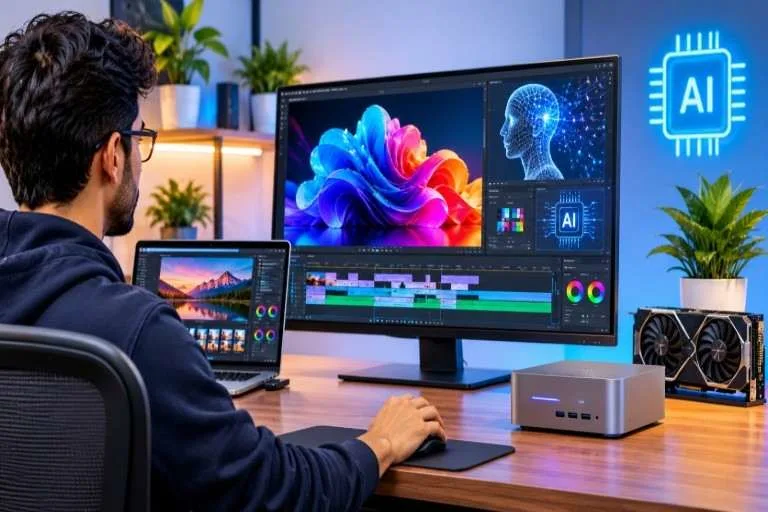
The showcase included the ProArt GR1X mini PC and ProArt P16 and P14 creator laptops. These products demonstrate ASUS’s focus on combining powerful computing hardware with artificial intelligence to support designers, photographers, video editors and other creative professionals.
The ProArt GR1X is particularly interesting because it is designed as an agentic AI mini PC. It brings advanced computing capabilities into a compact desktop form factor, allowing users to explore AI-powered creative workflows without depending entirely on cloud-based services.
The showcase also featured NVIDIA-powered solutions and professional OLED monitors designed for demanding creative tasks.
What Makes AI-Powered Computers Different?
Traditional computers mainly depend on their processors, memory and graphics hardware to perform everyday tasks. AI-powered computers introduce additional capabilities that allow applications to process information, generate content and automate certain activities more efficiently.
For example, AI-powered computers can assist users with:
- Generating and editing digital images.
- Improving video editing workflows.
- Creating graphics and visual designs.
- Supporting software development and coding.
- Automating repetitive creative tasks.
- Running selected AI models locally.
These capabilities can save time and help professionals concentrate on more important aspects of their work.
Another important development is local AI processing. Instead of sending every request to an online server, compatible computers can run certain AI applications directly on their own hardware.
This can offer advantages in privacy, responsiveness and reduced dependence on internet connectivity, depending on the application and hardware configuration.
Why Local AI Processing Matters in 2026
Local AI computing is becoming an important technology trend because businesses and individual users increasingly want more control over their data and applications.
For example, a video editor working with large projects may benefit from AI-assisted editing tools running directly on a powerful computer. Similarly, designers can experiment with image-generation applications and other creative software without relying entirely on external cloud services.
However, local AI performance depends on available memory, graphics processing power, software optimization and the size of the AI models being used.
This is why manufacturers are investing in computers with advanced processors, powerful GPUs and larger memory configurations.
How AI Computers Could Change the Future of Work
AI-powered computers could influence several industries, including education, business, software development, photography, filmmaking and graphic design.
Students may use AI tools to organize information and support learning. Developers may benefit from coding assistants that help explain and generate programming solutions. Creative professionals can use intelligent applications to improve productivity and explore new ideas.
Compact AI desktop computers could also make advanced computing more accessible to smaller businesses and independent creators.
However, these technologies are not intended to replace human creativity or decision-making. Instead, they provide additional tools that help people complete tasks more efficiently.
What Should Buyers Consider Before Purchasing an AI Computer?
Although AI computers are attracting attention, buyers should carefully evaluate their requirements before investing in new hardware.
Important factors include processor performance, RAM capacity, GPU capabilities, storage space, cooling systems and battery life for laptops.
Users should also check whether their preferred software supports local AI processing and whether the computer has sufficient hardware resources for those applications.
Price is another important consideration, particularly for students and small businesses.