

 By
ASUS Expands Local AI Computing in 2026: The Future of Personal Computers
Artificial intelligence is becoming one of the biggest developments in the computer industry. From everyday laptops to high-performance desktop systems, computer manufacturers are finding new ways to integrate AI into their products. On November 12, 2026, ASUS announced an expanded range of local AI computing solutions designed for individual users, gamers, content creators and businesses.
This development highlights an important change in the PC market. Instead of depending entirely on online AI services, users are increasingly getting the opportunity to run compatible AI applications directly on their own computers.
What Is ASUS Bringing to the Computer Market?
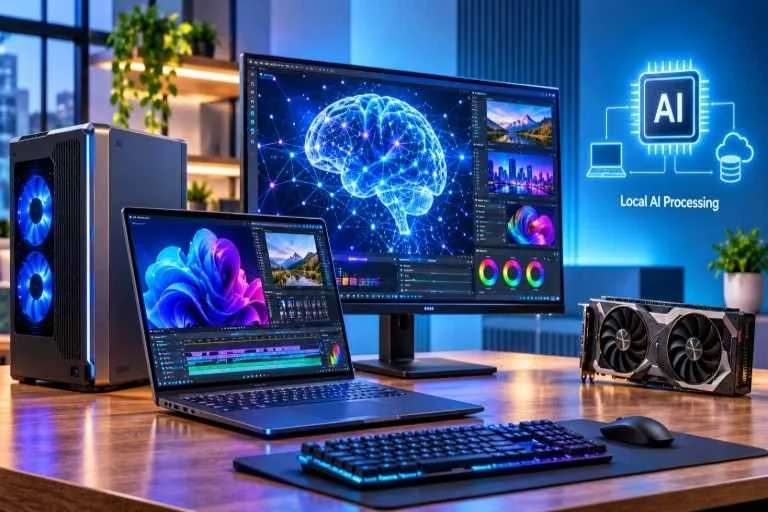
ASUS is expanding its AI computing ecosystem with solutions covering several categories of computer hardware. These include DIY desktop PCs, gaming computers, mini PCs, creator workstations, professional desktops and enterprise-level computing systems.
The company is focusing on making AI technology available to different types of users rather than limiting it to expensive specialist machines.
For example, gaming enthusiasts can explore AI-capable desktop configurations using compatible graphics cards, while professional creators can use more powerful workstations for demanding applications. Businesses can also consider dedicated AI infrastructure for their computing requirements.
The announcement demonstrates ASUS’s intention to make local AI computing a broader part of the personal computer market.
Why Is Local AI Computing Becoming Important?
Traditionally, many AI applications depend on cloud servers to process user requests. This means information is transferred through the internet to remote computing infrastructure before results are returned.
Local AI computing works differently. It allows compatible applications and AI models to operate directly on a computer using its processor, graphics card and dedicated AI hardware.
This approach offers several potential advantages.
1. Better Data Privacy: Users can process certain information locally without sending every request to an external cloud service. This can be particularly useful for businesses handling confidential information.
2. Reduced Internet Dependency: Compatible AI applications can continue working without a constant internet connection once the required models and resources are available locally.
3. Faster Workflows: Local processing can reduce network delays and provide faster responses for supported tasks, depending on the computer’s hardware.
4. Greater Control: Users can choose compatible models, applications and computing resources based on their individual requirements.
However, performance depends on the model size, available memory, processor capabilities and graphics hardware.
How AI Is Changing Gaming and Creative Computers
AI is also creating new opportunities in gaming and digital content creation.
Modern graphics cards and processors can support AI-assisted features that improve image processing, video editing, rendering and other demanding workloads.
For gamers, AI technologies can help improve graphics quality, image upscaling and overall gaming experiences when supported by compatible hardware and software.
Content creators can use local AI tools to generate images, edit videos, organize projects and automate repetitive tasks.
Graphic designers, software developers and video editors may also benefit from AI assistants that help simplify complicated workflows.
By expanding its hardware ecosystem, ASUS is targeting users who want to combine traditional PC performance with modern AI capabilities.
What Does This Mean for Businesses?
Businesses are another important audience for local AI computers.
Organizations increasingly use AI for document analysis, software development, customer support, research and data processing. However, depending entirely on cloud platforms may create additional costs, privacy concerns and infrastructure requirements.
Local AI systems offer another option. Companies can deploy compatible hardware within their own environments and configure applications according to their operational needs.
Small businesses may benefit from compact AI-capable desktops, while larger organizations can explore professional workstations and enterprise computing infrastructure.
This flexibility could make AI adoption more practical across different industries.
What Should Buyers Consider Before Purchasing an AI PC?
Although AI computers are attracting significant attention, buyers should understand their requirements before purchasing new hardware.
Important factors include processor performance, graphics card capabilities, RAM, storage capacity, cooling systems and power consumption.
Users should also check whether their preferred AI software supports local execution and whether the computer has enough memory to run the required models.
For everyday users, an expensive workstation may not be necessary. A suitable AI-capable laptop or desktop could be sufficient for basic productivity and creative applications.