

 By
Introduction
India’s education sector is witnessing another important step towards digital learning and competency-based education. The Council for the Indian School Certificate Examinations (CISCE) has launched its nationwide digital assessment initiative, known as CISCE SHINE 2026, to understand students’ learning abilities and identify areas where they need additional academic support.
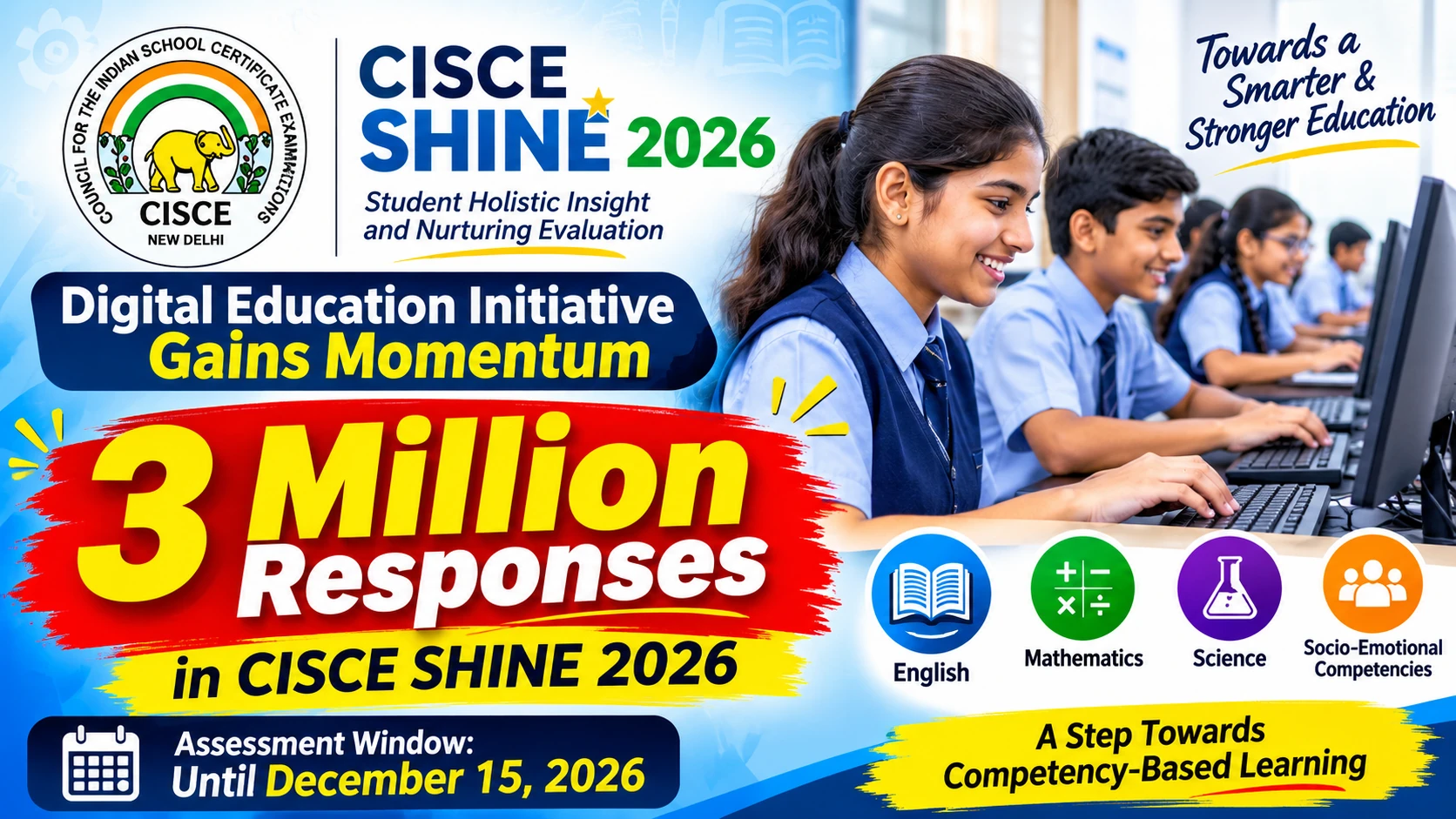
The initiative has received an encouraging response from schools across the country. Within just 48 hours of its launch on November 15, 2026, nearly 450 affiliated schools had started the assessment, while the digital platform recorded more than three million student responses.
This development highlights the growing importance of technology in India’s education system. Instead of concentrating only on examination marks, the new assessment aims to understand how students learn, what they already know and where they need improvement.
What Is CISCE SHINE 2026?
CISCE SHINE stands for Student Holistic Insight and Nurturing Evaluation. It is a free and mandatory digital diagnostic assessment introduced by the Council for the Indian School Certificate Examinations for its affiliated schools.
The primary objective of SHINE 2026 is to evaluate students’ learning competencies at important stages of their academic journey. The initiative is designed to help schools understand students’ strengths and weaknesses through a structured assessment process.
Unlike traditional examinations that mainly focus on marks and grades, SHINE focuses on identifying learning gaps and understanding students’ overall academic development.
The assessment is being conducted for students studying in Classes 4, 6 and 9. It evaluates competencies corresponding to the expected learning levels of Classes 3, 5 and 8, respectively.
Through this approach, teachers can understand whether students have developed the essential skills required before moving to the next stage of education.
More Than 3 Million Responses Recorded Within 48 Hours
One of the biggest highlights of CISCE SHINE 2026 is the impressive response received shortly after its launch.
According to reports based on the Council’s announcement, nearly 450 affiliated schools had commenced the assessment within the first 48 hours. During this period, the platform successfully recorded more than three million student responses.
The assessment was launched on November 15, 2026, and the participation figures were reported on November 18.
The encouraging response indicates the growing adoption of digital assessment systems among educational institutions. It also demonstrates how technology can help schools collect learning-related information on a large scale.
The current edition builds upon a pilot initiative conducted by CISCE in the previous year. That programme covered approximately one lakh students across 273 schools.
With the 2026 edition, the Council aims to expand competency-based assessments across its affiliated school network.
Which Subjects Are Covered Under SHINE 2026?
CISCE SHINE 2026 focuses on both academic knowledge and socio-emotional competencies. The assessment covers four major areas:
1. English
The English assessment focuses on students’ language-related abilities, including comprehension and their understanding of written communication. These skills are important for effective communication and learning across different subjects.
2. Mathematics
The Mathematics section evaluates students’ numerical understanding, mathematical reasoning and ability to apply concepts to different situations.
3. Science
The Science assessment focuses on students’ understanding of scientific concepts and their ability to apply knowledge to practical situations. It encourages conceptual learning rather than simply memorising textbook information.
4. Socio-Emotional Competencies
Apart from academic subjects, SHINE also considers socio-emotional competencies. These are important for students’ overall development, including their ability to understand themselves, interact with others and respond to different situations.
By covering these areas, the initiative aims to provide a broader understanding of student development.
How Will SHINE 2026 Help Students and Teachers?
The main purpose of SHINE 2026 is to make assessments more meaningful and useful for classroom learning.
The information collected through the assessment can help teachers identify topics where students are performing well and areas where they require additional attention.
For example, if students demonstrate difficulties in mathematical reasoning or English comprehension, teachers can plan additional classroom activities and provide targeted learning support.
This approach can offer several benefits:
- Identifying Learning Gaps: Teachers can understand which concepts students have not fully understood.
- Personalised Learning Support: Students who need additional academic assistance can receive more focused attention.
- Improved Teaching Methods: Assessment insights can help teachers adapt their classroom strategies.
- Better Academic Planning: Schools can use learning information to plan improvement activities.
- Holistic Development: Including socio-emotional competencies provides a broader perspective on student development.
The initiative aims to encourage schools to use assessment results as a tool for improvement rather than treating examinations only as a method of ranking students.
Alignment With the National Education Framework
Another important feature of SHINE 2026 is its alignment with the National Curriculum Framework for School Education (NCF-SE) 2023 and CISCE learning outcomes.
The broader direction of India’s education reforms is to encourage conceptual understanding, critical thinking, practical application and competency-based learning.
The National Education Policy (NEP) 2020 also emphasises moving away from rote memorisation towards a more comprehensive approach to education.
SHINE supports this direction by focusing on students’ learning competencies and identifying areas that require improvement.
Such initiatives can help educational institutions understand whether classroom teaching is producing the expected learning outcomes.
CISCE Leadership Highlights the Importance of Meaningful Assessment
Commenting on the encouraging response, Joseph Emmanuel, Chief Executive and Secretary of CISCE, highlighted the importance of making assessments more purposeful.
He explained that assessments should help educators understand students better and support their individual learning requirements.
He also emphasised that the objective of SHINE is not simply to measure what students know, but to understand how they learn and where they need support.
The Council expects the information generated through the initiative to help teachers make informed educational decisions and create learning environments that respond to students’ different needs.
What Is the Last Date for SHINE 2026?
According to the announcement, the CISCE SHINE 2026 assessment window will remain open until December 15, 2026.
Participation is mandatory for CISCE-affiliated schools, and the assessment covers students studying in Classes 4, 6 and 9.
Schools are expected to complete the assessment within the announced period and use the resulting insights to support students’ learning needs.
Students and parents should contact their respective schools for information about assessment schedules and participation arrangements.
Conclusion
CISCE SHINE 2026 represents an important development in India’s move towards technology-supported and competency-based education. Recording more than three million student responses within 48 hours demonstrates the scale of participation and the growing role of digital platforms in school education.
By assessing English, Mathematics, Science and socio-emotional competencies, the initiative aims to provide schools with a better understanding of student learning requirements.
The programme also reinforces the idea that education should not be measured only through examination scores. Identifying learning gaps, improving teaching strategies and providing appropriate academic support are equally important for students’ long-term development.
As the assessment continues until December 15, 2026, its implementation and the way schools use the resulting insights will be important to watch. SHINE could contribute to a more student-centred approach to education, where every learner receives the guidance and support needed to reach their potential.
Follow Us On Instagram.