


 By
By Database Security in 2026: Protecting Critical Data from Modern Cyber Threats
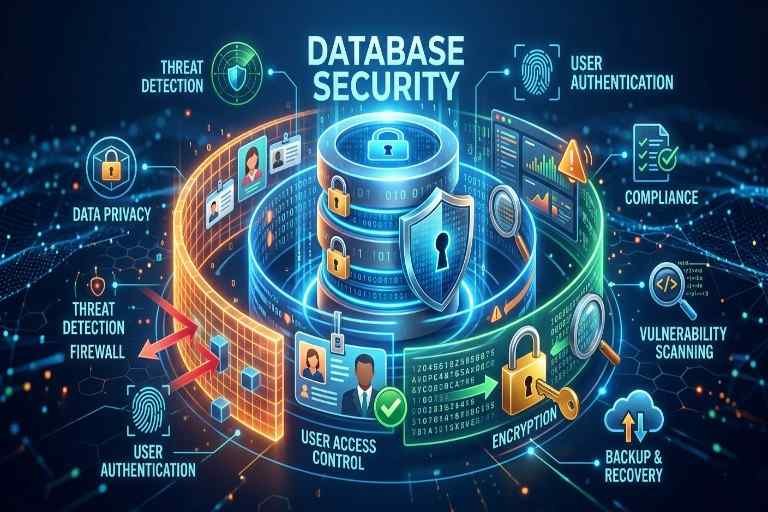
Data is one of the most valuable assets for any organization in today’s digital world. Businesses, government agencies, healthcare providers, financial institutions, and educational organizations all rely on databases to store and manage critical information. From customer records and financial transactions to employee details and confidential business data, databases hold information that must remain secure. As cyberattacks become increasingly sophisticated, Database Security has become a fundamental pillar of cybersecurity in 2026.
Database Security refers to the technologies, policies, and best practices used to protect databases from unauthorized access, theft, corruption, misuse, and accidental data loss. Whether databases are hosted on-premises, in cloud environments, or in hybrid infrastructures, organizations must implement strong security controls to safeguard sensitive information and maintain regulatory compliance.
Why Database Security Matters
Databases are among the most attractive targets for cybercriminals because they contain valuable and sensitive information. A successful attack on a database can expose confidential customer records, disrupt business operations, and result in severe financial and legal consequences.
Common database security threats include:
- Unauthorized access.
- SQL injection attacks.
- Insider threats.
- Data theft.
- Malware and ransomware.
- Misconfigured database servers.
A compromised database can lead to identity theft, financial fraud, regulatory penalties, loss of customer trust, and long-term reputational damage. This makes database security a critical investment for organizations of every size.
SQL Injection Prevention: Blocking One of the Most Common Attacks
SQL Injection remains one of the most dangerous threats targeting databases. This attack occurs when malicious SQL commands are inserted into application input fields, allowing attackers to manipulate database queries.
If successful, SQL injection attacks may enable cybercriminals to:
- Access confidential information.
- Modify or delete database records.
- Bypass authentication systems.
- Gain administrative privileges.
- Disrupt application functionality.
Organizations can significantly reduce the risk of SQL injection by following secure development practices such as:
- Using parameterized queries and prepared statements.
- Validating and sanitizing all user input.
- Applying input filtering techniques.
- Performing regular application security testing.
- Deploying Web Application Firewalls (WAFs).
Preventing SQL injection begins during the software development process and remains an essential part of application security.
Role-Based Access Control (RBAC): Restricting Database Access
Not every employee should have unrestricted access to organizational data. Role-Based Access Control (RBAC) ensures that users receive permissions based only on their job responsibilities.
For example:
- Database administrators receive full management privileges.
- Developers access development databases only.
- Finance teams view financial information.
- Customer support staff access customer records relevant to their work.
The advantages of RBAC include:
- Reduced insider threats.
- Better regulatory compliance.
- Simplified permission management.
- Protection of sensitive business information.
Organizations should also follow the Principle of Least Privilege, granting users only the minimum access required to perform their duties.
Regular access reviews help identify unnecessary permissions and strengthen overall database security.
Encryption of Data at Rest: Protecting Stored Information
Even if attackers gain access to storage systems, encrypted data remains unreadable without the correct encryption keys. Encryption of data at rest is one of the most effective methods for protecting sensitive information.
Data at rest includes:
- Database files.
- Backup storage.
- Archived information.
- Storage volumes.
Strong encryption practices include:
- Using industry-standard encryption algorithms.
- Encrypting backup data.
- Implementing secure encryption key management.
- Rotating encryption keys periodically.
Encryption helps organizations reduce the impact of data breaches while meeting privacy regulations and industry compliance standards.
Continuous Database Monitoring and Threat Detection
Modern databases require continuous monitoring to identify suspicious activities before they become serious security incidents.
Database Activity Monitoring (DAM) solutions provide visibility into:
- User login attempts.
- Privileged account activity.
- Unauthorized access attempts.
- Unusual database queries.
- Configuration changes.
Many organizations now use Artificial Intelligence (AI) and Machine Learning (ML) to detect anomalies, identify emerging threats, and automate security responses.
Continuous monitoring enables security teams to detect attacks early and respond quickly to minimize damage.
Emerging Database Security Trends in 2026
The database security landscape continues to evolve alongside advances in technology.
AI-Powered Database Protection
AI-driven analytics help identify unusual user behavior, prioritize risks, and automate threat detection.
Cloud Database Security
As businesses increasingly migrate databases to cloud platforms, cloud-native security tools provide stronger protection for distributed environments.
Zero Trust Database Access
Zero Trust frameworks require continuous verification of users, devices, and applications before allowing database access.
Automated Compliance Management
Organizations are using automation to simplify compliance with regulations such as GDPR, HIPAA, PCI DSS, and other data protection standards.
Best Practices for Strengthening Database Security
Organizations should adopt several essential security practices:
- Prevent SQL injection through secure coding.
- Implement Role-Based Access Control (RBAC).
- Encrypt sensitive data at rest.
- Enable Multi-Factor Authentication (MFA).
- Monitor database activity continuously.
- Apply software updates and security patches promptly.
- Perform regular vulnerability assessments.
- Maintain secure backups and disaster recovery plans.
A layered security approach provides comprehensive protection against modern database threats.