

 By
By The JEE Advanced 2026 results have highlighted a significant shift in the profile of students qualifying for one of India’s most competitive engineering entrance examinations. This year, candidates from Scheduled Caste (SC) and Scheduled Tribe (ST) categories recorded a substantial rise in qualification rates, while women achieved their highest qualification rate in six years.
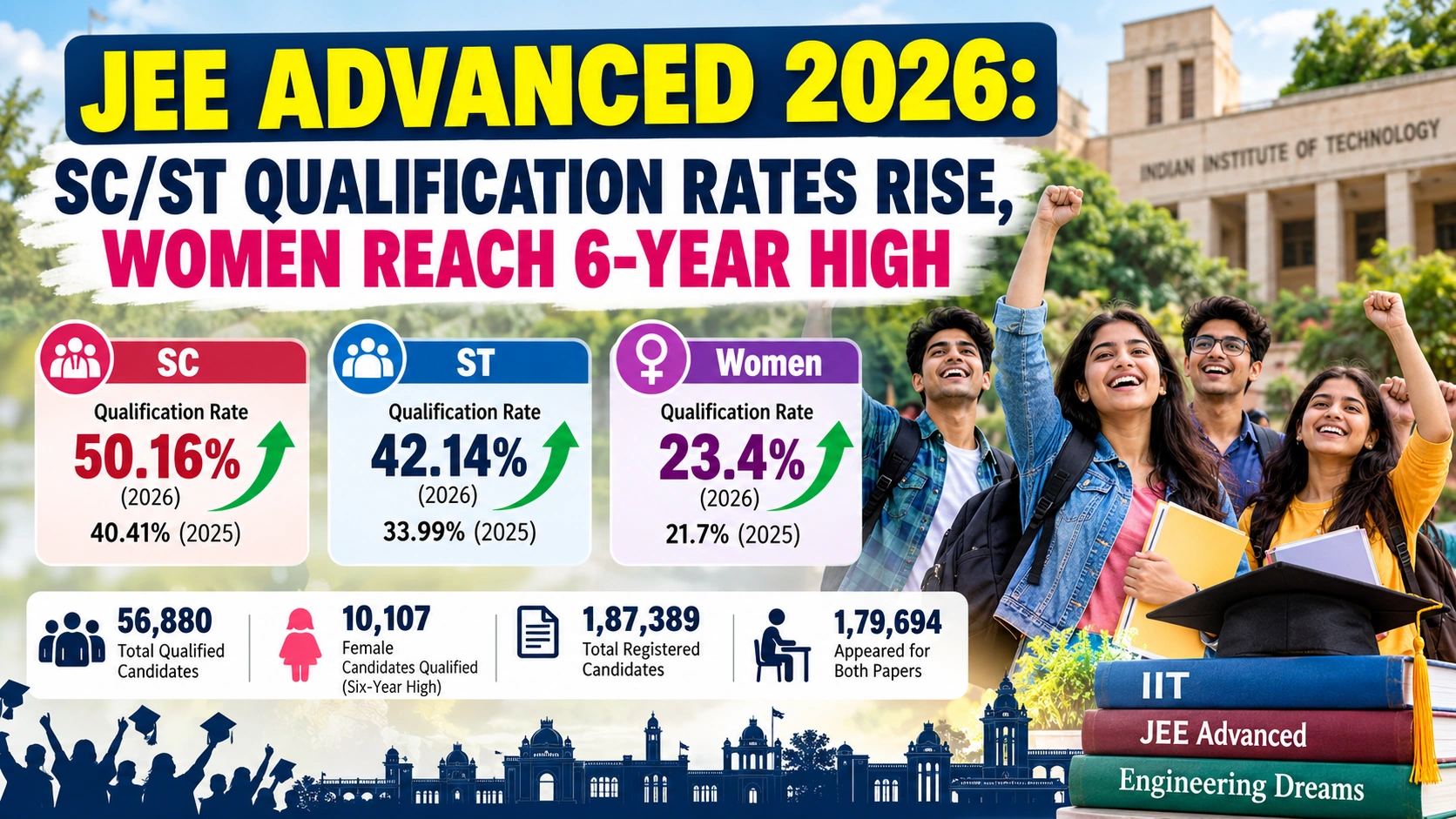
According to the Joint Implementation Committee (JIC) report released by IIT Roorkee, 56,880 candidates qualified for JEE Advanced 2026 after appearing in both papers. Among them were 10,107 female candidates, marking the first time in the six-year period covered by the report that the number of women qualifiers crossed the 10,000 mark.
SC Qualification Rate Crosses 50% for the First Time
One of the biggest highlights of JEE Advanced 2026 is the performance of SC candidates.
The SC qualification rate increased from 40.41% in 2025 to 50.16% in 2026, representing an increase of nearly 9.8 percentage points. In simple terms, approximately one out of every two SC candidates qualified for the examination this year.
The number of SC qualifiers also increased significantly. In 2025, 12,499 SC candidates qualified, whereas the figure increased to 15,856 in 2026.
This represents an increase of 3,357 qualified candidates in just one year, making the improvement particularly significant.
The official JEE Advanced 2026 result data also records thousands of candidates qualifying across different categories, reflecting the broad participation in this year’s examination.
ST Candidates Also Show Strong Improvement
The Scheduled Tribe category also recorded a major improvement in qualification rates.
The ST qualification rate increased from 33.99% in 2025 to 42.14% in 2026. This represents an increase of approximately 8.1 percentage points.
The number of ST qualifiers rose from 5,008 in 2025 to 6,379 in 2026, an increase of around 1,371 candidates.
Together, SC and ST candidates accounted for 22,235 qualifiers, which is close to 39% of the total 56,880 candidates who qualified.
Interestingly, the qualification rates of both SC and ST candidates were higher than the General category rate this year.
General and OBC-NCL Qualification Rates Decline
While SC and ST qualification rates increased sharply, the General and OBC-NCL categories recorded slight declines.
The General category qualification rate fell from approximately 43% in 2025 to 39.8% in 2026.
For OBC-NCL candidates, the qualification rate decreased from 18.2% to 17.5%.
The number of General-category qualifiers also decreased slightly, from 16,154 in 2025 to 15,883 in 2026. OBC-NCL qualifiers declined from 12,606 to 12,385.
These figures demonstrate that the increase in the overall qualifying pool was accompanied by a notable change in the category-wise distribution of successful candidates.
Women Achieve Six-Year High
Another major highlight of JEE Advanced 2026 is the performance of female candidates.
A total of 43,112 women registered for JEE Advanced 2026. Of these, 40,562 appeared in both papers, while 10,107 women qualified.
The female qualification rate reached 23.4%, compared with 21.7% in 2025. According to the JIC report, this is the highest female qualification rate recorded during the six-year period covered by the report.
Women represented nearly 18% of all qualified candidates this year.
The achievement is particularly significant because the number of female qualifiers has grown considerably over the past decade. In 2016, around 4,570 women qualified. In 2026, the number has risen to 10,107, representing an increase of more than 120%.
Top Female Candidate Secures AIR 77
The performance of individual female candidates also made headlines.
The top-ranked female candidate in JEE Advanced 2026 was Arohi Deshpande, who secured All India Rank 77 with a score of 280 out of 360 marks.
She scored 101 marks in Mathematics, 86 in Physics and 93 in Chemistry, demonstrating strong performance across all three subjects.
Her achievement is another indication of the increasing participation and success of women in highly competitive engineering entrance examinations.
Women’s Representation in IITs Continues to Grow
The rise in female JEE Advanced qualifiers comes alongside efforts to increase women’s representation in the IIT system.
In 2018, IITs introduced supernumerary seats for women to improve gender representation. Since then, the proportion of women among IIT students has steadily increased.
In 2026, 3,814 female-only seats were allotted, while another 37 women secured seats through the gender-neutral pool. Women accounted for approximately 20.22% of the total IIT seats this year.
The trend indicates that initiatives aimed at encouraging women to pursue engineering and technology education are contributing to greater representation in the IIT system.
Overall JEE Advanced 2026 Performance
JEE Advanced 2026 saw 1,87,389 candidates register for the examination. Of these, 1,79,694 candidates appeared in both Paper 1 and Paper 2, while 56,880 candidates qualified.
The overall qualification rate among candidates who appeared in both papers was approximately 31.7%.
The examination was conducted on May 17, 2026, and the official results recorded 56,880 successful candidates. IIT Delhi zone candidate Shubham Kumar topped the Common Rank
Follow Us On Instagram.