


 By
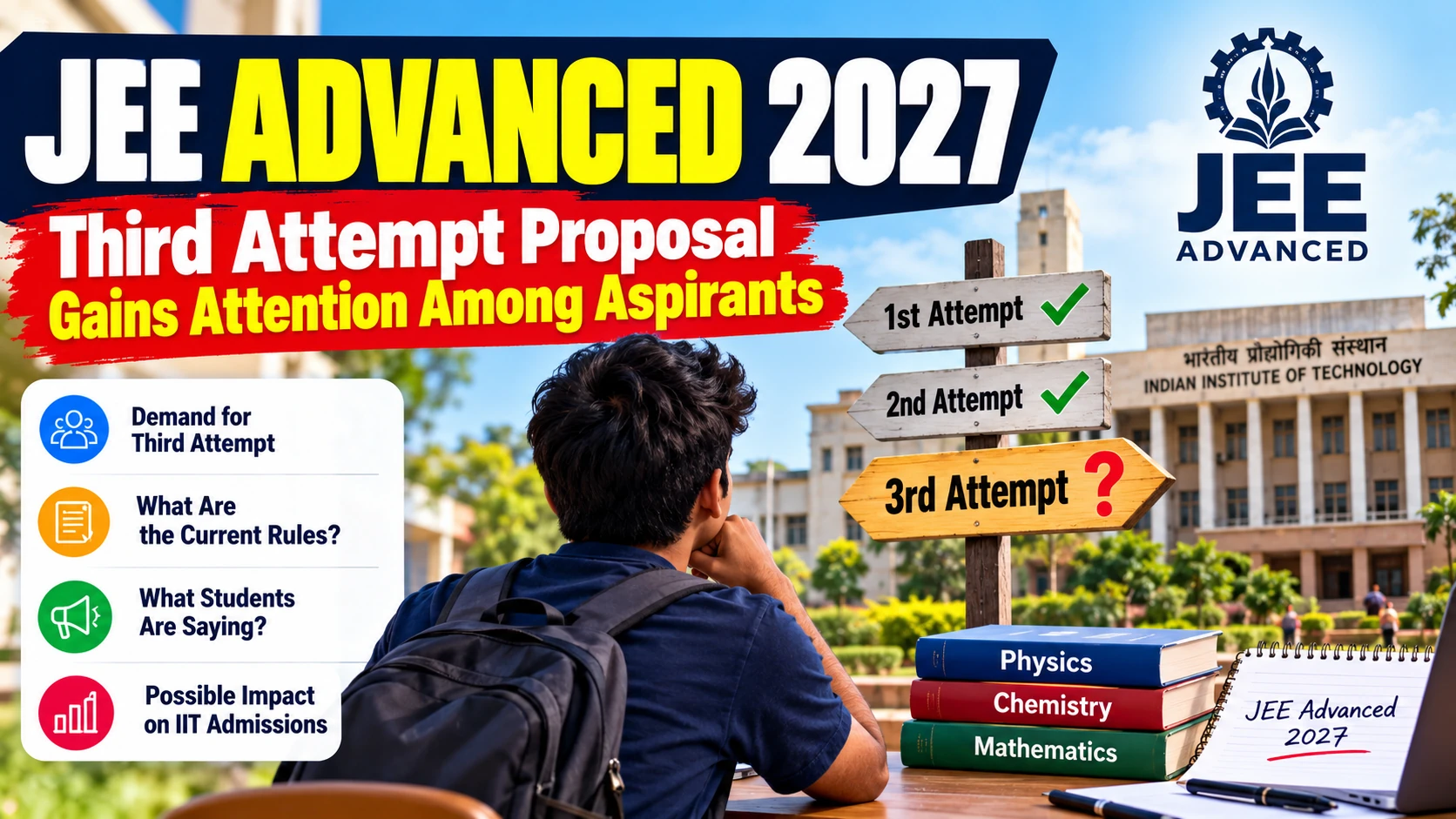
JEE Advanced 2027: The possibility of introducing a third attempt for the Joint Entrance Examination (JEE) Advanced has become a topic of interest among engineering aspirants preparing for admission to the prestigious Indian Institutes of Technology (IITs). Students who face difficulties qualifying for the examination within the existing attempt limit are particularly interested in any proposal that could provide another opportunity.
JEE Advanced is one of India’s most competitive engineering entrance examinations. Every year, thousands of students prepare intensively to secure admission to undergraduate programmes at IITs. The examination tests conceptual understanding, analytical thinking and problem-solving skills in Physics, Chemistry and Mathematics.
The discussion surrounding a possible third attempt has raised several questions. Will the eligibility rules change for 2027? Will students who have already exhausted their attempts benefit? What would such a decision mean for the preparation strategy of candidates?
Important: A third attempt should not be treated as an officially approved change unless the organising authority publishes a formal notification. Aspirants must follow the official JEE Advanced 2027 information brochure for confirmed eligibility criteria.
What Is the JEE Advanced Third Attempt Proposal?
JEE Advanced generally follows specific eligibility conditions relating to the number of attempts, the year of passing Class 12 and other requirements. Under the established framework, candidates are ordinarily allowed a maximum of two attempts in two consecutive years, subject to the applicable rules.
The idea of a third attempt would potentially give eligible students another chance to compete for IIT admission. It has attracted attention because many students believe that an additional opportunity could help them demonstrate their abilities without having to abandon their IIT aspirations after two attempts.
However, discussions, demands and social media claims do not automatically change examination policy. Any modification would require an official decision by the relevant authorities and clear instructions concerning eligibility, implementation and the admission cycle.
Until such an announcement is published, students should not assume that the third-attempt proposal has been accepted for JEE Advanced 2027.
Why Are Aspirants Demanding a Third Attempt?
Several factors help explain why the possibility of an additional attempt interests students.
1. High Competition for IIT Seats
Admission to IITs is highly competitive. Candidates must perform well in JEE Advanced and satisfy the applicable admission requirements. Even students with strong academic foundations may struggle to secure a sufficiently high rank because of the examination’s difficulty and the competition involved.
An additional attempt could give some students another opportunity to improve their performance.
2. Pressure During Preparation
JEE preparation often involves long study hours, regular mock tests and extensive revision. Examination anxiety, health difficulties, personal circumstances and gaps in preparation can affect performance.
Students who narrowly miss their target may feel that another attempt would allow them to correct their mistakes and approach the examination with greater confidence.
3. Learning From Previous Attempts
Experience gained from earlier examinations can help candidates identify weak subjects, improve time management and understand the question pattern. A third attempt, if officially permitted, could allow eligible students to apply those lessons more effectively.
Nevertheless, an additional attempt would not guarantee admission. Candidates would still need to meet the official eligibility criteria and achieve the required examination performance.
4. Fairness and Equal Opportunity
Some aspirants believe that an additional opportunity could help students whose preparation was interrupted by unforeseen circumstances. Others argue that a consistent attempt limit is important for maintaining predictable admission rules and fair treatment across different batches.
These competing considerations make any proposed change a matter for careful policy evaluation.
Will JEE Advanced 2027 Allow Three Attempts?
At present, students should rely on the official examination authorities rather than assume that a third attempt has been introduced.
The eligibility rules for JEE Advanced 2027 must be checked in the official information brochure when available. Candidates should pay particular attention to:
- The maximum number of permitted attempts.
- The two-consecutive-year eligibility rule, if retained.
- The accepted Class 12 examination years.
- The minimum academic and subject requirements.
- Any special provisions or transitional rules announced by the authorities.
Even if a proposal receives public attention, it may not apply to the 2027 examination. Alternatively, any eventual policy change could include specific conditions that determine which candidates benefit.
Students who have already used their permitted attempts should therefore avoid making educational or financial decisions based on unverified reports.
How Could a Third Attempt Affect IIT Admissions?
If an additional attempt were formally approved, its impact would depend on the scope and timing of the policy.
First, more candidates might become eligible to appear for the examination. This could increase the number of aspirants competing for available seats.
Second, coaching institutes and students might adjust their preparation schedules. Candidates could have more time to strengthen fundamental concepts, practise advanced problems and improve examination performance.
Third, the authorities would need to communicate how the new rule interacts with existing eligibility conditions. Clear instructions would be particularly important for candidates from earlier Class 12 batches.
However, an additional attempt would not necessarily mean an increase in IIT seats. Seat availability, programme eligibility, ranking requirements and the centralised admission process would continue to determine admission outcomes according to the applicable rules.
What Should JEE Advanced 2027 Aspirants Do Now?
While waiting for an official announcement, students should continue preparing according to the existing eligibility framework.
Follow the Official Notification
Visit the official JEE Advanced website regularly for updates about eligibility, registration, examination dates and the information brochure. Give priority to official notices over forwarded messages and social media posts.
Strengthen Fundamental Concepts
Focus on understanding Physics, Chemistry and Mathematics rather than memorising solutions. Advanced-level questions often require students to combine multiple concepts and apply them in unfamiliar situations.
Practise Previous Years’ Papers
Solving previous years’ question papers helps candidates understand the examination structure, practise time management and identify recurring conceptual difficulties.
Take Mock Tests
Regular mock examinations can help students improve accuracy and develop a realistic strategy for attempting questions. Review every mock test to understand why mistakes occurred and how to prevent them.
Keep Alternative Options Open
Students should also research other engineering entrance examinations and undergraduate programmes. Maintaining alternative plans is a sensible way to manage uncertainty while continuing to pursue IIT admission.
Where Can Students Check Official Updates?
Candidates should use the following official websites for reliable information:
- JEE Advanced: https://jeeadv.ac.in/
- JEE Main: https://jeemain.nta.nic.in/
- JoSAA counselling: https://josaa.nic.in/
The JEE Advanced website is the primary source for examination-specific eligibility notifications. JEE Main information is relevant to the preceding examination stage, while JoSAA publishes information about the centralised seat-allocation process.
Students should read the complete notification and check the date of publication before acting on any reported policy change.
Conclusion
The proposal for a third attempt in JEE Advanced 2027 has attracted attention because it could provide another opportunity for aspirants who have struggled to qualify within the existing attempt limit. Students see the possibility as a chance to improve their performance, learn from previous examinations and continue pursuing their IIT goals.
However, the proposal must not be confused with an officially implemented rule. Unless the examination authorities confirm a change, candidates should prepare according to the established eligibility conditions and avoid relying on unofficial announcements.
For now, the most effective approach is to maintain a consistent preparation schedule, practise previous years’ papers, improve conceptual understanding and monitor the official JEE Advanced website for verified updates.
Disclaimer: This article discusses the third-attempt proposal as a topic of interest among aspirants. It does not confirm that a third attempt has been approved for JEE Advanced 2027. Candidates should verify all eligibility conditions through official notifications.