


 By
By Senior leader of the Bharat Rashtra Samithi (BRS) and former minister K. T. Rama Rao (KTR) has signaled a decisive shift in the party’s approach by announcing a renewed focus on protest-driven politics. This move comes as the BRS seeks to reposition itself as a strong and active opposition following its loss of power in Telangana.
Addressing party workers and leaders, KTR emphasized that BRS will prioritize people’s issues and take them to the streets through agitations, protests, and public campaigns. He stated that the party’s primary role now is to hold the ruling Congress government accountable and to highlight what it views as failures in governance and unmet promises. By adopting this strategy, BRS aims to reconnect with the grassroots and rebuild its political momentum.
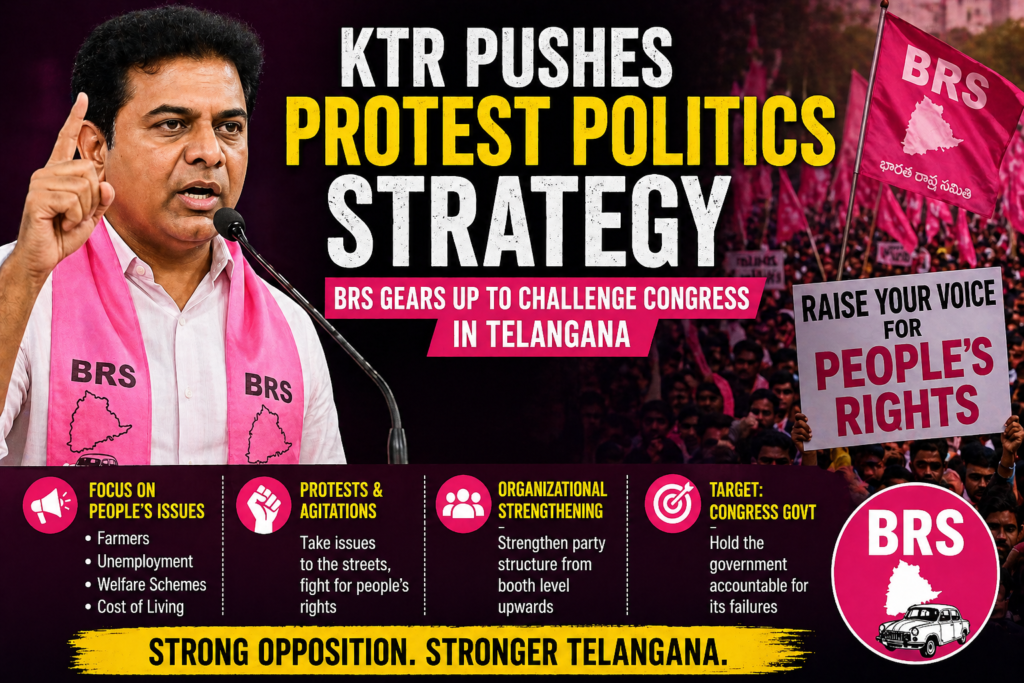
KTR outlined that the party would raise key public concerns, including farmer issues, unemployment, welfare scheme implementation, and rising costs of living. He stressed that these are not merely political talking points but real challenges faced by the people of Telangana. According to him, sustained public engagement and visible action are necessary to ensure that these issues receive attention and are addressed effectively.
A significant aspect of this strategy is the planned organizational restructuring within the party. KTR indicated that BRS would strengthen its cadre from the booth level upwards, ensuring that the party remains active and responsive in every constituency. This includes revamping local committees, encouraging youth participation, and improving coordination between leadership and grassroots workers. Such structural changes are intended to make the party more agile and better prepared for future electoral battles.
Political analysts view this shift toward protest politics as a calculated move. In many cases, opposition parties rely on public demonstrations and issue-based campaigns to stay relevant and maintain visibility. For BRS, which previously focused on governance and development narratives while in power, this represents a transition to a more confrontational and mobilization-driven approach. It allows the party to directly engage with citizens and position itself as a voice of dissent.
At the same time, this strategy also reflects the intensifying competition between BRS and the ruling Congress. With Chief Minister A. Revanth Reddy actively promoting his government’s achievements and policies, BRS is attempting to counter that narrative by highlighting gaps and shortcomings. The protest approach enables the party to challenge the government not just in legislative forums but also in public spaces, where political messaging can have a broader impact.
However, the success of this strategy will depend on how effectively BRS can translate protests into sustained public support. While demonstrations can draw attention, they must be backed by clear messaging and credible alternatives to resonate with voters. The party will need to balance criticism with constructive proposals to maintain its relevance and credibility.
There is also the question of public response. In a politically aware state like Telangana, voters often evaluate parties based on both their past performance and current actions. BRS will have to navigate perceptions related to its previous tenure while presenting itself as a renewed and responsive opposition. KTR’s leadership and communication skills will play a crucial role in shaping this narrative.
Opposition parties, including the Indian National Congress, are likely to respond to BRS’s strategy by defending their governance record and countering criticism. This could lead to more frequent political confrontations, both on the ground and in public discourse, further intensifying the political climate in the state.
In conclusion, KTR’s push for a protest-based political strategy marks a significant shift for BRS as it adapts to its role in opposition. By focusing on grassroots mobilization, public issues, and organizational strengthening, the party aims to regain its footing and challenge the ruling government effectively. As this strategy unfolds, it is expected to play a key role in shaping Telangana’s political dynamics in the lead-up to future elections.