

 By
By Physical Security: Protecting People, Property, and Critical Infrastructure in a Modern World
In today’s increasingly connected world, cybersecurity often receives significant attention. However, protecting digital systems alone is not enough. Businesses, organizations, and individuals must also protect the physical spaces where people, equipment, data, and critical infrastructure are located. This is where physical security plays an essential role.
Physical security refers to the measures, technologies, and procedures used to protect people, buildings, equipment, facilities, and physical assets from unauthorized access, theft, vandalism, accidents, and other threats. From traditional locks and security guards to modern biometric access systems and intelligent CCTV cameras, physical security has evolved significantly with technology.
Why Is Physical Security Important?
A physical security incident can have serious consequences. An unauthorized person entering an office could steal equipment, access confidential documents, damage property, or potentially gain access to systems that contain sensitive digital information.
For businesses, physical security also supports business continuity. A damaged server room, stolen device, or unauthorized entry into a restricted area can result in operational disruption and financial losses.
Strong physical security therefore creates multiple layers of protection around people, facilities, and valuable resources.
Key Components of Physical Security
1. Locks and Access Control
Locks are one of the oldest and simplest forms of physical security. Modern organizations use traditional locks alongside electronic access control systems.
Access cards, PIN-based systems, smart locks, and mobile-based access solutions allow organizations to control who can enter specific areas. Access permissions can also be customized based on employees’ roles and responsibilities.
2. Security Guards
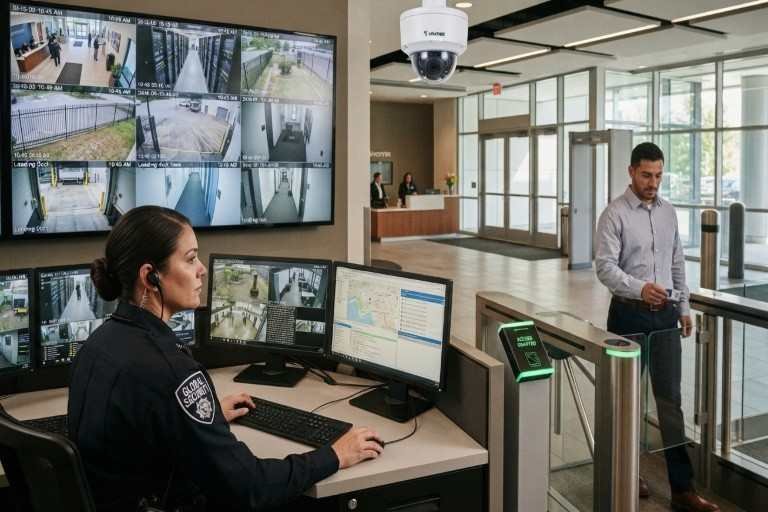
Security guards provide a human layer of protection that technology cannot completely replace. They can monitor entrances, verify visitors, patrol facilities, respond to suspicious activities, and assist during emergencies.
In environments such as corporate offices, warehouses, shopping centers, residential communities, and industrial facilities, trained security personnel can provide continuous physical monitoring and rapid response.
3. CCTV Cameras
Closed-circuit television (CCTV) cameras are among the most widely used physical security technologies. Modern cameras can provide high-resolution video, night vision, motion detection, remote monitoring, and intelligent alerts.
Organizations can use CCTV systems to monitor entrances, parking areas, server rooms, warehouses, production facilities, and other sensitive locations. Recorded footage can also support investigations after security incidents.
4. Fire Alarm and Safety Systems
Physical security is not limited to preventing unauthorized access. Protecting people and infrastructure from environmental hazards is equally important.
Fire alarms, smoke detectors, emergency lighting, sprinklers, and evacuation systems help organizations detect and respond to fires and other emergencies. Regular testing and maintenance are essential to ensure these systems work when needed.
5. Fences and Perimeter Security
Fences, gates, barriers, and controlled entry points help establish a physical boundary around a property. They can discourage unauthorized entry and provide security teams with greater control over who and what enters a facility.
For industrial sites, warehouses, data centers, and other high-security locations, perimeter protection can be an important first layer of defense.
6. Biometric Security
Biometric authentication uses unique physical or behavioral characteristics to verify identity. Examples include fingerprint scanners, facial recognition, iris scanning, and other biometric technologies.
Biometric access systems can reduce dependence on physical access cards or passwords. They are commonly used in offices, government facilities, research centers, financial institutions, and other environments requiring controlled access.
Modern Physical Security and Technology
Technology is transforming traditional physical security into intelligent, connected security ecosystems. Modern systems can integrate CCTV cameras, access control, alarms, sensors, and monitoring platforms into a centralized solution.
Artificial intelligence and analytics can help identify unusual activity, detect unauthorized movement, and generate automated alerts. Cloud-based security platforms can also enable authorized personnel to monitor facilities remotely.
However, technology should complement—not completely replace—security policies, trained personnel, regular inspections, and emergency procedures.
Best Practices for Physical Security
Organizations can strengthen their physical security by following several best practices:
- Conduct regular physical security risk assessments.
- Restrict access to sensitive and restricted areas.
- Use strong access control and regularly review permissions.
- Install CCTV cameras in strategically important locations.
- Maintain and test fire alarms and emergency systems.
- Train employees and security personnel on emergency procedures.
- Monitor visitor access and maintain appropriate records.
- Regularly inspect locks, fences, gates, cameras, and other security equipment.
- Create an incident response plan for physical security emergencies.
The Future of Physical Security
The future of physical security will increasingly combine people, processes, and intelligent technologies. AI-powered video analytics, smart sensors, biometric authentication, mobile access credentials, and integrated security platforms are expected to make security systems more proactive.
Organizations will also increasingly focus on combining physical and cybersecurity. For example, protecting a server room requires both physical access controls and strong digital security. This integrated approach helps protect the complete infrastructure rather than treating physical and digital risks separately.