

 By
By Rajasthan’s 2026 urban local body elections have produced a closely contested political picture, with the Bharatiya Janata Party (BJP) winning the largest number of wards overall, while the Congress, Independents and smaller parties also secured substantial representation.
Results for Rajasthan’s urban local bodies were declared on September 14, 2026, after polling was conducted in two phases. The elections covered 309 urban local bodies across the state, including municipal corporations, municipal councils and municipalities.
Rajasthan Civic Election 2026: Overall Results
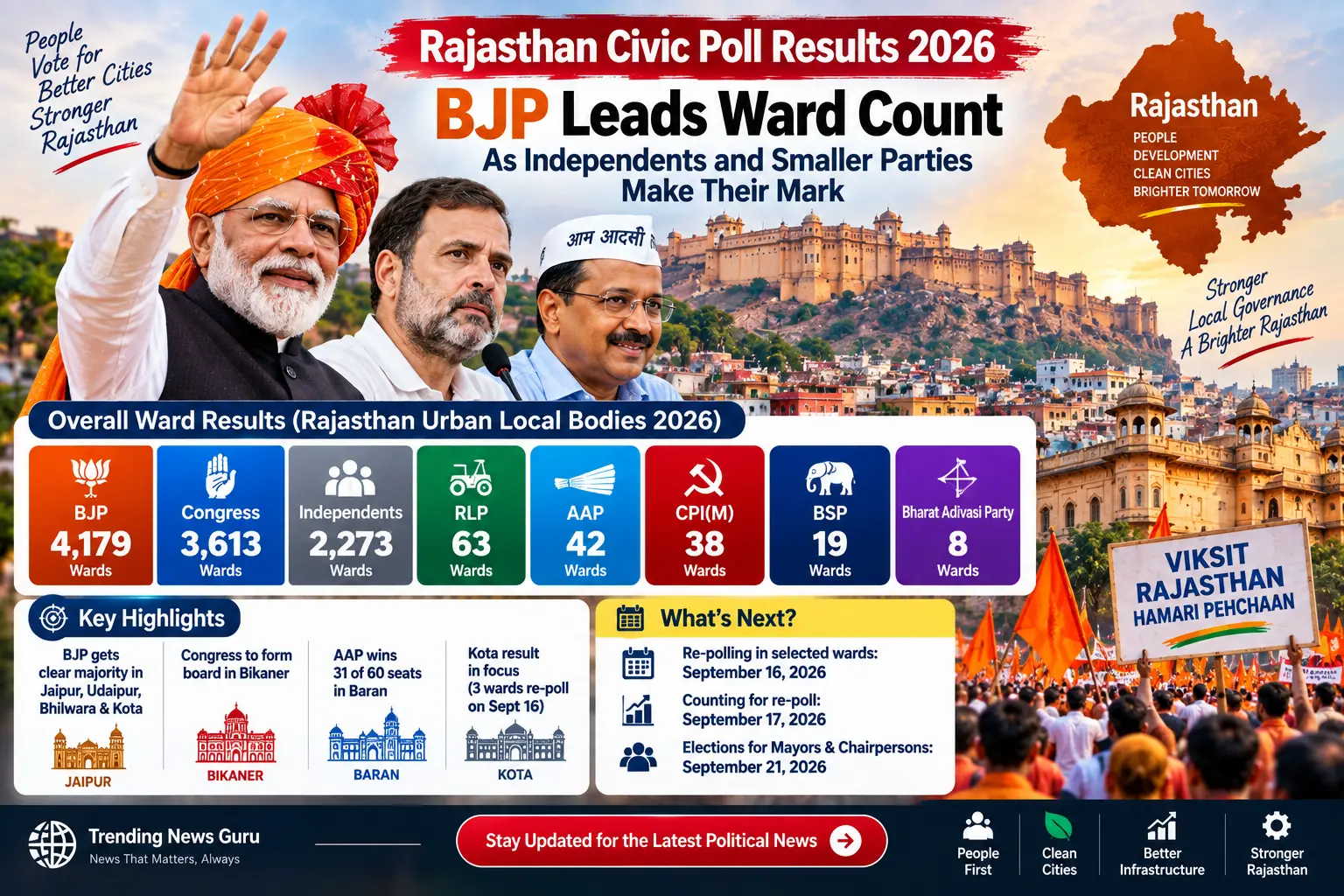
According to the reported final results, the BJP won 4,179 wards, while the Congress won 3,613 wards. Independent candidates secured 2,273 wards, making them an important factor in several local bodies.
Other parties also won seats across the state. The Rashtriya Loktantrik Party (RLP) won 63 wards, the Aam Aadmi Party (AAP) won 42, CPI(M) won 38, the Bahujan Samaj Party (BSP) won 19 and the Bharat Adivasi Party won 8 wards.
The results show that urban Rajasthan’s political landscape includes significant representation beyond the two largest parties.
BJP and Congress Performance Across Urban Bodies
The BJP emerged as the leading party in the overall ward count. It was also positioned to form boards in several major municipal corporations.
The BJP secured clear majorities in four of Rajasthan’s 10 municipal corporations, including Jaipur, Udaipur, Bhilwara and Kota. The Congress was set to form the board in Bikaner, while several other corporations produced results where neither major party independently crossed the majority mark.
In some cities, therefore, Independent councillors and smaller parties could play an important role in determining the composition of local administrations.
Kota Municipal Corporation Result
Kota produced one of the closely watched results in the Rajasthan civic elections.
In the 100-member Kota Municipal Corporation, the BJP won 55 wards, while the Congress won 40, with the remaining seats going to Independents. However, counting-related issues affected a small number of wards.
Results in three Kota wards and one ward in nearby Suket were put on hold following EVM-related technical issues. A re-poll was scheduled for September 16, with counting for those votes scheduled for September 17.
The final local-body leadership arrangements in affected areas will therefore depend on completion of the remaining electoral process.
Independents Become Important in Several Cities
One of the notable features of the Rajasthan civic election results is the number of Independent councillors who won.
Independent candidates secured more than 2,200 wards across the state’s urban local bodies. In several municipal corporations where neither BJP nor Congress obtained a majority, Independents could become important to the formation of the governing board.
For example, in Ajmer, Congress won 37 of 80 wards while BJP won 32, with Independents and rebel candidates taking the remaining seats. Neither major party crossed the majority threshold, leaving the final composition of the local board dependent on further political developments.
AAP Makes a Mark in Baran
The Aam Aadmi Party also recorded a notable result in Rajasthan.
In the Baran Municipal Council, AAP won 31 of 60 seats, while Congress secured 18 and BJP won 9. The result gave AAP a majority in the municipal council and ended Congress’s previous control of the local body.
The result is significant because Rajasthan’s urban politics has traditionally been dominated by BJP and Congress, while smaller parties have generally had a more limited presence.
What Happened in Other Major Cities?
The results varied considerably from one urban area to another.
In Bharatpur Municipal Corporation, Independents won 36 of the 65 wards, while BJP won 20 and Congress won 7. In Pali, Congress won 29 wards compared with BJP’s 21, while Independents won 15.
In Jhalawar Municipal Council, Congress won 29 wards compared with BJP’s 13. At the same time, BJP won the Jhalrapatan Municipality in the same broader region.
These results demonstrate the differences between individual cities and regions rather than showing a uniform outcome across Rajasthan.
When Will Mayors and Chairpersons Be Elected?
The election process does not end with the ward results.
The State Election Commission has issued the schedule for elections to mayors and chairpersons in the urban local bodies where the required electoral process has been completed. According to reports, elections for these posts are scheduled for September 21, 2026, after the remaining re-polling and counting procedures are completed.
The final leadership of several local bodies will depend on the composition of their elected councillors and, in closely divided councils, the support of Independents or smaller parties.
Why Are These Results Important?
Urban local body elections provide a picture of political representation at the city and municipality level.
The 2026 Rajasthan results show three major trends: the BJP recorded the highest overall ward count, Congress retained substantial representation in several urban areas, and Independents and smaller parties won enough seats to influence local-government formation in a number of places.
The results also highlight how local elections can produce different outcomes from one city to another, even within the same state.
What Happens Next in Rajasthan Politics?
The immediate focus will be on the remaining re-polls and counting, followed by elections for mayors and chairpersons.
The outcome of these leadership elections will determine how the 309 urban local bodies are administered during the next term. Political parties will also have to work with councillors from different groups in places where no single party has a clear majority.
For voters and political observers, the coming days will therefore be important for understanding how the ward-level results translate into actual municipal leadership.
Conclusion
The Rajasthan Urban Local Body Election 2026 results have produced a diverse political picture. The BJP recorded the highest number of ward victories overall, Congress remained a major force in several areas, while Independents and smaller parties secured significant representation.
With re-polling scheduled in selected wards and mayoral and chairperson elections still ahead, the final political structure of several Rajasthan urban bodies is yet to be completed.
The September 2026 civic election results are therefore an important development in Rajasthan’s local politics, offering a detailed view of how voters across different cities and municipalities have distributed their support.
Follow Us On Instagram