 By
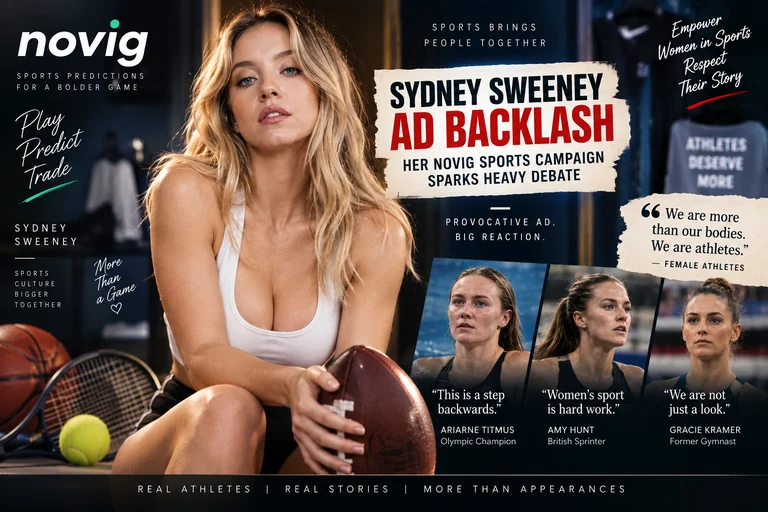
By Sydney Sweeney ad backlash has become one of the biggest entertainment and sports-marketing discussions of the week after the actress appeared in a provocative campaign for sports prediction company Novig. The advertisement, launched on September 9, shows Sweeney using sports equipment in deliberately provocative ways while promoting Novig as a platform focused on sports predictions and trading. Within days, the campaign went viral and attracted criticism from professional athletes who argued that it sexualises women’s sport rather than celebrating athletic ability.
The controversy has grown beyond ordinary social-media criticism, with Olympic and professional athletes publicly questioning the message behind the campaign. At the same time, the advertisement has generated enormous attention for Novig, raising an interesting question about whether the backlash may actually be part of the campaign’s marketing strategy.
What Is the Sydney Sweeney Novig Advertisement?
The new campaign is for Novig, a sports prediction and trading platform that allows users to make predictions on sports outcomes. Sweeney is not simply the face of the advertisement: reports say she is also a strategic partner and equity holder in the company. Novig described the campaign as a bold attempt to cut through traditional sports advertising and focus attention on the platform.
The advertisement features Sweeney posing with equipment associated with different sports, including tennis, basketball, football, baseball and hockey. The visual style deliberately uses humour, glamour and provocative imagery rather than the conventional training-focused presentation normally associated with sports campaigns.
That creative decision immediately divided viewers.
Some social-media users saw the commercial as deliberately cheeky and attention-grabbing, while others argued that it reduced the conversation around women’s sports to Sweeney’s appearance.
Why Did Female Athletes Criticise the Campaign?
The strongest backlash has come from female athletes.
British sprinter Amy Hunt criticised the campaign after competing at the Ultimate Championship in Budapest. In a post-race interview, she contrasted the advertisement’s portrayal with the physical effort required to compete at the highest level, pointing to muscles, hard work, blood, sweat and tears as the reality of women’s sport.
Australian Olympic swimming champion Ariarne Titmus was even more direct. She said she was deeply frustrated by the campaign and argued that using a woman’s body in this way for commercial purposes was a step backwards for women who have spent years working to be recognised for their sporting achievements.
Former gymnast Gracie Kramer also criticised the campaign, saying female athletes have spent their careers fighting against being reduced to their bodies rather than being recognised for their abilities.
The criticism therefore isn’t simply about whether the advertisement is provocative. For many athletes, the bigger issue is the message it sends about how women in sport are represented.
Athletes Say Women Should Be Recognised for Ability
Several athletes responded by posting images and videos of themselves training and competing.
The message was consistent: women’s sport should highlight strength, discipline, skill and achievement rather than relying on sexualised imagery.
Cycling gold medallist Sophie Capewell also criticised the campaign and argued that women should be seen for what they can do, not simply for how they look. Rugby player Ellie Boatman similarly said athletes work extremely hard to reach their level and do not want sexualisation to become the primary way women are recognised in sport.
This created an unusual social-media counter-campaign, with athletes effectively showing audiences what professional women’s sport actually looks like.
Sydney Sweeney Appears to Respond
As criticism grew, Sydney Sweeney appeared to respond indirectly through her social-media activity.
The actress shared images of athletes who had previously posed nude or semi-nude for magazine features, including Serena Williams, Ronda Rousey, Megan Rapinoe and Caroline Wozniacki. She also shared an image involving NFL player Myles Garrett’s previous ESPN Body Issue shoot.
Sweeney did not, however, issue a lengthy public statement directly addressing every criticism.
Her social-media response appeared to suggest that athletes themselves have previously participated in artistic or revealing photoshoots, raising a broader question about whether athletic identity and sensuality can coexist.
But critics argue that the context matters: those magazine shoots were designed around athletes and their bodies, while the Novig campaign uses a celebrity to sell a sports prediction product.
Novig Defends the Campaign
While criticism has intensified, Novig has defended the creative direction.
The company has positioned the advertisement as an intentionally bold campaign designed to attract attention in an increasingly crowded sports and betting market. Sweeney herself was reportedly involved in developing the partnership, rather than simply being hired as a conventional celebrity spokesperson.
That distinction is important because the campaign appears to be built around virality.
Rather than presenting a traditional commercial explaining the features of a betting platform, Novig created something designed to generate conversation. The strategy has clearly worked from an attention perspective: the advertisement reportedly accumulated more than 22 million views within its first two days.
The problem for the company is that a significant portion of that attention has come alongside criticism.
Is the Controversy Actually Helping Novig?
From a marketing perspective, the campaign has achieved something extremely valuable: people are talking about Novig.
Northeastern University media experts described the strategy as a form of provocative or “troll” marketing, suggesting that creating a controversial advertisement can encourage viewers to share it and discuss it online. The campaign’s reach therefore extends far beyond people who would normally encounter a sports-prediction advertisement.
However, attention and positive brand perception are not the same thing.
Novig may have succeeded in making its name recognizable, but the company also has to deal with criticism that its campaign trivialises women’s sporting achievements. The long-term effect will depend on whether the controversy brings new users to the platform or creates a negative association with the brand.
Another Controversial Campaign for Sydney Sweeney
The Novig controversy is not the first time Sydney Sweeney has found herself at the centre of an advertising debate.
Her previous American Eagle “Great Jeans” campaign also generated significant online controversy. Critics debated the campaign’s use of the word “genes,” while the brand and Sweeney rejected interpretations connecting the advertisement to eugenics. Sweeney previously said she was surprised by the reaction and maintained that the campaign was about the jeans and not the political interpretations attached to it.
The latest controversy therefore comes at a time when Sweeney’s advertising campaigns are already receiving unusually high levels of public attention.
That makes the Novig campaign even more significant for her growing image as a major Hollywood celebrity and commercial personality.
The Bigger Debate Around Women in Sport
At the heart of the controversy is a much bigger conversation about representation.
Women’s sport has received greater visibility in recent years, with major competitions attracting growing audiences and athletes becoming increasingly powerful cultural figures. At the same time, female athletes continue to debate how their bodies are represented in advertising, media and social platforms.
For critics of the Sydney Sweeney campaign, the concern is that sexualised imagery can overshadow the athletic achievements of women.
For supporters, the issue is more complicated. They argue that women should have the freedom to present themselves however they choose and that appearing glamorous or sexual should not automatically undermine an individual’s athletic identity.
That tension is unlikely to disappear anytime soon.
A Marketing Success or a Step Too Far?
There is little doubt that the Novig advertisement succeeded in attracting attention.
The campaign has reached millions of viewers, generated extensive media coverage and placed both Sydney Sweeney and Novig at the centre of a global online discussion. From a pure awareness perspective, that is a major achievement.
But the criticism from athletes shows why provocative advertising can be risky.
When a campaign enters an area as culturally sensitive as women’s sport, the creative decision can easily become larger than the product being advertised. Instead of discussing Novig’s features, much of the conversation has shifted toward objectification, representation and the treatment of female athletes.
That could become the campaign’s biggest strength or its biggest weakness.
Final Verdict: Sydney Sweeney Ad Backlash Continues
The Sydney Sweeney ad backlash has quickly developed into a wider debate about celebrity advertising, women’s sports and the line between provocative marketing and objectification.
Sweeney’s Novig campaign was clearly designed to be noticed, and it has achieved that goal. But the strong response from athletes including Ariarne Titmus, Amy Hunt, Sophie Capewell and Gracie Kramer shows that many women in sport believe the advertisement sends the wrong message.
Whether audiences ultimately remember the campaign as clever marketing or a controversial misstep will depend on what happens next. For now, one thing is certain: Sydney Sweeney’s latest advertisement has become much bigger than a sports-betting commercial.