 By
By The invention of the electronic computer is one of the most important technological breakthroughs in human history. Computers have transformed the way people work, communicate, and process information. The world’s first electronic computer marked the beginning of the modern computing era. Before electronic computers were invented, calculations were performed manually or with mechanical machines, which were slow and limited. The development of the first electronic computer revolutionized data processing and laid the foundation for today’s powerful digital systems.
What is an Electronic Computer?
An electronic computer is a machine that processes data using electronic circuits and components. Unlike mechanical computers that rely on gears and moving parts, electronic computers use electrical signals to perform calculations and store information. These machines can process large amounts of data at high speed and with greater accuracy.
Electronic computers consist of several essential components, including input devices, memory, processing units, and output devices. These parts work together to receive data, process it, store it, and produce results. The invention of the first electronic computer introduced a new era of automation and efficiency in computing.
The World’s First Electronic Computer: ENIAC
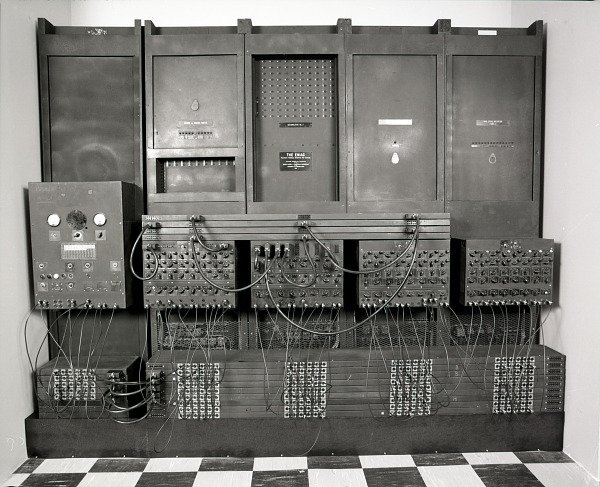
The Electronic Numerical Integrator and Computer (ENIAC) is widely recognized as the world’s first general-purpose electronic digital computer. ENIAC was developed in the United States during World War II to perform complex calculations for the military, particularly for artillery firing tables.
ENIAC was designed and built by two engineers, John W. Mauchly and J. Presper Eckert, at the University of Pennsylvania. The project was funded by the United States Army and was completed in 1945. It officially began operation in 1946.
ENIAC represented a huge advancement in computing technology because it used electronic vacuum tubes instead of mechanical components. This allowed it to perform calculations much faster than previous machines.
Key Features of ENIAC
ENIAC was a massive machine with remarkable capabilities for its time. It contained about 18,000 vacuum tubes, 70,000 resistors, and thousands of other electronic components. The computer occupied a large room and weighed approximately 30 tons.
One of the most impressive features of ENIAC was its speed. It could perform around 5,000 additions per second, which was extremely fast compared to earlier computing machines. Before ENIAC, calculations that took hours or days could be completed in seconds.
However, ENIAC did not have a stored-program concept like modern computers. To change the program, engineers had to manually reconnect cables and switches, which could take many hours or even days.
Development and Purpose of ENIAC
During World War II, the United States Army needed faster methods to calculate artillery firing tables. These tables helped soldiers determine the correct angles and distances for firing weapons. Manual calculations were extremely time-consuming and prone to errors.
To solve this problem, the Army funded a project to build a high-speed electronic calculator. This led to the development of ENIAC. Although the war ended before the machine was fully completed, ENIAC later contributed to several important scientific and military calculations.
The computer was also used for weather prediction, nuclear energy research, and other scientific experiments. Its success demonstrated the potential of electronic computing technology.
Limitations of the First Electronic Computer
Although ENIAC was a groundbreaking invention, it had several limitations. One major limitation was its size and power consumption. The computer required a large room and consumed enormous amounts of electricity.
Another limitation was its programming method. Unlike modern computers that store programs in memory, ENIAC required manual rewiring for different tasks. This made programming complicated and time-consuming.
The vacuum tubes used in ENIAC also generated a lot of heat and frequently failed, requiring constant maintenance. Despite these challenges, ENIAC proved that electronic computing was possible and practical.
Impact on Modern Computing
The invention of ENIAC had a profound impact on the development of modern computers. It demonstrated that electronic machines could perform complex calculations much faster than mechanical systems. This success encouraged researchers and engineers to continue improving computer technology.
After ENIAC, new computers were developed with better designs, including the stored-program concept introduced in later machines like EDVAC and EDSAC. These improvements made computers smaller, faster, and easier to program.
Over time, vacuum tubes were replaced by transistors, integrated circuits, and microprocessors. These advancements led to the creation of personal computers, laptops, smartphones, and powerful servers used today.
Legacy of the First Electronic Computer
The legacy of the world’s first electronic computer continues to influence modern technology. ENIAC paved the way for the development of digital computing systems used in almost every industry, including education, healthcare, finance, engineering, and entertainment.
Today’s computers are millions of times faster and smaller than ENIAC, but the basic concept of electronic data processing remains the same. The work of early computer pioneers helped shape the digital world we live in today.
Conclusion
The creation of the world’s first electronic computer was a historic milestone in technological development. ENIAC demonstrated the power of electronic computation and opened the door for future innovations in computing. Although it was large, complex, and difficult to program, it proved that electronic machines could perform calculations at unprecedented speed.
Modern computers owe much of their existence to this early breakthrough. The invention of ENIAC not only solved immediate wartime problems but also laid the foundation for the advanced digital technologies that drive our modern society.
do u follow instagram