

 By
By Physical Security in 2026: Smart Strategies to Protect People, Property, and Critical Assets
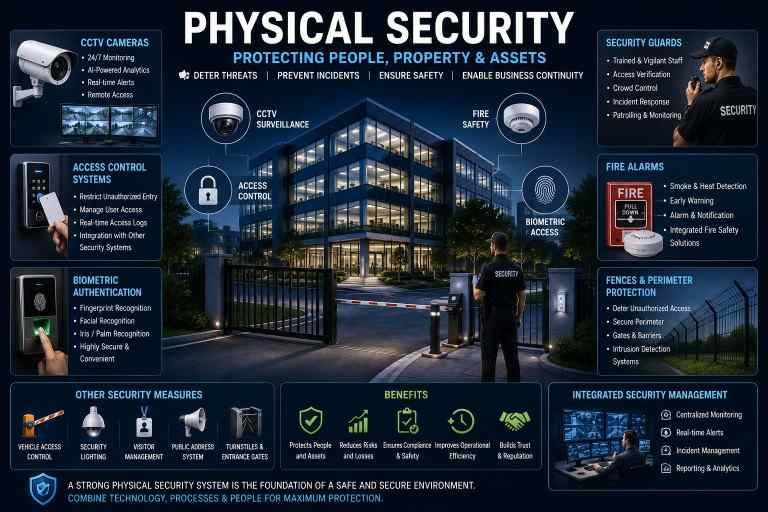
In an increasingly digital world, organizations often focus on cybersecurity to defend against online threats. However, physical security remains the first and most fundamental layer of protection for businesses, government facilities, schools, hospitals, and residential communities. No matter how advanced an organization’s digital defenses are, inadequate physical security can expose valuable assets, sensitive information, and employees to significant risks. In 2026, physical security has evolved beyond traditional locks and security guards, embracing intelligent technologies such as AI-powered surveillance, biometric authentication, smart access control, and integrated monitoring systems.
Physical Security refers to the measures, technologies, and procedures used to protect people, buildings, equipment, and physical assets from theft, unauthorized access, vandalism, natural disasters, and other security threats. A modern physical security strategy combines traditional protective measures with advanced technologies to create a safer and more resilient environment.
Why Physical Security Matters
Organizations today face a wide range of physical threats, including unauthorized entry, theft, workplace violence, vandalism, sabotage, and environmental emergencies. Critical facilities such as data centers, manufacturing plants, research laboratories, and healthcare institutions also store valuable equipment and sensitive information that require robust physical protection.
A successful physical security breach can lead to financial losses, operational downtime, reputational damage, and even legal consequences. As businesses expand across multiple locations and adopt smart building technologies, implementing comprehensive physical security has become more important than ever.
Smart Locks and Access Control Systems
Traditional keys are increasingly being replaced by intelligent access control systems that provide greater security and flexibility. Smart locks allow organizations to manage building access using access cards, PIN codes, smartphones, or cloud-based credentials.
Modern access control systems enable administrators to:
- Grant or revoke access remotely.
- Schedule access permissions for employees and contractors.
- Monitor entry and exit activities in real time.
- Generate detailed audit logs for compliance.
- Reduce risks associated with lost or duplicated keys.
Cloud-based access management also simplifies security across multiple office locations while improving operational efficiency.
Biometric Authentication for Secure Building Access
Biometric authentication has become one of the most reliable methods of verifying identity. Instead of relying solely on passwords or access cards, biometric systems use unique physical characteristics such as fingerprints, facial recognition, iris scans, or palm vein recognition.
Industries including banking, healthcare, government, and data centers increasingly rely on biometrics to secure restricted areas. When combined with Multi-Factor Authentication (MFA), biometric verification significantly reduces the risk of unauthorized access while providing a faster and more convenient user experience.
AI-Powered CCTV Surveillance
Closed-Circuit Television (CCTV) systems have evolved into intelligent security platforms powered by Artificial Intelligence. Modern surveillance cameras can automatically detect suspicious behavior, identify unauthorized individuals, recognize abandoned objects, and generate real-time security alerts.
AI-powered video analytics improve security by:
- Detecting unusual movements.
- Recognizing faces and license plates.
- Monitoring restricted areas.
- Reducing false alarms.
- Supporting rapid incident response.
Cloud-connected surveillance platforms also allow security teams to monitor multiple locations remotely, improving visibility and operational efficiency.
Fire Safety and Emergency Preparedness
Physical security extends beyond preventing unauthorized access—it also includes protecting people from emergencies such as fires, smoke hazards, gas leaks, and natural disasters.
Modern fire protection systems integrate smoke detectors, heat sensors, automated sprinkler systems, emergency alarms, and centralized monitoring platforms. These technologies quickly detect hazards, notify occupants, and activate emergency response procedures to minimize damage.
Organizations should also conduct regular evacuation drills, inspect fire safety equipment, and maintain updated emergency response plans to ensure preparedness during critical situations.
Perimeter Protection and Security Personnel
Perimeter security forms the first line of defense for any facility. Fences, security gates, barriers, lighting systems, and vehicle access controls help prevent unauthorized entry while protecting critical infrastructure.
Security guards continue to play a vital role by verifying visitor identities, monitoring premises, responding to emergencies, and coordinating with law enforcement when necessary. Today, security personnel increasingly use mobile patrol applications, digital visitor management systems, and AI-assisted surveillance tools to enhance their effectiveness.
Integrating Physical Security with Cybersecurity
One of the biggest security trends in 2026 is the convergence of physical security and cybersecurity. Many physical security systems—including CCTV cameras, access control devices, alarm systems, and smart building technologies—are connected to enterprise networks and cloud platforms.
Organizations must secure these connected devices through encryption, secure authentication, software updates, network segmentation, and continuous monitoring. Integrating physical and cybersecurity operations enables faster incident detection and provides a unified view of organizational security.