 By
By Cloud Security in 2026: Protecting Data, Applications, and Cloud Infrastructure from Emerging Threats
Cloud computing has become the foundation of modern digital business. Organizations use cloud platforms to host applications, store sensitive information, run databases, support remote work, and deploy artificial intelligence workloads. However, the rapid expansion of cloud environments has also created new security challenges. In 2026, cloud security is evolving beyond traditional infrastructure protection, with identity, AI agents, APIs, misconfigurations, and continuous monitoring becoming major areas of concern.
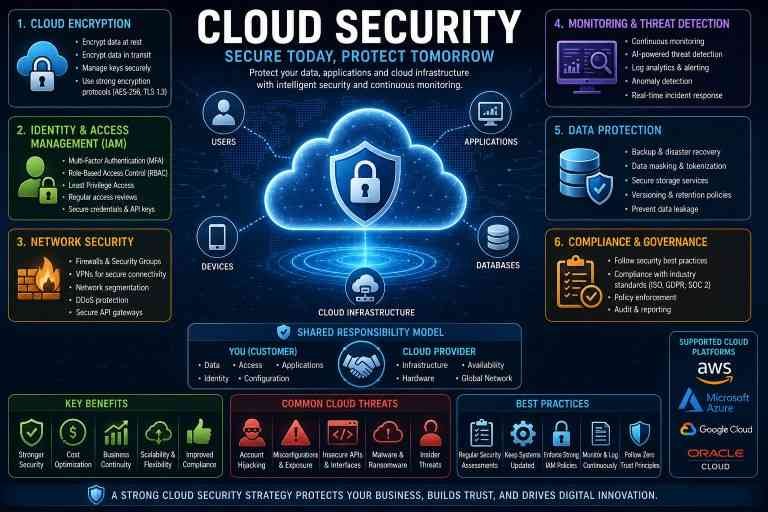
Cloud Security refers to the technologies, policies, processes, and controls used to protect cloud-hosted data, applications, services, workloads, and infrastructure from unauthorized access and cyberattacks. A strong cloud security strategy combines encryption, Identity and Access Management (IAM), Zero Trust principles, continuous monitoring, vulnerability management, and automated threat detection.
Why Cloud Security Matters
Cloud environments are highly dynamic. Virtual machines, containers, serverless applications, APIs, databases, and AI workloads can be created and modified rapidly. This flexibility improves business agility but can also introduce security gaps.
The 2026 cloud threat landscape is increasingly focused on identity and artificial intelligence, alongside APIs and third-party dependencies. The Cloud Security Alliance’s 2026 threat survey identifies AI-enhanced attacks and AI system compromise among the leading cloud security concerns.
Common risks include compromised credentials, excessive permissions, exposed storage, insecure APIs, vulnerable workloads, ransomware, insider threats, and cloud misconfigurations.
Cloud Encryption: Protecting Data
Encryption remains one of the most important layers of cloud security. It protects information by converting readable data into an encrypted format that cannot be understood without the appropriate key.
Organizations should protect:
- Data at rest stored in databases, storage services, and backups.
- Data in transit moving between users, applications, APIs, and cloud services.
- Sensitive backups and snapshots stored within cloud environments.
Cloud Key Management Services (KMS) can help organizations control encryption keys, rotate them regularly, and restrict access to authorized users and services.
Identity and Access Management Is Becoming Critical
Identity has become one of the most important components of cloud security. Modern environments contain not only human users but also service accounts, APIs, automation tools, containers, and AI agents.
The Cloud Security Alliance reports that organizations are facing growing challenges in distinguishing AI-agent activity from human activity, highlighting gaps in identity attribution and access control.
Organizations should implement:
- Multi-Factor Authentication (MFA)
- Role-Based Access Control (RBAC)
- Least-privilege permissions
- Privileged access management
- Conditional access policies
- Regular access reviews
- Secure management of API keys and service accounts
The goal is simple: every identity should receive only the permissions required to perform its specific task.
Zero Trust for Cloud Environments
Traditional security models often assumed that users or systems inside a trusted network could be given broader access. Modern cloud environments require a different approach.
Zero Trust follows the principle of “never trust, always verify.” Every user, device, workload, API, and service should be authenticated and authorized before accessing sensitive resources.
Zero Trust can reduce the impact of compromised credentials by limiting access and preventing attackers from moving easily between cloud workloads.
Continuous Cloud Monitoring
Cloud infrastructure can change within minutes, making periodic security assessments insufficient. Continuous monitoring provides real-time visibility into cloud activity and helps security teams identify suspicious behavior.
Modern monitoring solutions can detect:
- Unusual login activity
- Privilege escalation
- Publicly exposed resources
- Suspicious API requests
- Unauthorized configuration changes
- Abnormal network traffic
- Vulnerable cloud workloads
Cloud Security Posture Management (CSPM), Security Information and Event Management (SIEM), and Cloud-Native Application Protection Platforms (CNAPP) can help organizations identify and prioritize risks across complex environments.
AI Agents Are Creating a New Security Challenge
One of the most significant cloud-security developments in 2026 is the rapid adoption of autonomous and agentic AI. AI agents can interact with applications, databases, APIs, and business systems on behalf of users.
This creates a new category of non-human identities that require their own security controls. The Cloud Security Alliance reports that 82% of surveyed enterprises had unknown AI agents operating in their environments, while 65% reported AI-agent-related incidents during the previous year.
Organizations should therefore maintain an inventory of AI agents, control their permissions, monitor their activity, rotate credentials, and establish clear processes for disabling or decommissioning agents that are no longer required.
API and Multi-Cloud Security
APIs are essential for connecting cloud applications and services, but insecure APIs can expose sensitive information or provide attackers with unauthorized access.
Organizations should implement strong authentication, authorization, rate limiting, encryption, secure token management, and continuous API monitoring.
Multi-cloud environments introduce additional complexity because security policies must remain consistent across different cloud providers. Centralized visibility and automated policy enforcement can help security teams manage these environments more effectively.
AI-Powered Cloud Threat Detection
Artificial Intelligence is also becoming an important defensive technology. AI-powered security platforms can analyze large volumes of cloud events, identify abnormal behavior, prioritize high-risk alerts, and assist with incident response.
However, AI should complement—not completely replace—human security teams. Security professionals still need to validate high-impact decisions, investigate incidents, and ensure automated security actions follow organizational policies.