


 By
By IoT Security in 2026: Protecting Connected Devices from AI-Powered Cyber Threats
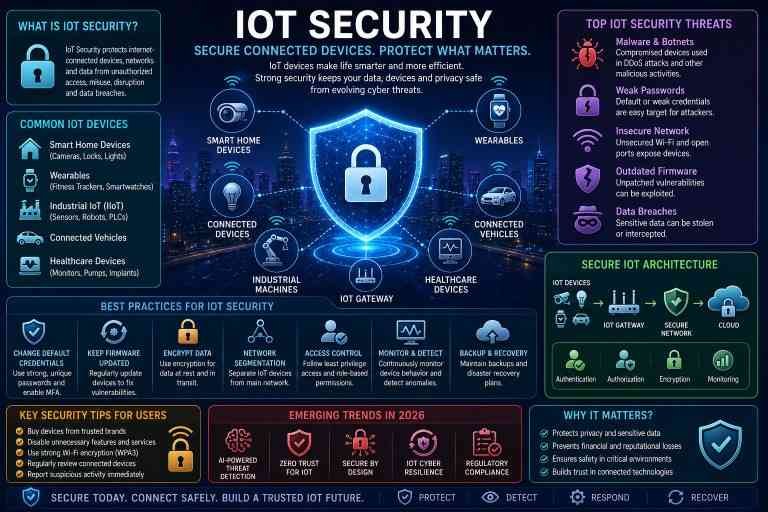
The Internet of Things (IoT) has transformed everyday life and modern businesses by connecting physical devices to the internet. Smart home appliances, security cameras, smartwatches, healthcare devices, connected vehicles, industrial sensors, and automated machines can now collect and exchange information in real time. However, this growing connectivity also creates a much larger cybersecurity attack surface. In 2026, IoT security is becoming a major cybersecurity priority as attackers target poorly protected devices, vulnerable firmware, exposed services, and interconnected networks.
IoT Security refers to the technologies, processes, and security practices used to protect connected devices, networks, applications, and data from unauthorized access, malware, data theft, and other cyber threats. Modern IoT security focuses not only on protecting individual devices but also on securing the complete ecosystem surrounding them.
Why IoT Security Matters
IoT devices are often designed with limited computing resources and long operational lifespans. Some devices may remain connected for years while receiving few or no security updates. This can leave vulnerabilities unpatched and provide attackers with opportunities to compromise devices.
Recent research published in Nature Reviews Electrical Engineering highlights that IoT vulnerabilities can have consequences across both cyber and physical environments, emphasizing the need for secure-by-design architectures, scalable vulnerability management, and stronger resilience.
Common IoT threats include weak passwords, outdated firmware, insecure APIs, malware, device spoofing, man-in-the-middle attacks, unauthorized remote access, and Distributed Denial-of-Service (DDoS) attacks.
Smart Home Security
Smart homes increasingly rely on connected cameras, smart locks, thermostats, televisions, speakers, lighting systems, and appliances. While these technologies provide convenience, compromising one device can potentially expose other systems connected to the same network.
Users should:
- Replace default usernames and passwords.
- Enable Multi-Factor Authentication (MFA) where available.
- Install firmware and security updates promptly.
- Disable unnecessary remote-access features.
- Use a separate Wi-Fi network or VLAN for IoT devices.
- Purchase devices from manufacturers that provide long-term security support.
Network segmentation is particularly useful because it can prevent a compromised smart device from becoming an easy pathway into laptops, smartphones, or other sensitive systems.
Wearable and Healthcare Device Security
Smartwatches, fitness trackers, medical sensors, and other wearable devices collect increasingly sensitive information, including health metrics, location data, and personal activity information.
Protecting these devices requires strong authentication, encrypted communication, secure mobile applications, and carefully controlled permissions. Organizations deploying connected healthcare devices should also maintain accurate inventories and monitor devices for unusual activity.
The security challenge is not limited to the device itself. Mobile applications, cloud platforms, APIs, and third-party services that process IoT data must also be secured.
IoT Botnets and AI-Powered Attacks
IoT botnets remain a major concern because attackers can compromise large numbers of poorly protected devices and use them collectively for DDoS attacks or other malicious activities. Recent 2026 research specifically highlights the increasing sophistication of IoT botnets and the difficulty of detecting them because of encrypted communications, changing attack behavior, and resource-constrained devices.
Artificial Intelligence is adding another dimension to this threat landscape. AI can help attackers automate reconnaissance and identify vulnerable systems more efficiently. At the same time, defenders can use AI and machine learning to detect unusual device behavior, identify botnet activity, and respond to threats faster.
This creates a continuing race between automated attacks and automated defense.
Connected Industrial Machines and IIoT
Industrial Internet of Things (IIoT) technology is transforming manufacturing, logistics, energy, and other industrial sectors. Sensors, controllers, robotic systems, and connected machines can exchange data continuously to improve efficiency and enable predictive maintenance.
However, an attack against an industrial IoT environment can affect more than data—it can disrupt physical processes and potentially create safety risks.
Organizations should implement:
- Network segmentation between IT and OT environments.
- Strong identity and access controls.
- Secure remote administration.
- Continuous monitoring of industrial traffic.
- Regular vulnerability assessments.
- Secure firmware and software updates.
- Device inventories and lifecycle management.
The International Telecommunication Union approved a new recommendation in June 2026 addressing security requirements for industrial IoT in smart manufacturing, reflecting the growing importance of protecting connected industrial environments.
Secure-by-Design IoT Devices
One of the most important IoT security trends is the shift toward security by design. Instead of adding security after a product is developed, manufacturers are increasingly expected to integrate security throughout the device lifecycle.
Important capabilities include secure boot, unique device identities, hardware-backed security, encrypted communications, signed firmware, secure update mechanisms, and protection against unauthorized modification.
Long-term security support is equally important. A device that receives regular vulnerability patches is considerably easier to defend than one that becomes unsupported shortly after purchase.
AI-Powered IoT Monitoring
As organizations deploy thousands or millions of connected devices, manually monitoring every device becomes impractical. AI-powered security platforms can establish normal behavior patterns and identify anomalies such as unusual traffic, unexpected connections, abnormal login attempts, or suspicious firmware changes.
Automated monitoring can help security teams detect compromised devices quickly and isolate them before attackers can move further through the network.
However, organizations should combine automation with human oversight, especially when security systems can automatically disconnect or modify critical devices.
Building IoT Cyber Resilience
IoT security should not focus exclusively on preventing attacks. Organizations also need to prepare for situations where devices are compromised.
A resilient IoT strategy should include asset inventories, vulnerability management, network segmentation, incident-response plans, secure backups, recovery procedures, and regular security testing.
The growing focus on IoT cyber resilience reflects the reality that connected environments cannot always prevent every attack. The objective is to detect incidents quickly, limit their impact, recover operations, and learn from security events.