

 By
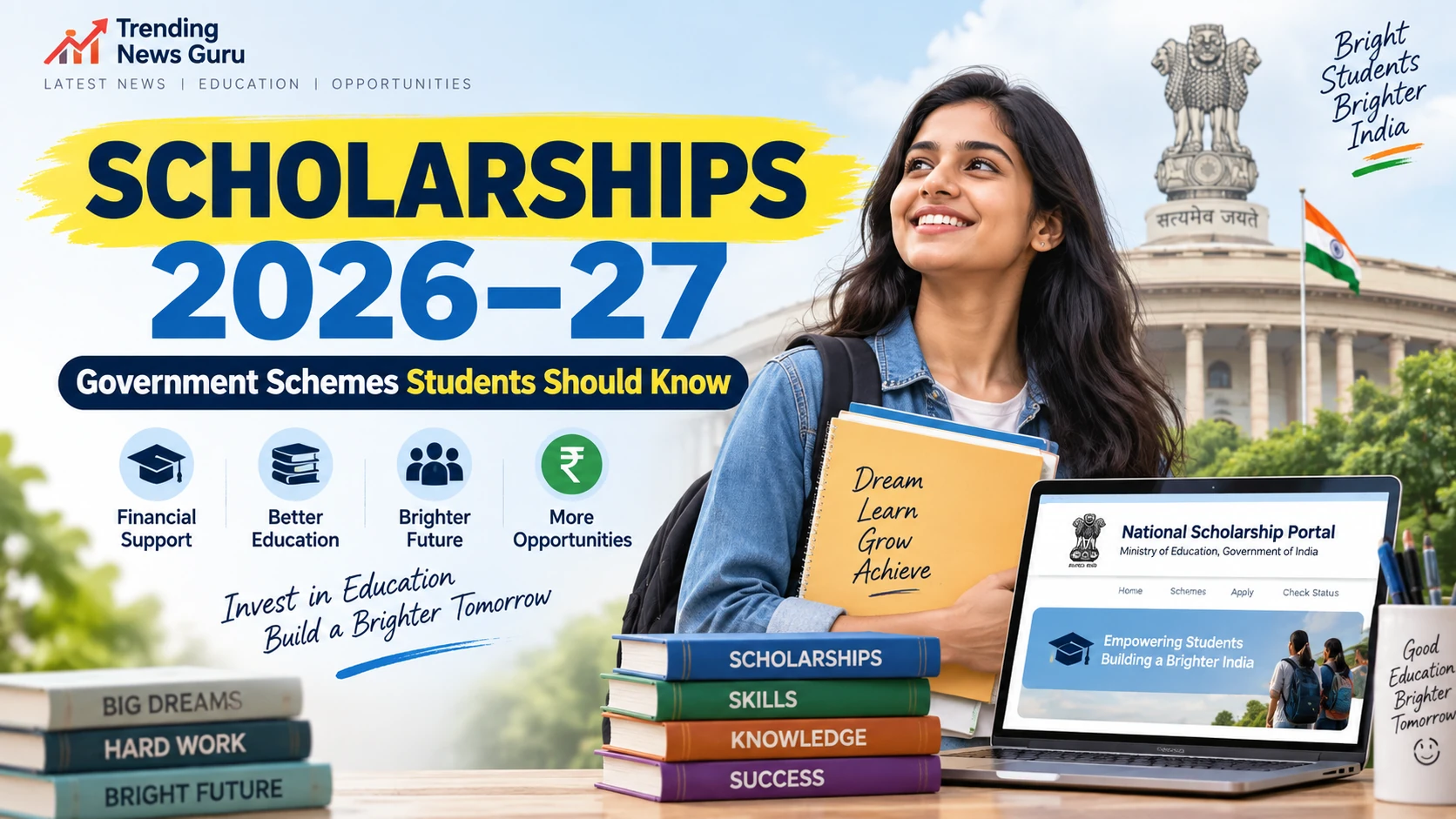
By Education is becoming increasingly expensive, but students in India have access to several government scholarship schemes designed to reduce the financial burden. For the academic year 2026–27, the National Scholarship Portal (NSP) is serving as the central platform for many Central Government scholarship applications. The portal opened for the 2026–27 academic year from June 1, 2026, and students can apply for schemes according to their eligibility. (Scholarships Government of India)
Government scholarships are available for school students, college students, technical education students, postgraduate students, students from economically weaker sections, SC/ST/OBC/EBC/DNT communities, students with disabilities and children of certain government personnel. Understanding the major schemes and their eligibility requirements can help students avoid missing important opportunities.
1. PM-USP Central Sector Scheme of Scholarship
The PM-USP Central Sector Scheme of Scholarship for College and University Students (CSSS) is one of the major scholarships available through NSP. It is primarily intended for meritorious students who have completed Class 12 and are pursuing higher education.
Under the scheme, eligible students can receive ₹12,000 per year at the undergraduate level for the first three years. Students pursuing postgraduate courses can receive ₹20,000 per year, while students in certain technical courses can receive ₹20,000 in the later year of their programme. (Education)
For 2026–27, renewal applications are also being processed through NSP. Students should carefully check the latest eligibility conditions before applying.
2. National Means-cum-Merit Scholarship Scheme
The National Means-cum-Merit Scholarship Scheme (NMMSS) is aimed at supporting economically weaker students and encouraging them to continue their education beyond the elementary level.
The scheme focuses on students entering secondary education and provides financial assistance to reduce the chances of students dropping out because of financial difficulties. Government planning documents for 2026–27 continue to identify NMMSS as a major scheme supporting economically weaker students in Classes IX to XII. (DSEL Education)
Students and parents should check the current application schedule and eligibility requirements on NSP.
3. PM YASASVI Scholarship
The PM YASASVI Central Sector Scheme provides scholarship support for eligible students belonging to OBC, EBC and DNT communities.
The NSP currently lists schemes covering Top Class Education in Schools as well as Top Class Education in Colleges. The college scheme is particularly useful for eligible students pursuing higher education in institutions covered under the scheme. (Scholarships Government of India)
Students should verify their community certificate, family-income requirements and institution eligibility before submitting an application.
4. Scholarships for SC Students
The government also provides the Central Sector Scholarship of Top Class Education for SC Students. It is designed to help meritorious SC students pursue higher education without allowing financial constraints to become a major barrier.
For 2026–27, this scheme is listed on the National Scholarship Portal, with fresh applications scheduled through NSP. (Scholarships Government of India)
Students should make sure that their caste certificate, income certificate and other required documents are valid and available before applying.
5. Scholarships for ST Students
Students belonging to Scheduled Tribes can also benefit from the National Fellowship and Scholarship for Higher Education of ST Students.
The scholarship component is intended to support eligible ST students pursuing higher education. The scheme is currently listed on NSP for the 2026–27 academic year. (Scholarships Government of India)
Students should check the detailed eligibility criteria because requirements can vary according to the level and type of course.
6. AICTE Pragati Scholarship for Girl Students
Girls pursuing technical education can look at the AICTE Pragati Scholarship Scheme. For 2026–27, NSP lists separate schemes for technical degree and technical diploma students. (Scholarships Government of India)
This is particularly relevant for girls studying eligible diploma or degree-level technical programmes. Students should check whether their institution and course meet AICTE requirements.
7. AICTE Saksham Scholarship
The AICTE Saksham Scholarship Scheme is designed for specially abled students pursuing technical education.
For 2026–27, NSP lists Saksham scholarships for both technical diploma and technical degree students. (Scholarships Government of India)
Eligible students should keep their disability-related documentation and educational records ready while applying.
8. AICTE Swanath Scholarship
Another important opportunity for technical students is the AICTE Swanath Scholarship Scheme. NSP currently lists Swanath scholarships for both technical degree and diploma students for 2026–27. (Scholarships Government of India)
The scheme is welfare-oriented and students should carefully read the current eligibility conditions to determine whether they qualify.
9. Scholarships for Students with Disabilities
The Department of Empowerment of Persons with Disabilities provides several scholarship opportunities. NSP currently lists Pre-Matric Scholarship, Post-Matric Scholarship and Top Class Education Scholarship for Students with Disabilities for 2026–27. (Scholarships Government of India)
These schemes cover students at different stages of education and can provide important financial support for eligible candidates.
10. Prime Minister’s Scholarship Schemes
Students from specific backgrounds can also find Prime Minister’s Scholarship Schemes on NSP. These include scholarships for eligible wards of Central Armed Police Forces and Assam Rifles personnel, as well as certain police personnel and railway employees. (Scholarships Government of India)
The eligibility criteria differ from general merit-based scholarships, so students should carefully read the individual scheme guidelines.
How to Apply for Scholarships in 2026–27?
The first step is to visit the official National Scholarship Portal and create the required One-Time Registration (OTR). For 2026–27, OTR is mandatory for students applying through NSP. The OTR is a unique 14-digit number linked to the student’s Aadhaar or Aadhaar Enrolment ID and is intended to remain applicable throughout the student’s academic career. (Scholarships Government of India)
Students should then log in, select the appropriate scholarship, complete the application and upload or provide the required documents. Applications go through verification before scholarship amounts are sanctioned and disbursed.
The NSP states that students may apply for one merit-based scholarship scheme and one or more welfare-based schemes, subject to the eligibility rules of the respective schemes. (Scholarships Government of India)
Documents Students Should Keep Ready
Before starting an application, students should generally keep documents such as:
- Aadhaar or Aadhaar Enrolment ID
- OTR number
- Previous examination marksheets
- Admission or bonafide certificate
- Bank account details
- Income certificate, where required
- Caste/community certificate, where applicable
- Disability certificate/UDID details, where applicable
- Passport-size photograph and other scheme-specific documents
Students should ensure that their bank account details are correct because eligible scholarship payments are generally transferred through Direct Benefit Transfer (DBT). (Education)
Important Dates for 2026–27
The application deadlines vary from scheme to scheme. Several major NSP schemes currently show October 31, 2026 as the student application deadline, while some schemes, including certain renewal applications and NMMSS, have earlier deadlines such as September 30, 2026. (Scholarships Government of India)
Therefore, students should not wait until the last date. They should check the individual scheme page on NSP because application, institute verification and government verification deadlines can be different.
Final Takeaway
Government scholarships can significantly reduce the cost of education for eligible students. From PM-USP and NMMSS to PM YASASVI, SC/ST scholarships and AICTE schemes such as Pragati, Saksham and Swanath, there are opportunities covering different educational levels and student categories.
For the 2026–27 academic year, students should start by checking the official National Scholarship Portal (NSP), completing their OTR and identifying schemes that match their course, academic performance and eligibility category. Since deadlines and requirements vary, checking the official scheme details before submitting the application is essential. (Scholarships Government of India)
Follow Us On Instagram